

Home
Class 11
PHYSICS
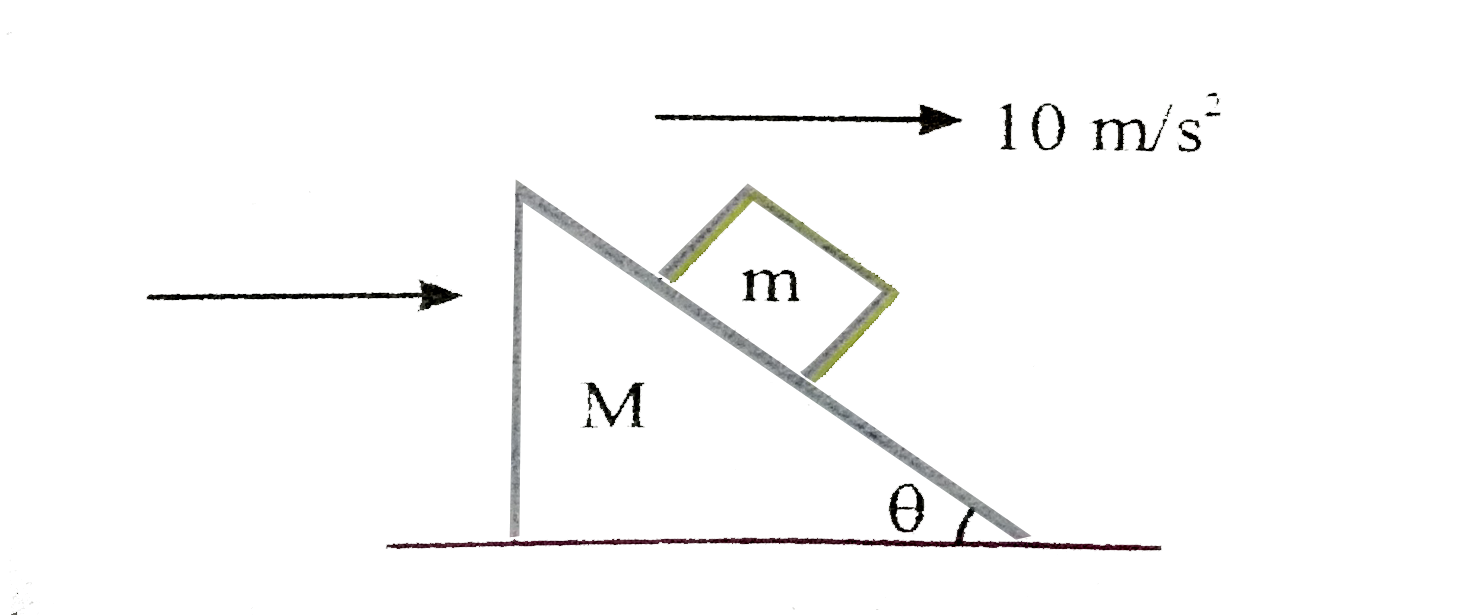
In the figure shown all the surfaces are...

In the figure shown all the surfaces are frictionless and mass of block `m=1kg`, block and wedge are held initially at rest, now wedge is given a horizontal acceleration of `10 m//s^(2)` by applying a force on the wedge so that the block does not slip on the wedge, the work done by normal force in ground frame on the block in `sqrt(3) sec` is
.

Promotional Banner

Similar Questions

Explore conceptually related problems

In the figure shown all the surfaces are frictionless, and mass of the block 'm' is 1 kg. The block and wedge are held initially at rest. Now wedge is given a horizontal acceleration of 5 m/s^(2) by applying a force on the wedge, so that the block does not slip on the wedge. Then work done by the normal force in ground frame on the block in 2 sec is : (##NAR_NEET_PHY_XI_P2_C06_E09_012_Q01.png" width="80%">

In figuer, shown all the surfaces are frictionless, and mass of the block is m=100g . The block and the wedge are held initially at rest. Now the wedge is given a horizontal acceleration of 10ms^-2 by applying a force on the wedge, so that the block does not slip on the wedge. Then find the work done in joules by the normal force in ground frame on the block in 1s .

In figuer, shown all the surfaces are frictionless, and mass of the block is m=100g . The block and the wedge are held initially at rest. Now the wedge is given a horizontal acceleration of 10ms^-2 by applying a force on the wedge, so that the block does not slip on the wedge. Then find the work done in joules by the normal force in ground frame on the block in 1s .

Figure-2.162 shows a wedge of mass 2kg resting on a fritionless floor. A block of mass 1 kg is kept on the wedge and the wedge is given an acceleration of 5 m//s^(2) towards right. Then :

A block of mass 1.0 kg rests on a wedge of angle theta . The acceleration which should be given to the wedge so that the block falls freely is :

A block of mass 1.0 kg rests on a wedge of angle theta . The acceleration which should be given to the wedge so that the block falls freely is :

A small block of mass 1 kg is kept on a rough inclined wedge of inclination 45^@ fixed in an elevator. The elevator goes up with a uniform velocity v=2 m//s and the block does not slide on the wedge. Find the work done by the force of friction on the block in 1s . (g=10 m//s^(2))

As shown in the figure a block of mass 'm' is placed on a smooth wedge moving with constant acceleration such that block does not move with respect to the wedge. Find work done by the net force on the block in time t. (Initial speed is 0)

As shown in the figure a block of mass 'm' is placed on a smooth wedge moving with constant acceleration such that block does not move with respect to the wedge. Find work done by the net force on the block in time t. (Initial speed is 0)

Block of mass m is stationary w.r.t. wedge. Normal force exerted by wedge on the block is