

Home
Class 12
PHYSICS
The figure show four situations in which...

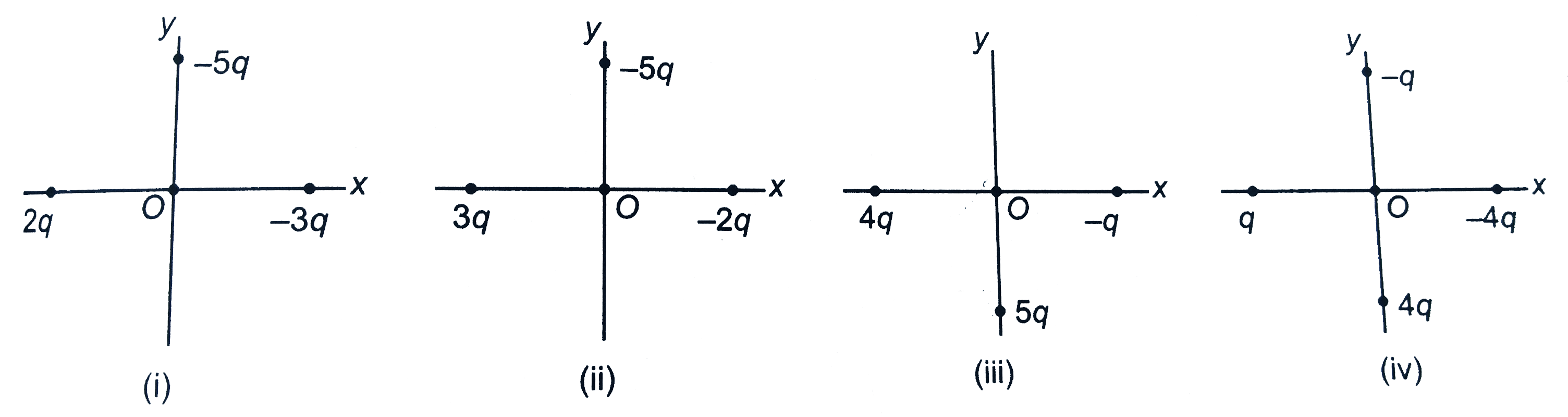
The figure show four situations in which charged particles are at equal distances from the origin. If `E_1,E_2,E_3 and E_4` be the magnitude of the net electic field at the origin in four situations i, ii, iii and iv respectively then

Promotional Banner

Similar Questions

Explore conceptually related problems

In the following four situations charged particles are equal distance from the origin. Arrange them the magnitude of the net electric field at origin greatest first

In the following four situations charged particles are equal distance from the origin. Arrange them the magnitude of the net electric field at origin greatest first

In the following four cases, charged particles are at equal distances from the origin. Arranged them in the descending order of magnitude of the net electric field at the origin.

The figure shows two large, closely placed, parallel, nonconducting sheets with identical (positive) uniform surface charge densities, and a sphere with a uniform (positive) volume charge density. Four points marked as 1,2,3, and 4 are shown in the space in between. If E_1, E_2, E_3, and E_4 are magnitude of net electric fields at these points, respectively, then

The figure shows two large, closely parallel, nonconducting sheets with identical (positive) uniform surface charge densities and a sphere with a uniform (positive) volume charge density. Four points marked as 1,2,3 and 4 are shown in the space in between. If E_(1),E_(2),E_(3) and E_(4) are magnitude of net electric fields at these points respectively then :

The figure shows two large, closely parallel, nonconducting sheets with identical (positive) uniform surface charge densities and a sphere with a uniform (positive) volume charge density. Four points marked as 1,2,3 and 4 are shown in the space in between. If E_(1),E_(2),E_(3) and E_(4) are magnitude of net electric fields at these points respectively then :

Figure shows electric lines of force. If E_(x) and E_(y) are the magnitudes of electric field at points x and y respectively, then

Figure, shown above, shows three situations involving a charged particle and a uniformly charged spherical shell. The charges and radii of the shells are indicated in the figure. If F_(1),F_(2) and F_(3) are the magnitudes of the force on the particle due to the shell in situations (I),(II) and (III) then

Figure, shown above, shows three situations involving a charged particle and a uniformly charged spherical shell. The charges and radii of the shells are indicated in the figure. If F_(1),F_(2) and F_(3) are the magnitudes of the force on the particle due to the shell in situations (I),(II) and (III) then