

Home
Class 12
PHYSICS
Three identical balls are connected by l...

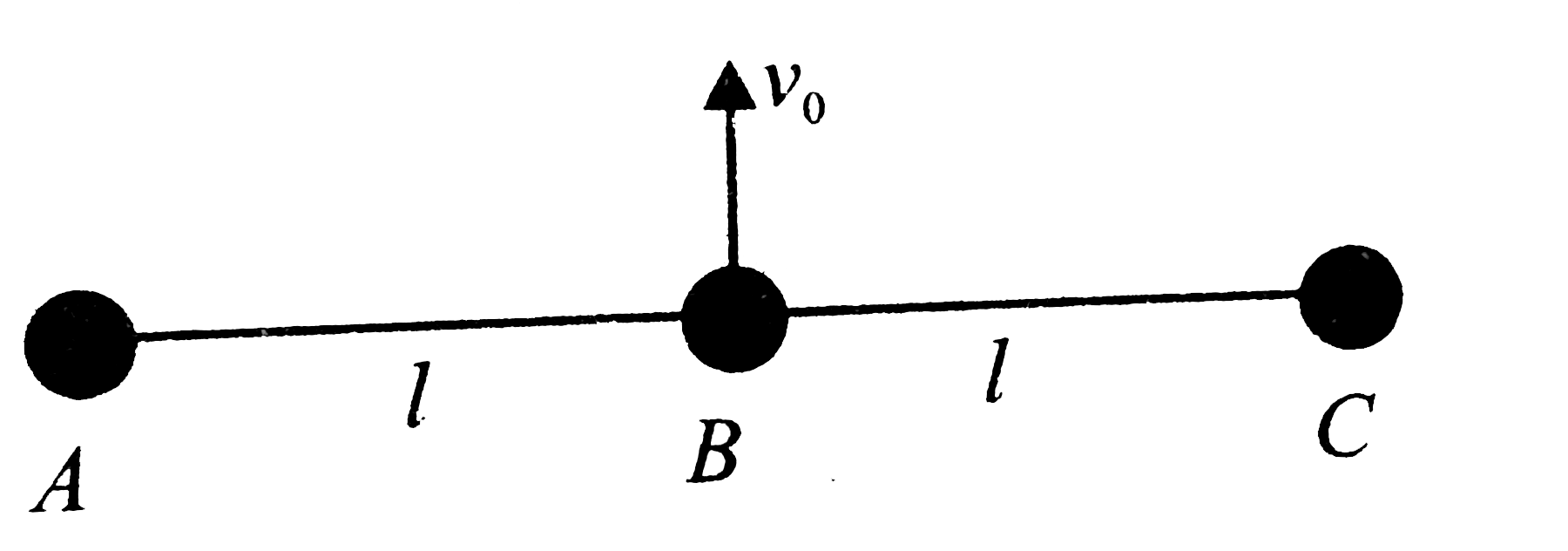
Three identical balls are connected by light inextensible strings with each other as shown and rest over a smooth horizontal table. Length of each string is `l`.
At moment `t = 0`, ball `B` is imparted a velocity `v_(0)` perpendicular to the strings and then the system is left on its own.

Calculate the velocity of `B` just before `A` collides with ball `C`.

Promotional Banner

Similar Questions

Explore conceptually related problems

Three identical balls are connected by light inextensible strings with each other as shown and rest over a smooth horizontal table. Length of each string is l . At moment t = 0 , ball B is imparted a velocity v_(0) perpendicular to the strings and then the system is left on its own. Calculate the velocity of A at the above given instant.

Three identical balls are connected by light inextensible strings with each other as shown and rest over a smooth horizontal table. Length of each string is l . At moment t = 0 , ball B is imparted a velocity v_(0) perpendicular to the strings and then the system is left on its own. If collision between the balls is completely inelastic, then

Three identical balls eah of mass m=0.5 kg are connected with each other as shown in figure and rest over a smooth horizontal table At moment t=0, ball B is imparted a horizontal velocity v_(0)=9ms^(-1) calculate velocity of A just before it collides with ball C.

Two identical small balls are interconnected with a light and inextensible thread having length L. The system is on a smooth horizontal table with the thread just taut. Each ball is imparted a velocity v , one towards the other ball and the other in a direction that is perpendicular to the velocity given to the first ball. (a) After how much time the thread will become taut again? (b) Calculate the kinetic energy of the system after the string gets taut.

Two identical balls are interconnected with a massless and inextensible thread. The system is in gravity free space with the thread just taut. Each ball is imparted a velocity v , one towards the other ball and the other perpendicular to the first, at t=0 . Then,

Two particles each of mass m are connected by a light inextensible string and a particle of mass M is attached to the midpoint of the string. The system is at rest on a smooth horizontal table with string just taut and in a straight line. The particle M is given a velocity v along the table perpendicular to the string. Prove that when the two particles are about to collide : (i) The velocity of M is (Mv)/((M + 2m)) (ii) The speed of each of the other particles is ((sqrt2M (M + m))/((M + 2m)))v .

Three blocks of masses 5 kg, 10 kg and 15 kg are connected to - light inextensible string placed on smooth horizontal table as shown below. (T_(1)) /( T_(2)) will be

Two identical balls each of mass m interconnected by a small light inextensible string are kept on a smooth horizontal surface. One of the balls is pushed towards the other with a speed v_(0) find the loss of K.E. of the ball. What will be the final velocities of the balls ? (e=1).

Two identical small balls, each of mass m , are connected by a massless and inextensible string of length l and placed on a smooth horizontal xy plane. An external agent pulling the string from its mid-point along y -axis with velocity v_(0) as shown in Fig. When the separation between the two balls reduces to l//2 then the speed of each ball will be

A mass m connected to inextensible string of length l lie on a horizontal smooth ground. Other end of string is fixed. Mass m is imparted a velocity v such that string remains taut & motion occurs in horizontal providely stirng during the time string turns through 90^(@)