

Home
Class 12
PHYSICS
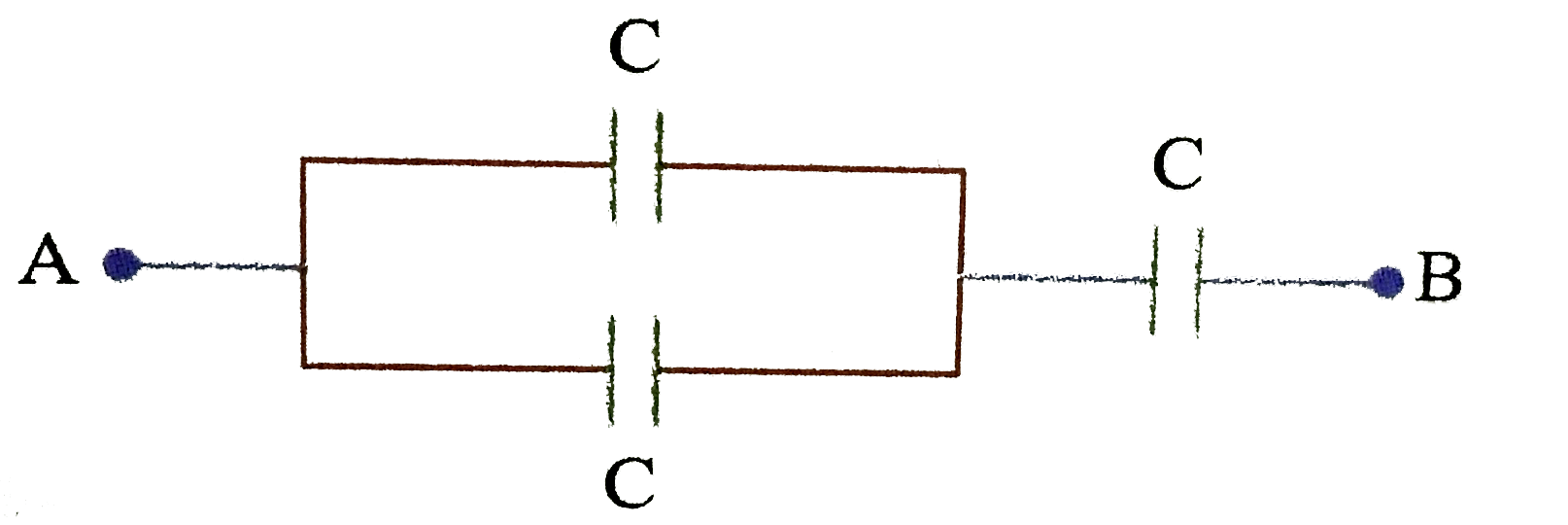
In the net work three identical capacito...

In the net work three identical capacitors are connected as shown. Each of them can withstand to a maximum `100 V` potential difference. What is the maximum voltage that can be applied across `A` and `B` so that no capacitor gets spoiled.
.

Promotional Banner

Similar Questions

Explore conceptually related problems

All six capacitors shown are identical. Each can withstand maximum 200 volts between its terminals. The maximum voltage that can be safely applied between A and B is

An RC circuit is made using five identical capacitors, each of which can withstand a maximum voltage of 2 volts. The maximum voltage which can be safely applied across points A and B is

Three uncharged capacitors are connected in the circuit as shown. What should be the value of C3(in uF) so that potential difference across each capacitor is same

Five capacitors are connected across a battery of 5V as shown in figure (o). Calculate the potential difference across the plates of the 5muF capacitor.

When two identical condensers are connected in series choose the correct statement regarding the working voltage (the maximum p.d that can be applied to a condenser) and the capacity.

In the arrangement shown, a potential difference is applied between points A and B. No capacitor can withstand a potential difference of more than 100 V

Three capacitors of 10,15 and 30 muF are connected in series and on this combination a potential difference of 60 V is applied. Calculate the charge, potential difference and energy stored on each capacitor.

A 10 mu F capacitor can withstand a maximum voltage of 100 V across it,whereas another 20 mu F capacitor can withstand a maximum voltage of only 25 V. What is the maximum voltage that can be put across their series combination ?

Three 2 Omega reistors , A,B and C , are connected as shown in (Fig. 3.44). Each of them dissipates energy and can withstand a maximum current that can flow through the three resistors ? .

N identical capacitors are connected in parallel which are charged to a potential V . If these are separated and connected in series then what potential difference will be obtained?