

Home
Class 12
PHYSICS
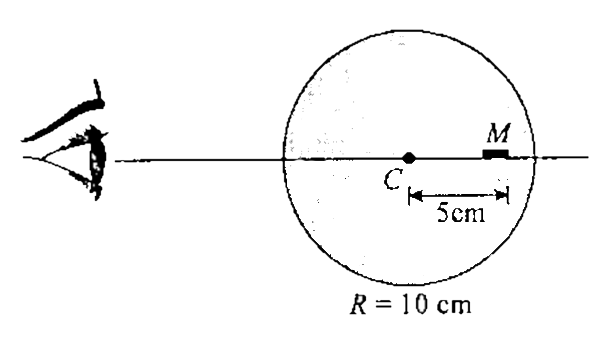
Figure shows a small object M of length ...

Figure shows a small object M of length 1mm which lies along a dimentrical line of a glass sphere of radius 1-

Promotional Banner

Similar Questions

Explore conceptually related problems

A smell object Q of length Q of length 1mm leis along the principle axis of a spherical glass of radius R = 10cm and refreactive index 3//2 . The object is seen from air along the principle axis form left. The distance of object from teh centre P is 5cm . Find the size of image is it real, inverted?

A glass sphere of radius 15 cm has a small bubble 6 cm from its centre. The bubble is viewed along a diameter of the sphere from the side on which it lies. How for from the surface will it appear to be if the refractive index of glass is 1.5 ?

A glass sphere of radius 5 xx 10^-2 m has a small bubble 2 xx 10^-2m from its centre. The bubble is viewed along a diameter of the sphere, from the side on which it lies. How far from the sphere will it appear? Refractive index of glass 1.5.

A glass sphere of radius 5 cm has a small bubble at a distance 2 cm from its centre. The bubble is viewed along a Diameter of the sphere from the side on which it lies.How far from the surface will it appear.Refractive index of glass is 1.5 2.5 cm behind the surface

A glass sphere of radius 5 cm has a small bubble at a distance 2 cm from its centre.The bubble is viewed along a Diameter of the sphere from the side on which it lies.How far from the surface will it appear.Refractive index of glass is 1.5 2.5 cm behind the surface

The Figure shows the equatorial circle of a glass sphere of radius R having centre at C. The eye of an observer is located in the plane of the circle at a distance R from the surface. A small insect is crawling along the equatorial circle. (a) Calculate the length (L) of the are on the circle where the insect lies where its image is visible to the observer. (b) Calculate the value of L when the eye is brought very close to the sphere. Refractive index of the glass is mu =(1)/(sqrt(2))

How much work is done in circulating a small object of mass m around a sphere of mass m in a circle of radius R.