

Home
Class 12
PHYSICS
A concave mirror forms real image of a p...

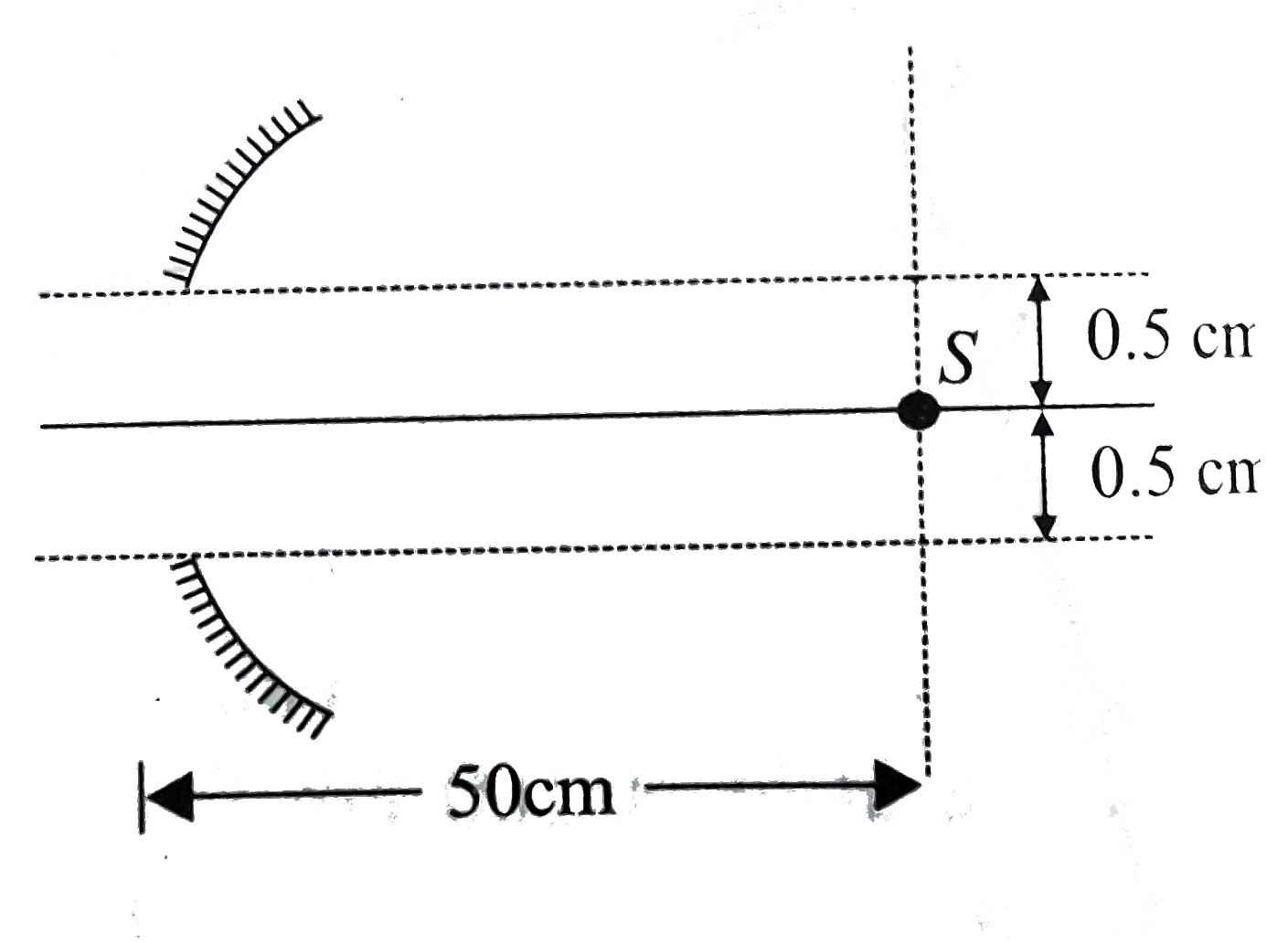
A concave mirror forms real image of a point source lying on the optical axis at a distance of 50cm from the mirror. The focal length of the mirror is 25cm. The mirror is cut in two, and its halves are drawn at a distance of 1 cm apart in a direction perpendicular to the optical axis.

Q. The distance between the two images formed by the two halves of the mirror is

Promotional Banner

Similar Questions

Explore conceptually related problems

Concave mirror forms the real image of a point source lying on the optical axis at a distance of 50 cm from the mirror. The focal length of the mirror is 25 cm. The mirror is cut into and its halves are drawn a distance of 1 cm apart in a direction perpendicular to the optical axis. How will the image formed by the halves of the mirror be arranged?

Concave mirror forms the real image of a point source lying on the optical axis at a distance of 50 cm from the mirror. The focal length of the mirror is 25 cm. The mirror is cut into and its halves are drawn a distance of 1 cm apart in a direction perpendicular to the optical axis. How will the image formed by the halves of the mirror be arranged?

A concave mirror forms real image of a point source lying on the optical axis at a distance of 50cm from the mirror. The focal length of the mirror is 25cm. The mirror is cut in two, and its halves are drawn at a distance of 1 cm apart in a direction perpendicular to the optical axis. Q. In the given situation, if the two halves are each rotated (before being separated) about S by 90^(@) , with reference to original position, then the distance between the two images will be

A concave mirror forms real image of a point source lying on the optical axis at a distance of 50cm from the mirror. The focal length of the mirror is 25cm. The mirror is cut in two, and its halves are drawn at a distance of 1 cm apart in a direction perpendicular to the optical axis. Q. In the given situation, if the two halves are each rotated (before being separated) about S by 90^(@) , with reference to original position, then the distance between the two images will be

A concave mirror forms real image of a point source lying on the optical axis at a distance of 50cm from the mirror. The focal length of the mirror is 25cm. The mirror is cut in two, and its halves are drawn at a distance of 1 cm apart in a direction perpendicular to the optical axis. Q. Two statements are provided. Choose which is true and which is false. Statement I: Image formed by half cut mirror has just half the intensity as that of the intensity of image formed by complete mirror. Statement II: More the lateral separation between the two halves of the mirror, less will be the separation between the two images, as show in the given situation.

A concave mirror forms real image of a point source lying on the optical axis at a distance of 50cm from the mirror. The focal length of the mirror is 25cm. The mirror is cut in two, and its halves are drawn at a distance of 1 cm apart in a direction perpendicular to the optical axis. Q. Two statements are provided. Choose which is true and which is false. Statement I: Image formed by half cut mirror has just half the intensity as that of the intensity of image formed by complete mirror. Statement II: More the lateral separation between the two halves of the mirror, less will be the separation between the two images, as show in the given situation.

A concave mirror of focal length 25 cm forms the real image of a point object at a distance O lying on its principal axis at a distance of 50 cm from the mirror. The mirror is cut into two halves and are drawn a distance of 1 cm apart in the direction perpendicular to the optical axis .How will the two halves of the concave mirror produce the image of the point object O?

A concave mirror forms an erect and there times magnified image on the axis of the mirror at a distance of 32 cm from the object. What is the focal length of the mirror?

An object is placed at a distance of 30 cm from a concave mirror and its real image is formed at a distance of 30 cm from the mirror. The focal length of the mirror is