

Home
Class 12
PHYSICS
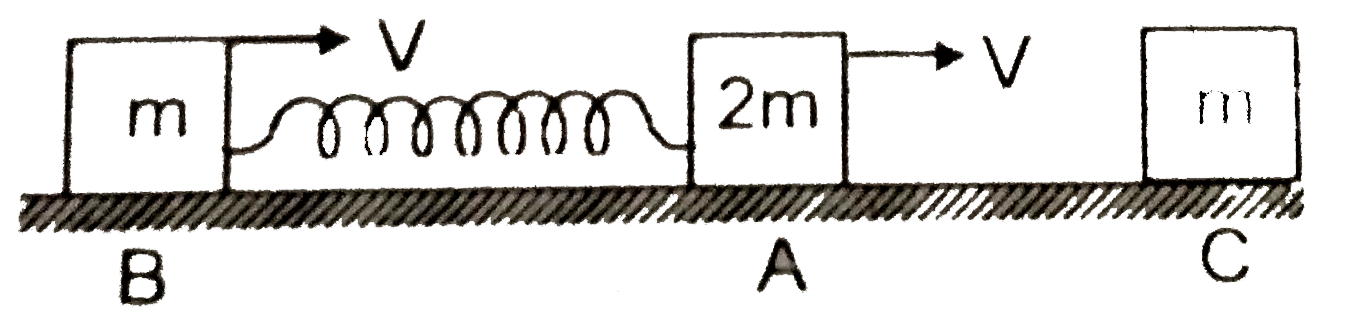
Two blocks A and B of mass 2 m and m res...


Two blocks A and B of mass 2 m and m respectively are connected to a massless spring of spring constant K. if A and B moving on the horizontal frictionless surface with velocity v to right. If A collides with C of mass m elastically and head on, then the maximum compressions of the spring will be

Promotional Banner

Similar Questions

Explore conceptually related problems

Two blocks A and B of mass 2m and m respectively are connected to a massless spring of force constant K as shown in figure A and B are moving on the horizontal frcitionless surface with velocity v to right with underformed spring. If B collides with C elastically, then maximum compression of the spring will be

Two blocks A and B of mass 2m and m respectively are connected to a massless spring of force constant K as shown in figure A and B are moving on the horizontal frcitionless surface with velocity v to right with underformed spring. If B collides with C elastically, then maximum compression of the spring will be

Two blocks A and B of mass m and 2m respectively are connected by a massless spring of spring constant K . This system lies over a smooth horizontal surface. At t=0 the bolck A has velocity u towards right as shown while the speed of block B is zero, and the length of spring is equal to its natural length at that at that instant. {:(,"Column I",,"Column II"),((A),"The velocity of block A",(P),"can never be zero"),((B),"The velocity of block B",(Q),"may be zero at certain instants of time"),((C),"The kinetic energy of system of two block",(R),"is minimum at maximum compression of spring"),((D),"The potential energy of spring",(S),"is maximum at maximum extension of spring"):}

Two blocks A and B of mass m and 2m respectively are connected by a massless spring of spring constant K . This system lies over a smooth horizontal surface. At t=0 the bolck A has velocity u towards right as shown while the speed of block B is zero, and the length of spring is equal to its natural length at that at that instant. {:(,"Column I",,"Column II"),((A),"The velocity of block A",(P),"can never be zero"),((B),"The velocity of block B",(Q),"may be zero at certain instants of time"),((C),"The kinetic energy of system of two block",(R),"is minimum at maximum compression of spring"),((D),"The potential energy of spring",(S),"is maximum at maximum extension of spring"):}

The ball sticks to block C , then block C collides elastically , head - on with A . If the maximum compression is x_(0) , the spring constant k is

Two block A and B of masses m and 2m respectively are connected by a spring of spring cosntant k. The masses are moving to the right with a uniform velocity v_(0) each, the heavier mass leading the lighter one. The spring is of natural length during this motion. Block B collides head on with a thrid block C of mass 2m . at rest, the collision being completely inelastic. The maximum compression of the spring after collision is -

Two block A and B of masses m and 2m respectively are connected by a spring of spring cosntant k. The masses are moving to the right with a uniform velocity v_(0) each, the heavier mass leading the lighter one. The spring is of natural length during this motion. Block B collides head on with a thrid block C of mass 2m . at rest, the collision being completely inelastic. The maximum compression of the spring after collision is -

Two block A and B of masses m and 2m respectively are connected by a spring of spring cosntant k. The masses are moving to the right with a uniform velocity v_(0) each, the heavier mass leading the lighter one. The spring is of natural length during this motion. Block B collides head on with a thrid block C of mass 2m . at rest, the collision being completely inelastic. The velocity of centre of mass of system of block A, B, & C is -

Two block A and B of masses m and 2m respectively are connected by a spring of spring cosntant k. The masses are moving to the right with a uniform velocity v_(0) each, the heavier mass leading the lighter one. The spring is of natural length during this motion. Block B collides head on with a thrid block C of mass 2m . at rest, the collision being completely inelastic. The velocity of centre of mass of system of block A, B, & C is -

Two block A and B of masses m and 2m respectively are connected by a spring of spring cosntant k. The masses are moving to the right with a uniform velocity v_(0) each, the heavier mass leading the lighter one. The spring is of natural length during this motion. Block B collides head on with a thrid block C of mass 2m . at rest, the collision being completely inelastic. The velocity of block B just after collision is -