

Home
Class 11
PHYSICS
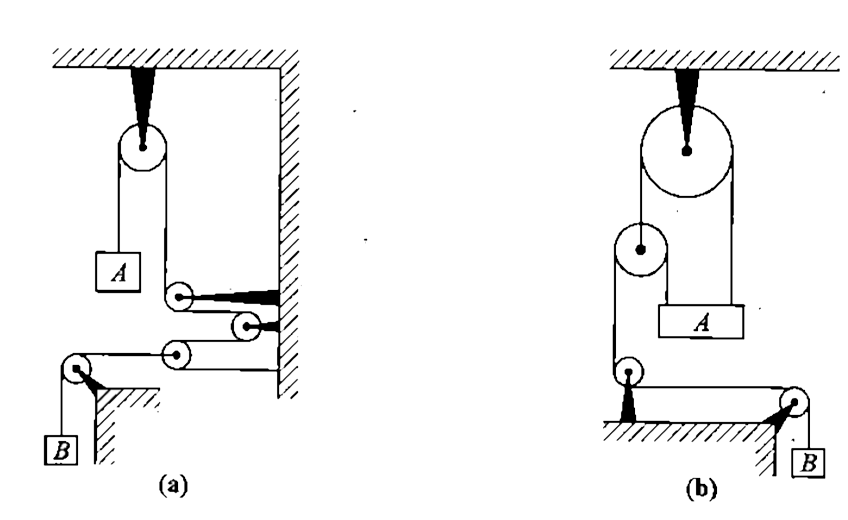
If masses of the blocks A and B shown in...

If masses of the blocks A and B shown in figure-2.204 (a) and 2.204(b) are 10kg and 5kg respectively, find the acceleration of the two masses. Assume all pulleys and strings are ideal. (Take `g=9.8m/s^(2)`)

Promotional Banner

Similar Questions

Explore conceptually related problems

In the figure-2.205 shown in blocks A, B and C has masses m_(A)= 5 kg, m_(B) = 5 kg and m_(C )= 10kg respectively, find the acceleration of the three blocks. Assume all pulleys and strings are ideal. (Take g = 10m//s^(2) )

In the adjacent figure, masses of A,B and C are 1kg ,3kg and 2kg respectively. Find (a) the acceleration of the system and (b) tension in the strings. Neglect friction. (g=10m//s^(2))

Two blocks A and B are shown in figure have masses 5 kg and 4kg respectively. The system is released from rest. The speed of B after A has travelled the distance 1 m along the incline is (take g= 10m/s^2 ,pulleys and strings are ideal and plane is smooth)

Two Block A and B of masses 10 kg and 6 kg respectively are connected through pulley as shown in figure. Find acceleration of block A.

Two masses of 8 kg and 4 kg are connected by a string as shown in figure over a frictionless pulley.The acceleration of the system is

The magnitudes of accelerations of blocks of mass 2 kg and 4 kg are respectively . ( Pulleys and threads are massless) ( g = 10 m//s^(2 )

In figure calculate the linear acceleration of the blocks. Mass of block B= 8kg mass of disc shaped pulley =2kg (take g=10m//s^(2) )

In figure calculate the linear acceleration of the blocks. Mass of block B= 8kg mass of disc shaped pulley =2kg (take g=10m//s^(2) )

The two blocks shown in figure-2.200 are initially at rest. Assuming ideal pulleys and strings and neglecting friction at all the surfaces, find the accelerations of the two blocks and the tension in the cable.(Take g = 9.8m/s^(2) )