Home
Class 12
PHYSICS
The friction coefficient between the hor...

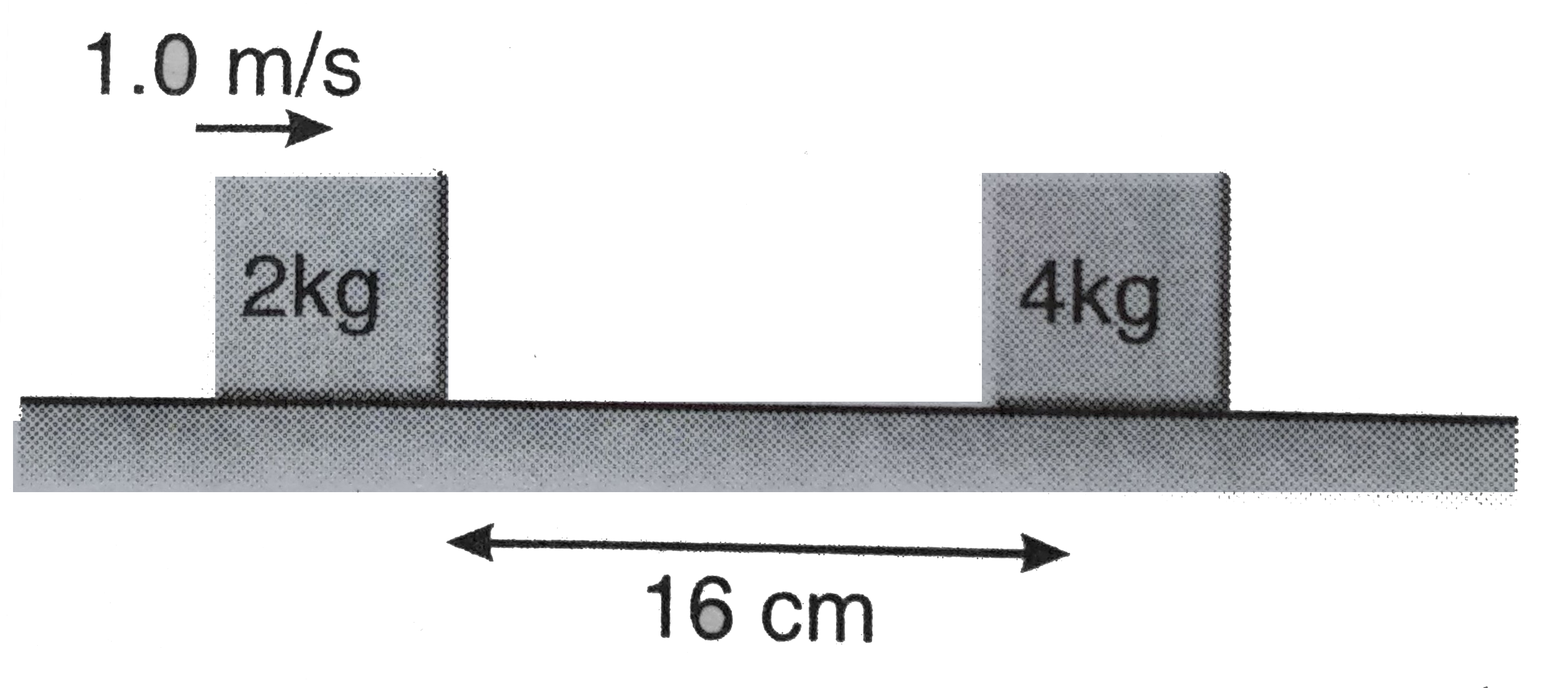
The friction coefficient between the horizontal surface and each of the block shown in the figure is `0.2`. The collision between the blocks is perfectly elastic. Find the separation between them when they come to rest. (Take `g=10m//s^2`).

Text Solution

Verified by Experts

Velocity of first block before collision, `v_(1)^(2)=1^(2)-2(2)xx0.16=1-0.64`
`v_(1)=0.6 m//s`
By conservation of momentum, `2xx0.6=2 v_(1)+4 v._(2)`
also `v._(2)-v._(1)=v_(1)` for elastic collision
If gives `v._(2)=0.4 m//s`
`v._(1)=0.2 m//s`
Now distance moved after collision
`s_(1)=((0.4)^(2))/(2xx2)& s_(2)=((0.2)^(2))/(2xx2)`
`therefore s=s_(1)+s_(2)=0.05m = 5 cm`.
Promotional Banner

Topper's Solved these Questions

  • COLLISION

    FIITJEE|Exercise SOLVED PROBLEMS (OBJECTIVE) MATRIX MATCH TYPE|2 Videos
  • COLLISION

    FIITJEE|Exercise Exercise|20 Videos
  • COLLISION

    FIITJEE|Exercise SOLVED PROBLEMS (OBJECTIVE) COMPREHENSION - II|2 Videos
  • AC CIRCUITS

    FIITJEE|Exercise ASSERTION REASONING TYPE|1 Videos
  • CURRENT ELECTRICITY

    FIITJEE|Exercise Comprehension -4|3 Videos

Similar Questions

Explore conceptually related problems

The friction coefficient between the horizontal surfce and ech of the blocks shown in figure is 0.20. The collision between the blocks is perfectly elastic. Find the separation between the two blocks when they come to rest. Take g=10 m/s^2 .

The friction coefficient between the horizontal surface and blocks A and B are (1)/(15) and (2)/(15) respectively. The collision between the blocks is perfectly elastic. Find the separation (in meters) between the two blcoks when they come to rest.

The friction coefficient between the table and the block shown in figure is 0.2. Find the tension in the two strings.

A small block of mass M moves with velocity 5 m/s towards an another block of same mass M placed at a distance of 2 m on a rough horizontal surface . Coefficient of friction between the blocks and ground is 0.25 . Collision between the two blocks is elastic , the separation between the blocks , when both of them come to rest , is ( g = 10 m//s^(2) )

The fricition coefficient between the table and block shown in fig. is 0.2 find the acceleration of the system (Take g=10 m//s^(2) )

For shown situation, if collision between block A and B is perfectly elastic, then find the maximum energy stored in spring in joules.

Three blocks A , B and C , whose masses are 9kg , 9kg and 18kg respectively as shown in the figure, are released from rest. The co-efficient of friction between block A and the horizontal surface is 0.5 & the co-efficient of friction between block B and the horizontal surface is 0.5 . Find the acceleration of block C just release [Take g=10m//s^(2) ]. All strings and pulleys are ideal

Two blocks A and B of masses 10 kg and 15 kg are placed in contact with each other rest on a rough horizontal surface as shown in the figure. The coefficient of friction between the blocks and surface is 0.2. A horizontal force of 200 N is applied to block A. The acceleration of the system is ("Take g"=10ms^(-2))

A force of 200N is applied as shown in the figure on block of 3 kg. The coefficient of friction between the block and the wall is 0.3. Find the friction acting on the block. (in N) {Take g = 10 m//s^(2)
