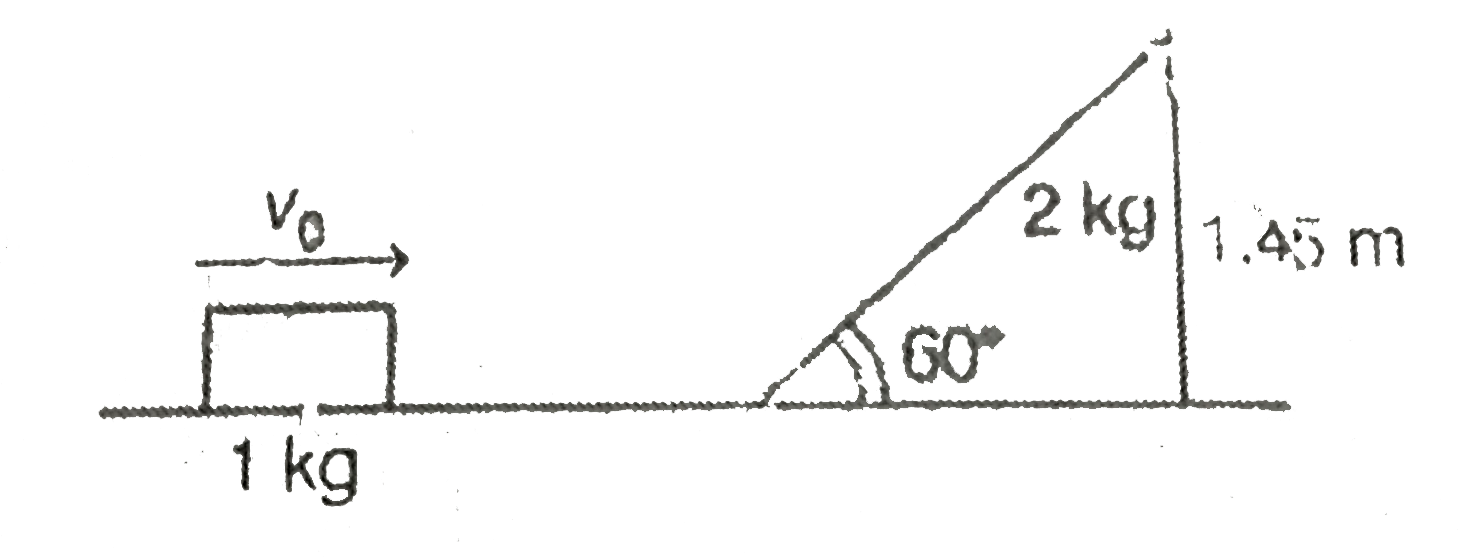
A block of mass 1 kg is moving towards a movablen vedge of amss 2 kg as shown in figure. All surfaces are smooth. When the block leaves the wedge from top, its velocity is making an angle `theta =30^(@)` with horizontal. In the whole process let J be the magnitude of net impulse given to the block by the wedge, `J_(H)` its horizontal component and `J_(V)` its vertical component. Then
A block of mass 1 kg is moving towards a movablen vedge of amss 2 kg as shown in figure. All surfaces are smooth. When the block leaves the wedge from top, its velocity is making an angle theta =30^(@) with horizontal. The value of v_(0) in m/s is
A block of mass 1 kg is moving towards a movablen vedge of amss 2 kg as shown in figure. All surfaces are smooth. When the block leaves the wedge from top, its velocity is making an angle theta =30^(@) with horizontal. To what maximum height will the block rise
A block of mass m is pushed towards a movable wedge of mass nm and height h , with a velocity u . All surfaces are smooth. The minimum value of u for which the block will reach the top of the wedge is
A small block of mass m is pushed towards a movable wedge of mass etam and height h with initial velocity u.All surface are smooth. The minimum value of u for which the block will reach the top of the wedge:
A block of mass m is pushed towards the movable wedge of mass M and height h , with a velocity v_(0) . All surfaces are smooth . The minimum value of v_(0) for which the block will reach the top of the wedge is
A block of mass 1 kg is released from the top of a wedge of mass 2 kg. Height of wedge is 10 meter and all the surfaces are frictionless. Then
A block of mass m is released from the top of a wedge of mass M as shown in figure. Find the displacement of wedges on the horizontal ground when the block reaches the bottom of the wedges. Neglect friction everywhere.