Home
Class 12
PHYSICS
A horizontal spring block system execute...

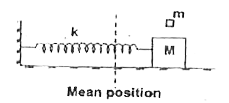
A horizontal spring block system executes SHM with ampitude A = 10 cm initial phase `phi =0` and angular frequency `omega`. The mass of block is M = 13kg and there is no friction between the block and the horizontal surface. The spring constant being 2500 N/m
At `t = t_(1)` sec [for which `omega t_(1) = phi_(1) = 30^(@)`). A mass m = 12kg is gently put on the block. [Assume that collision between the block and the mass is perfectly inelastic and mass m remains stationary w.r.t the block M always]

The new amplitude of the system will be

A

5 cm

B

8 cm

C

10 cm

D

none of these

Text Solution

Verified by Experts

The correct Answer is:

B

`omega. = omega sqrt((M)/(M + m))`
`x_(1) = A sin phi_(1)`
Potential energy stored in the spring at `(t = t_(1)) = (1)/(2) kx_(1)^(2) = (1)/(2) M omega^(2) sin^(2) phi_(1)`
Let v and v. be the velocity of system just before collsion and just after collision, so using COLM
`v. = (Mv)/((M + m)) = (MA omega cos theta)/((M + m))`
Total energy after collision `= PE + KE = (1)/(2) kx_(1)^(2) + (1)/(2) (M + m)v^(2)`
`=(1)/(2) MA^(2) omega^(2) [(M + m sin^(2) theta)/(M + m)] = (1)/(2) kA^(2) [(M + m sin^(2) theta)/(M + m)] = 8J`
`(1)/(2) (M + m) A^(2) omega^(2) = (1)/(2) MA^(2) omega^(2) [(M + m sin^(2) theta)/(M + m)]`
`A. = A sqrt((M + m sin^(2) theta)/(M + m)) = 8 cm`
Promotional Banner

Topper's Solved these Questions

  • SIMPLE HARMONIC MOTION

    FIITJEE|Exercise Assertion Reason type|1 Videos
  • SIMPLE HARMONIC MOTION

    FIITJEE|Exercise Numerical Based Questions|6 Videos
  • SIMPLE HARMONIC MOTION

    FIITJEE|Exercise Solved Problems (Objective)|16 Videos
  • SEMICONDUCTOR AND DEVICE

    FIITJEE|Exercise SOLVED PROBLEMS Objective: Level-I|20 Videos
  • TEST PAPERS

    FIITJEE|Exercise PHYSICS|747 Videos

Similar Questions

Explore conceptually related problems

A horizontal spring block system executes SHM with amplitude A = 10 cm initial phase phi =0 and angular frequency omega . The mass of block is M = 13 kg and there is no friction between the block and the horzontal surface. The spring constant being 2500N/M At t = t_(1) sec [for which omega t_(1) = phi_(1) = 30^(@) ]. A mass m = 12 kg is gently put on the block. [Assume that collision between the block adn the mass is perfectly inelastic and mass m remains stationary w.r.t. the block M always] The new angular frequency of the system will be

A horizontal spring block system executes SHM with ampitude A = 10 cm initial phase phi =0 and angular frequency omega . The mass of block is M = 13kg and there is no friction between the block and the horizontal surface. The spring constant being 2500 N/m At t = t_(1) sec [for which omega t_(1) = phi_(1) = 30^(@) ). A mass m = 12kg is gently put on the block. [Assume that collision between the block and the mass is perfectly inelastic and mass m remains stationary w.r.t the block M always] The total energy of system after collision at any moment of time is

A horizontal spring-block system of mass 1kg executes SHM of amplitude 10 cm. When the block is passing through its equilibrium position another mass of 1kg is put on it and the two move together.

In a horizontal spring-block system force constant of spring is k = 16N/m, mass of the block is 1 kg. Maximum kinetic energy of the block is 8J. Then

A horizontal spring -block system of mass 2kg executes S.H.M when the block is passing through its equilibrium positiojn an object of mass 1kg is put on it the two move togather The new amplitude of vibration is (A being its initial amplitude)

A horizontal spring block system of mass M executes simple haormonic motion. When the block is passing through its equilibrium position, an object of mass m is put on it and the two move together. Find the new amplitude and frequency of vibration. Given, k is the spring constant of the system.

A block of mass M=1 kg resting on a smooth horizontal surface is connected to a horizontal light spring of spring constant k=6N/m whose other end is fixed to a verticall wall. Another block of mass m=0.5 kg is placed over the block M. If the coefficient of friction between the two blocks mu =0.4, find the maximum kinetic energy (in J) that the system can have for simple hormonic oscillation under the action of the spring.

FIITJEE-SIMPLE HARMONIC MOTION-COMPREHENSION
  1. A pendulum is formed by pivoting a long thin rod of length L and mass ...

    Text Solution

    |

  2. A pendulum is formed by pivoting a long thin rod of length L and mass ...

    Text Solution

    |

  3. A pendulum is formed by pivoting a long thin rod of length L and mass ...

    Text Solution

    |

  4. A horizontal spring block system executes SHM with ampitude A = 10 cm ...

    Text Solution

    |

  5. A horizontal spring block system executes SHM with ampitude A = 10 cm ...

    Text Solution

    |

  6. A horizontal spring block system executes SHM with amplitude A = 10 cm...

    Text Solution

    |

  7. A horizontal spring block system executes SHM with amplitude A = 10 cm...

    Text Solution

    |

  8. A device used to print large maps, drawings, graphs, etc is known as p...

    Text Solution

    |

  9. A device used to print large maps, drawings, graphs, etc is known as p...

    Text Solution

    |

  10. A device used to print large maps, drawings, graphs, etc is known as p...

    Text Solution

    |

  11. The is an arrangement of pulleys as shown in figure. All the pulley ar...

    Text Solution

    |

  12. The is an arrangement of pulleys as shown in figure. All the pulley ar...

    Text Solution

    |

  13. The is an arrangement of pulleys as shown in figure. All the pulley ar...

    Text Solution

    |

  14. Two identical blocks P and Q have mass m each. They are attached to tw...

    Text Solution

    |

  15. Two identical blocks P and Q have mass m each. They are attached to tw...

    Text Solution

    |

  16. A pendulum is formed by pivotting a long thin rod of length L and mass...

    Text Solution

    |

  17. A pendulum is formed by pivotting a long thin rod of length L and mass...

    Text Solution

    |
