Home
Class 12
PHYSICS
A cylinder of radius R made of a materia...

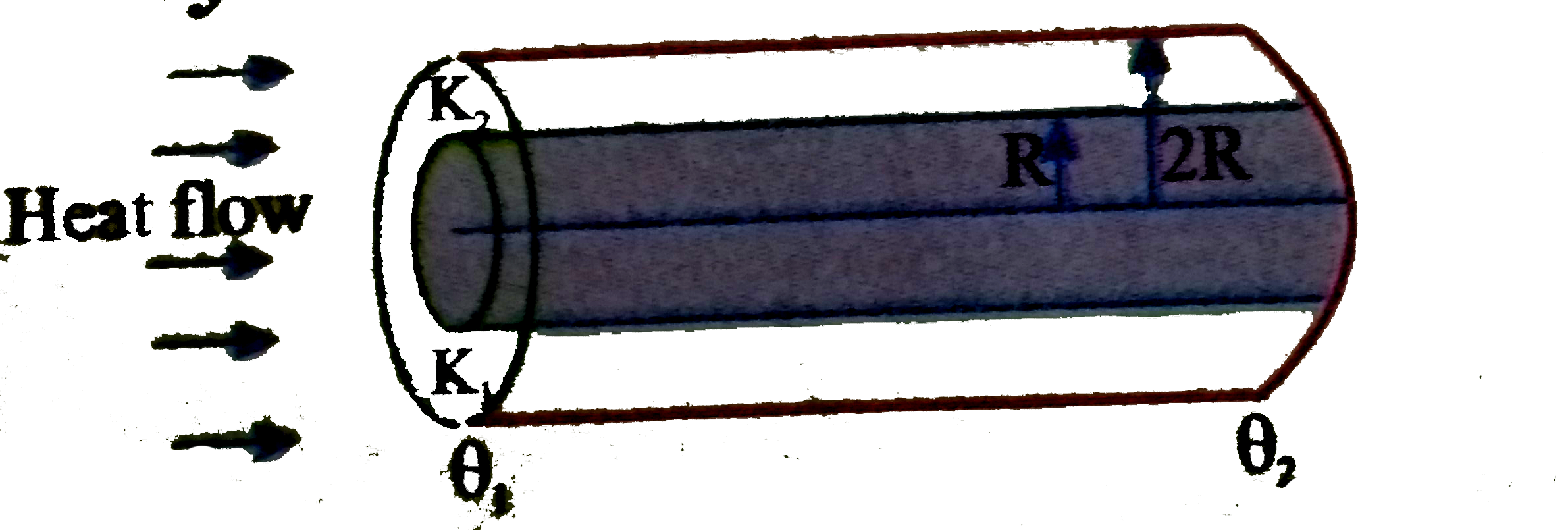
A cylinder of radius `R` made of a material of thermal conductivity `K_(1)` is surrounded by cylindrical shell of inner radius `R` and outer radius `2R` made of a material of thermal con-ductivity `K_(2)` The two ends of the combined system are maintained at two differnet tem-peratures There is no loss of heat across the cylindrical surface and system is in steady state What is the effective thermal conductivity of the system
.

Text Solution

Verified by Experts

Two cylinders are in parallel, therefore equivalent thermal resistance R is given by
`1/R=1/(R_(1))+1/(R_(2))`
But `R=l/(KA)`
`:.(kA)/l=(k_(1)A_(1))/(l_(1))+(k_(2)A_(2))/(l_(2))`
Hre `l_(1)=l_(2)=l` and `A_(1)=piR^(2)`
`A_(2)=pi(2R)^(2)-piR^(2)=3piR^(2)` and `a=pi(2R)^(2)=4piR^(2)`
`:. (k4piR^(2))/l=(k_(1)piR^(2))/l+(k_(2)3piR^(2))/l`
i.e. `k=(k_(1)+3k_(2))/4`
Promotional Banner

Topper's Solved these Questions

  • HEAT AND TEMPERATURE

    FIITJEE|Exercise SOLVED PROBLEMS OBJECTIVE|15 Videos
  • HEAT AND TEMPERATURE

    FIITJEE|Exercise COMPREHENSION TYPE|5 Videos
  • HEAT AND TEMPERATURE

    FIITJEE|Exercise NUMERICAL BASES QUESTIONS|1 Videos
  • GRAVITATION

    FIITJEE|Exercise Numerical based Question|2 Videos
  • KINEMATICS

    FIITJEE|Exercise NUMERICAL BASED QUESTIONS DECIMAL TYPE|5 Videos

Similar Questions

Explore conceptually related problems

A cylinder of radius R made of a material of thermal conductivity K_1 is surrounded by a cylinderical shell of inner radius R and outer radius 2R made of a material of thermal conductivity K_2 . The two ends of the combined system are maintained at two different temperatures. There is no loss of heat across the cylindrical surface and the system is in steady state. The effictive thermal conductivity of the system is

A cylinder of radius R made of a material of thermal conductivity K_1 is surrounded by a cylindrical shell of inner radius R and outer radius 2R made of a material of thermal conductivity K_2 . The two ends of the combined system are maintained at two different temperatures. There is no loss of heat across the cylindrical surface and the system is in steady state. The effective thermal conductivity of the system is (a) K_1 + K_2 (b) K_1K_2//(K_1+K_2) (c ) (K_1 + 3K_2)//4 (d) (3K_1 + K_2)//4 .

A cylinder of radius R made of material of thermal conductivity K_(1) is surrounded by a cylindrical shell of inner radius R and outer radius 3R made of a material of thermal conductivity K_(2) . The two ends of the combined system are maintained at two different temperatures. What is the effective thermal conductivity of the system ?

A cylinder A of a material of thermal conductivity K_(1) is surrounded by a cylindrical shell of inner radius equal to the cylinder. The shell is made of a material of thermal conductivity K_(2) . The two ends of the combined system are maintained at two different temperature. if the effective thermal conductivity of the system is (4K_(1) + 5K_(2))/(9) , find the rate of outer radius of the shell to the radius of the cylinder.

A cylinder of radius R is surrounded by a cylindrical shell of inner radius R and oputer radius 2R. The thermal conductivity of the material of the inner cylinder si k_(1) and that of the outer cylinder is K_(2) ,Assumming no loss of heat , the effective thermal conductivity of the system for heat flowing along the length of the cylionder is :

What is the volume of the material in a spherical shell with inner radius ‘r' and outer radius 'R' ?

Calculated thermal conductance for radial flow of a spherical sheel of inner and outer radius r_(1) and r_(2) . Assume that thermal conductivity of the material is K

A cylinder of radius R and length l is made uo of a substnace whose thermal conductivity K varies with the distance x from the axis as K=K_(1)x+K_(2) Detemine the effective thermal conductivity between the flat faces of the cylinder .

A metallic cylindrical shell of length 50 cm has inner radius of 3 cm and outer radius of 6 cm. If the inner and outer surfaces of the cylinder are maintained at 0^@C and 80^@C , respectively, then find the rate of flow of heat from the outer surface to the inner surface. Take, thermal conductivity of metal = 69.3 Wm^(-1) k^(-1)

FIITJEE-HEAT AND TEMPERATURE-SOLVED PROBLEMS SUBJECTIVE
  1. In an experiment on the specific heat of a metal a 0.20 kg block of th...

    Text Solution

    |

  2. An ice cube of mass 0.1kg at 0^@C is placed in an isolated container w...

    Text Solution

    |

  3. We have two vessels of equal volume, one filled with hydrogen and the ...

    Text Solution

    |

  4. Let us assume that air is under standard conditions close to the Earth...

    Text Solution

    |

  5. A vertical hollow cylinder of height 1.52 m is fitted with a movable p...

    Text Solution

    |

  6. Two glass bulbs of equal volume are connected by a narrow tube and are...

    Text Solution

    |

  7. In the given figure and ideal gas change its state from state A to st...

    Text Solution

    |

  8. Calculate the escape velocity of a body from the moon. [g(moon)=1.67m/...

    Text Solution

    |

  9. An ideal gas is taken through a cyclic thermodynamical process through...

    Text Solution

    |

  10. Two moles of helium gas(lambda=5//3) are initially at temperature 27^@...

    Text Solution

    |

  11. A piston can freely move inside a horizonta cylinder closed from both ...

    Text Solution

    |

  12. A Monatomic ideal gas of two moles is taken through a cyclic process s...

    Text Solution

    |

  13. One mole of a moatomic idal gas is taken through the cycle shown in fi...

    Text Solution

    |

  14. A cylinder of radius R made of a material of thermal conductivity K(1)...

    Text Solution

    |

  15. A lake is covered with ice 2 cm thick. The temperature of ambient air...

    Text Solution

    |

  16. A solid copper sphere (density rho and specific heat c) of radius r at...

    Text Solution

    |

  17. The earth receives solar energy at the rate of 2 cal Cm^(-2) per minut...

    Text Solution

    |

  18. A container open at the top is made of a perfectly insulating materia...

    Text Solution

    |

