Home
Class 12
PHYSICS
A block of ice -10^(@)C is slowly heated...

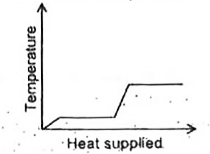
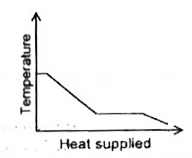
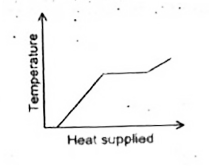
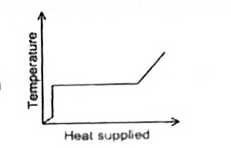
A block of ice `-10^(@)C` is slowly heated and converted to steam at `100^(@)C`. Which of the following curves represent the phenomenon qualitatively?

A

B

C

D

Text Solution

AI Generated Solution

The correct Answer is:

To analyze the heating process of a block of ice at -10°C being converted to steam at 100°C, we can break down the process into several steps and represent it qualitatively on a temperature vs. heat graph. ### Step-by-Step Solution: 1. **Initial State**: The block of ice starts at -10°C. At this stage, it is in solid form. 2. **Heating the Ice**: As heat is supplied, the temperature of the ice will increase from -10°C to 0°C. This is a linear increase in temperature as the ice absorbs heat. 3. **Phase Change (Melting)**: At 0°C, the ice begins to melt into water. During this phase change, the temperature remains constant at 0°C while the ice absorbs heat (latent heat of fusion). This heat is used to break the bonds between the ice molecules, allowing them to transition into the liquid state. 4. **Heating the Water**: Once all the ice has melted and we have water at 0°C, further heating will raise the temperature of the water from 0°C to 100°C. This again is a linear increase in temperature as the water absorbs heat. 5. **Phase Change (Vaporization)**: At 100°C, the water begins to convert into steam. Similar to the melting process, during this phase change, the temperature remains constant at 100°C while the water absorbs heat (latent heat of vaporization). This heat is used to convert the water into steam. 6. **Final State**: After all the water has been converted to steam, the temperature can increase further if more heat is supplied, but for this problem, we stop at the steam phase at 100°C. ### Qualitative Graph Representation: - The graph will have a rising slope from -10°C to 0°C (heating the ice). - A horizontal line at 0°C (melting the ice). - Another rising slope from 0°C to 100°C (heating the water). - A horizontal line at 100°C (vaporizing the water). - The graph will illustrate the temperature changes and the constant temperature during phase changes. ### Conclusion: The correct qualitative curve representing the phenomenon involves two linear segments (heating the ice and heating the water) and two horizontal segments (melting and vaporization). ---
Promotional Banner

Topper's Solved these Questions

  • HEAT AND TEMPERATURE

    FIITJEE|Exercise ASSIGNMENT PROBLEMS (OBJECTIVE) (LEVEL-I) (ASSERTION AND REASON)|2 Videos
  • HEAT AND TEMPERATURE

    FIITJEE|Exercise ASSIGNMENT PROBLEMS (OBJECTIVE) (LEVEL II)|20 Videos
  • HEAT AND TEMPERATURE

    FIITJEE|Exercise ASSIGNMENT PROBLEMS (SUBJECTIVE) (LEVEL II AND III)|15 Videos
  • GRAVITATION

    FIITJEE|Exercise Numerical based Question|2 Videos
  • KINEMATICS

    FIITJEE|Exercise NUMERICAL BASED QUESTIONS DECIMAL TYPE|5 Videos

Similar Questions

Explore conceptually related problems

A block of ice at -10^@C is slowly heated and converted to steam at 100^@C. Which of the following curves represents the phenomenon qualitatively?

A block of ice at -12^(@)C is slowly heated and converted into steam at 100^(@)C . Which of the following curves best represents the event ?

A block of ice at -5^@C is slowly heated and converted to steam at 100^@C . The process can be qualitatively represented by the curve

The ice at 0^(@)C is converted into steam at 100^(@)C . State the isothermal changes in the process.

Ice at 0^(@)C is converted into steam at 100^(@)C . State the isothermal changes in this process?

5g ice at 0^(@)C is mixed with 5g of steam at 100^(@)C . What is the final temperature?

FIITJEE-HEAT AND TEMPERATURE-ASSIGNMENT PROBLEMS (OBJECTIVE) (LEVEL-I)
  1. A liquid with coefficient of real volume expansion (gamma) is filled i...

    Text Solution

    |

  2. At room temperature (27^(@)C) the 'rms' speed of the molecules of a ce...

    Text Solution

    |

  3. Two moles of a monatomic gas is mixed with three moles of a diatomic g...

    Text Solution

    |

  4. A diatomic gas does 80 J of work when expanded isobarically. The heat ...

    Text Solution

    |

  5. A block of ice -10^(@)C is slowly heated and converted to steam at 100...

    Text Solution

    |

  6. When an ideal diatomic gas is heated at constant pressure, the fractio...

    Text Solution

    |

  7. If the density of a gas at NTP is 1.3mg//cm^(3) and velocity of sound ...

    Text Solution

    |

  8. The velocities of three molecules are 3v, 4v and 5v. Calculate their r...

    Text Solution

    |

  9. If the average kinetic energy of gas molecule at 27^(@)C is 6.21xx10^(...

    Text Solution

    |

  10. A substance of mass M kg requires a power input of P wants to remain i...

    Text Solution

    |

  11. The coefficient of linear expansion of a rod is alpha and its length i...

    Text Solution

    |

  12. Two idential container joined by a small pipe initially contain the sa...

    Text Solution

    |

  13. A cyclic process ABCD is shown in the figure P-V diagram. Which of the...

    Text Solution

    |

  14. A spherical black body with radius 12 cm radiates 640 w power at 500 K...

    Text Solution

    |

  15. m grams of a gas of molecules weight M is flowing in an insulated tub...

    Text Solution

    |

  16. Two metallic spheres S1 and S2 are made of the same material and have ...

    Text Solution

    |

  17. Two perfect gases at absolute temperature T(1) and T(2) are mixed. The...

    Text Solution

    |

  18. A pendulum clock keeps correct time at 0^(@)C. Its mean coefficient of...

    Text Solution

    |

  19. Two straight metallic strips each of thickness t and length l are rive...

    Text Solution

    |

  20. The radius of a ring is R and its coefficient of linear expansion is a...

    Text Solution

    |
