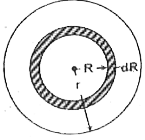
A uniform charged disc whose total charge has magnitude q and whose radius is r rotates with constant angular velocity of magnitude `omega`. What is the magnetic dipole moment?
Text Solution
Verified by Experts
The surface charge density is `q//pir^(2)`. Hence the charge within a ring of radius R and width dR is `dq = (q)/(pi r^(2)) (2 pi RdR) = (2q)/(r^(3)) (RdR)` The current carried by this ring is its charge divided by the rotation period, `di = (dq)/(2 pi // omega) = (q omega)/(pi r^(2)) [R.dR]` The magnetic moment contributed by this ring has the magnitude dM = a |di|, where a is the area of ring. `dM = pi R^(@) |di| = (q omega)/(r^(2)) R^(3) dR` `M = int dM = int_(R - 0)^(r ) q. (omega)/(r^(2)) (R^(3) dR) = q omega (r^(2))/(4)`
A uniformly charged thin conducting spherical shell of radius R and charge q is rotated with constant angular velocity omega about a diameter. The magnetic dipole moment of the system is
A uniformly charged disc of radius r and having charge q rotates with constant angular velocity omega . The magnetic dipole moment of this disc is (1)/(n)qomegar^(2) . Find the value of n.
A charge q is spread uniformly over an insulated loop of radius r. If it is rotated with an angular velocity omega with respect to normal axis then the magnetic moment of the loop is :
A charge q is spread uniformly over an insulated loop of radius r. If it is rotated with an angular velocity omega with respect to normal axis then the magnetic moment of the loop is
Charge Q is uniformly distributed over a nonconducting ring of radius R and mass m. It is made to rotate about an axis passing through its centre and perpendicular to its plone with an angular velocity of rotation omega . Find its magnetic dipole moment and its ratio with angular momentum.
A rod has a total charge Q uniformly distributed along its length L. If the rod rotates with angular velocity omega about its end, compute its magnetic moment.
A disc is rotating with angular velocity omega . If a child sits on it, what is conserved?