Home
Class 12
PHYSICS
A particle of charge +q and mass m movin...

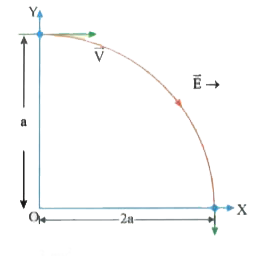
A particle of charge +q and mass m moving under the influnce of a uniform electric field `E hati `and a uniform magnetic field `Bhatk` follows trajectory from P to Q as shown in figure. The velocities at P and Q `vhati` and `-2vhatj` respectively. Which of the following statement(s) is/are correct

A

`E = (3)/(4) (mv^(2))/(qa)`

B

Rate of work done by electric field at P is `(3)/(4) (mv^(3))/(a)`

C

Rate of work done by electric field at p is zero

D

Rate of work done by both the fields at Q is zero

Text Solution

Verified by Experts

The correct Answer is:

A, B, C

In going from P to Q increase in kinetic energy
`= (1)/(2) m (2v)^(2) - (1)/(2) mv^(2) = (1)/(2) m (3v^(2))` = work done by electric field
or `(3)/(2) mv^(2) = Eq xx 2a` `implies` `E = (3)/(4) (mv^(2))/(qa)`
The rate of work done by E at P = force due to E X velocity
`= qEv = q ((3mv^(2))/(4qa)) V = (3mv^(3))/(4a)`
At q. `vec(v)` is a perpendicular to `vec(E )` and `vec(B)` therefore no work is done by the either field
Promotional Banner

Topper's Solved these Questions

  • MAGNETIC

    FIITJEE|Exercise Comprehension-1|3 Videos
  • MAGNETIC

    FIITJEE|Exercise Comprehension-2|2 Videos
  • MAGNETIC

    FIITJEE|Exercise Solved Problems (Subjective)|10 Videos
  • LAWS OF MOTION

    FIITJEE|Exercise COMPREHENSION-III|2 Videos
  • MAGNETISM

    FIITJEE|Exercise Example|12 Videos

Similar Questions

Explore conceptually related problems

A particle of charge +q and mass m moving under the influence of as uniform electric field Ehati and uniform magnetic field B hatk follows trajectory form P to Q as shown in figure. The velocities at P and Q re vhati and -2hatj . Which of the following statement(s) is/are correct? a. E=3/4[(mv^2)/(qa)] b. Rate of work done by the electrif field at P is 3/4[(mv^3)/a] c. Rate of work done by the electric field at P is zero. d. Rate of work done by both the field at Q is zero.

A particle of charge +q and mass m moving under the influence of a uniform electric field E hat(i) and uniform magnetic field B hat(k) follows a trajectory from P to Q as shown in fig. The velocities at P and Q are v hat(i) and - 2v hat(j) . which of the following statement(s) is/are correct ?

A particle of charge +q and mass m moving under the influence of a uniform electric field E hati and a magnetic field Bhatk enters in I quadrant of a coordinate system at a point (0,a) with initial velocity v hati and leaves the quadrant at a point (2a.,0) with velocity -2vhatj Find (aq) Magnitude of electric field at point (0,a) (C ) Rate of work done by both the fields at (2a,0) .

A particle of charge q, mass starts moving from origin under the action of an electric field vecE=E_(0)hati and magnetic field vecB=B_(0)hatk . Its velocity at (x,0,0) is v_(0)(6hati+8hatj) . The value of is

A charge particle of charge q and mass m is moving with velocity v as shown in fig In a uniform magnetic field B along -ve z-direction.Select the correct alternative (s).

A particle of charge q and mass m is moving along the x-axis with a velocity v and enters a region of electric field E and magnetic field B as shown in figures below. For which figure the net force on the charge may be zero?

A charged particle of charge q and mass m is shot into a uniform magnetic field of induction B at an angle theta with the field. The frequency of revolution of the particle

A charged particle is moving in a circular path in uniform magnetic field. Match the following.

Four particles enter a region of uniform magnetic field. Their trajectories are shown in figure. What are the signs of the charge of all four particles ?
