Home
Class 12
PHYSICS
A long cylindrical conductor of radius R...

A long cylindrical conductor of radius R having a cylindrical cavity of radius R/2 through out its length is lying with its axis parallel to x-axis. The distance between the axes of the cylinder and the cavity length in the positive x direction. The across sectional view of the cylinder is shown in the figure
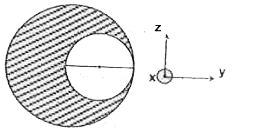
A charged particle having specific charge (charge to mass ratio) is `(18 pi)/(mu_(0) I) xx 10^(6)` SI unit is projected from a point on the axis of the cavity along x-axis with the speed of 10^6 m/s. Radius of curves of the path of the particle is equal to


A

R/18

B

R/9

C

R/6

D

R.3

Text Solution

Verified by Experts

The correct Answer is:
C
Promotional Banner

Topper's Solved these Questions

Similar Questions

Explore conceptually related problems

A long cylindrical conductor of radius R having a cylindrical cavity of radius R/2 through out its length is lying with its axis parallel to x-axis. The distance between the axes of the cylinder and the cavity length in the positive x direction. The across sectional view of the cylinder is shown in the figure The magnetic induction at point on the cavity is

A solid spherical conductor of radius R has a spherical cavity of radius at its centre. A charge is kept at the centre of the cavity. The charge at the inner surface, outer surface are respectively.

How does the electric field (E) between the plates of a charged cylindrical capacitor vary with the distance r from the axis of the cylinder ?

A solid spherical conductor of radius R has a spherical cavity of radius a(a

A cylindrical space of radius R is filled with a uniform magnetic induction parallel to the axis of the cylinder. If B charges at a constant rate, the graph showin the variation of induced electric field with distance r from the axis of cylinder is

A cylinder of radius R_(1) have cylinderical cavity of radius R_(2) as shown in the figure and have current density J (down ward). Find Magnetic field when when point is in cavity

a point charge q is placed at the centre of a cylinder of length L and radius R the electric flux through the curved surface of the cylinder is