Home
Class 12
PHYSICS
A hemisphere of radius R, made of glass ...

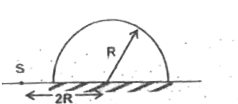
A hemisphere of radius R, made of glass of refractive index (3/2) is placed on 'the table. A point source of light is placed at a distance 2R from the centre, of hemisphere. If source is viewed diametrically opposite side of hemisphere. Find the position of image of source.

Text Solution

Verified by Experts

Refraction due to first surface.
`(3/2)/v_(1) - 1/(-R) = (3/2 -1)/R implies v_(1)= -3R`
Refraction due to second surface.
`1/v - (3//2)/(-(3R + 2R)) = (1 - 3/2)/(-R)`
Position of image from the centre of hemisphere is at a distance 6R opposite side of source.
Promotional Banner

Topper's Solved these Questions

  • OPTICS

    FIITJEE|Exercise Solved problem (objective)|15 Videos
  • OPTICS

    FIITJEE|Exercise Comprehension-1(prob)|3 Videos
  • OPTICS

    FIITJEE|Exercise Illustration|10 Videos
  • MODERN PHYSICS

    FIITJEE|Exercise Numerical based questions|5 Videos
  • PHYSICS PART-III

    FIITJEE|Exercise NUMERICAL BASED QUESTIONS DECIMAL TYPE|11 Videos

Similar Questions

Explore conceptually related problems

A point source of light is placed at a distance of 2f from a converging lens of focal length f. The intensity onteh other side of the lens is maximum at a distance

A glass hemisphere of radius R and of material having refractive index 1.5 is silvered on its flat face as shown in figure., A small object of height h is located at a distance 2R from the surface of hemisphere as shown in the figure. The final image will form.

A point light source of 100W is placed at a distance x from the centre ofa hole ofradius R in a sheet as shown in figure, Find the power passing through the hole in sheet

A solid glass sphere with radius R and an index of refraction 1.5 is silvered over one hemisphere. A small object is located on the axis of the sphere at a distance 2R to the left of the vertex of the unsilvered hemisphere. Find the position of final image after all refractions and reflection have taken place.

The internal surface of the walls of a sphere is specular (i.e. reflecting). The radius of the sphere is R = 36 cm . A point source S is placed at a distance R//2 from the centre of the sphere and sends light to the remote part of the sphere. Where will the image of the source be after two successive reflection from the remote and then the nearest wall of the sphere ? How wil the position of the image change if the source sends light to the nearest wall first ? Consider paraxial rays.

The inner surface of the wall of a sphere is perfectly reflecting. Radius of the sphere is R. A point source S is placed at a distance R//2 from the centre of the sphere. Consider the reflection of light from the farthest wall followed by reflection from the nearest wall. Where is the image of the source? Consider paraxial rays only.

A point source (A) is kept on the axis of a hemi- spherical paperweight made of glass of refractive index mu = ( 3 )/( 2) . The distance of the point source from the centre (O) of the sphere is R where R is radius of the hemisphere. Use paraxial approximations for answering following questions (a) Find the change in radius of curvature of the wave- fronts just after they enter the glass at O. (b) Find the radius of curvature of the wavefronts at point P just outside the glass.

The distance of the centre of mass of a hemispherical shell of radius R from its centre is

The internal surface of the walls of a sphere is specular. The radius of the sphere is R=36cm. A point source S is placed at a distance R//2 from the cneter of the sphere and sends light to the remote part of the sphere. Where will the image of the source be after two successive reflections from the remote and then nearest wall of the sphere? How will the position of the image change if the source sends light to the nearest wall first?Consider paraxial rays.

FIITJEE-OPTICS-SOLVED PROBLEMS (SUBJECTIVE)
  1. A light ray is incident on an irregular shaped slab of refractive inde...

    Text Solution

    |

  2. A hemisphere of radius R, made of glass of refractive index (3/2) is p...

    Text Solution

    |

  3. A right angle prism(45^(@) - 90^(@) - 45^(@)) of refractive index n ha...

    Text Solution

    |

  4. A right angle prism(45^(@) - 90^(@) - 45^(@)) of refractive index n ha...

    Text Solution

    |

  5. The convex surface of a thin concavo-convex lens of glass of R.l. 1.5 ...

    Text Solution

    |

  6. The convex surface of a thin concavo-convex lens of glass of R.l. 1.5 ...

    Text Solution

    |

  7. Two parallel beams of light P and Q (separation d) containing radiatio...

    Text Solution

    |

  8. Two parallel beams of light P and Q (separation d) containing radiatio...

    Text Solution

    |

  9. Light is incident at an angle alpha on one planar end of a transparent...

    Text Solution

    |

  10. A ray of light strikes a glass slab of thickness t. (i) Prove that i...

    Text Solution

    |

  11. A ray of light travelling in air is incident at grazing angle (inciden...

    Text Solution

    |

  12. A prism of refractive index n(1) & another prism of reactive index n(2...

    Text Solution

    |

  13. Suppose that one of the slit in Young's experiment is wider than the o...

    Text Solution

    |

  14. In a Young's interference experimental arrangement, the incident yello...

    Text Solution

    |

  15. A coherent parallel beam of microwaves of wavelength A = 0.5 mm fails ...

    Text Solution

    |

  16. Two monochromatic coherent sources of wavelength 5000 Å are placed alo...

    Text Solution

    |

  17. In a Young's double slit experiment using monochromatic light, the fri...

    Text Solution

    |

  18. A coherent beam light of intensity I and absolute wavelength lambda= 5...

    Text Solution

    |
