
Home
Class 12
PHYSICS
The convex surface of a thin concavo-con...

The convex surface of a thin concavo-convex lens of glass of R.l. 1.5 has a radius of curvature 20 cm. The concave surface has a radius of curvature 60 cm. The convex side is silvered and placed horizontally.
Q Where should a pin be placed on the axis such that its image is formed on the same point.

Text Solution

Verified by Experts
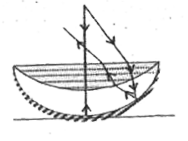
The effective focal length F of the combination is given as `- 1/F = 1/f_(g) - 1/f_(m) + 1/f_(g)` because refraction takes place twice with the curved surface and one reflection takes places with the mirror.
`implies - 1/F = 2/f_(g) - 1/f_(m)`
Since `1/f_(g) = (n-1)(1/R_(1) - 1/R_(2))` & `f_(m)= R_(1)/2` , where `R_(1)` and `R_(2)` are the radii of curvature of lower and upper surface the lens. Putting `R_(1)=20cm, R_(2)=60cm, n_(2)=1.5`
`f_(m)= (-R_(1))/2 = (-20)/2 implies f_(m) = -10`
we obtain `f_(g)`= +60cm
`implies - 1/F = 2/60 - 1/(-10)`
`implies F=-7.5 cm` (concave mirror)
For the image to be formed at the same points, the object distance
`l = 2F=-15cm`
Hence, the object should be placed at a distance of 15 cm from the lens on optic axis.
Promotional Banner

Topper's Solved these Questions

  • OPTICS

    FIITJEE|Exercise Solved problem (objective)|15 Videos
  • OPTICS

    FIITJEE|Exercise Comprehension-1(prob)|3 Videos
  • OPTICS

    FIITJEE|Exercise Illustration|10 Videos
  • MODERN PHYSICS

    FIITJEE|Exercise Numerical based questions|5 Videos
  • PHYSICS PART-III

    FIITJEE|Exercise NUMERICAL BASED QUESTIONS DECIMAL TYPE|11 Videos

Similar Questions

Explore conceptually related problems

The convex surface of a thin concave-convex lens of glass of refractive index 1.5 has a radius of curvature 20 cm. The concave surface has a radius of curvature 60 cm. The convex side is silvered and placed on a horizontal surface as shown in figure. (a) Where should a pin be placed on the axis so that its image is formed at the same place ? (b) If the concave part is filled with water (mu = 4/3), find the distance through which the pin should be moved so that the image of the pin again coincides with the pin.

The convex surface of a thin concavo-convex lens of glass of R.l. 1.5 has a radius of curvature 20 cm. The concave surface has a radius of curvature 60 cm. The convex side is silvered and placed horizontally. Q If the concave part is filled with water of refractive index 4/3, find the distance through which the pin should be moved so that the image of the pin again coincides with the pin?

The concave surface of a thin concavo -convex lens of glass of refractive index 1.5 has a radius of curvature of 20cm .The concave surface has a radius of curvature of 60cm .The covnex side is silvered and placed on a horizontal surface as shown in the figure. A small object is placed on the principal axis of the combination,at a distance of 30cm in front of the mirror.The magnification of the image is

The concave surface of a thin concavo -convex lens of glass of refractive index 1.5 has a radius of curvature of 20cm .The concave surface has a radius of curvature of 60cm .The covnex side is silvered and placed on a horizontal surface as shown in the figure. The combination behaves like

The concave surface of a thin concavo -convex lens of glass of refractive index 1.5 has a radius of curvature of 20cm .The concave surface has a radius of curvature of 60cm .The covnex side is silvered and placed on a horizontal surface as shown in the figure. The focal length of the combibnation has the magnitude.

The concave surface of a thin concavo-convex lens of index 1.5 has radius of curvature 50cm and 10cm respectively.The concave side is silvered andplaced on a horizontal surface as shown Focal length of silvered lens is:

The concave surface of a thin concavo-convex lens of index 1.5 has radius of curvature 50cm and 10cm respectively.The concave side is silvered andplaced on a horizontal surface as shown The object distance at which its image coincides with itself is

FIITJEE-OPTICS-SOLVED PROBLEMS (SUBJECTIVE)
  1. A light ray is incident on an irregular shaped slab of refractive inde...

    Text Solution

    |

  2. A hemisphere of radius R, made of glass of refractive index (3/2) is p...

    Text Solution

    |

  3. A right angle prism(45^(@) - 90^(@) - 45^(@)) of refractive index n ha...

    Text Solution

    |

  4. A right angle prism(45^(@) - 90^(@) - 45^(@)) of refractive index n ha...

    Text Solution

    |

  5. The convex surface of a thin concavo-convex lens of glass of R.l. 1.5 ...

    Text Solution

    |

  6. The convex surface of a thin concavo-convex lens of glass of R.l. 1.5 ...

    Text Solution

    |

  7. Two parallel beams of light P and Q (separation d) containing radiatio...

    Text Solution

    |

  8. Two parallel beams of light P and Q (separation d) containing radiatio...

    Text Solution

    |

  9. Light is incident at an angle alpha on one planar end of a transparent...

    Text Solution

    |

  10. A ray of light strikes a glass slab of thickness t. (i) Prove that i...

    Text Solution

    |

  11. A ray of light travelling in air is incident at grazing angle (inciden...

    Text Solution

    |

  12. A prism of refractive index n(1) & another prism of reactive index n(2...

    Text Solution

    |

  13. Suppose that one of the slit in Young's experiment is wider than the o...

    Text Solution

    |

  14. In a Young's interference experimental arrangement, the incident yello...

    Text Solution

    |

  15. A coherent parallel beam of microwaves of wavelength A = 0.5 mm fails ...

    Text Solution

    |

  16. Two monochromatic coherent sources of wavelength 5000 Å are placed alo...

    Text Solution

    |

  17. In a Young's double slit experiment using monochromatic light, the fri...

    Text Solution

    |

  18. A coherent beam light of intensity I and absolute wavelength lambda= 5...

    Text Solution

    |

