Home
Class 12
PHYSICS
T is a point at the bottom of a tank fil...


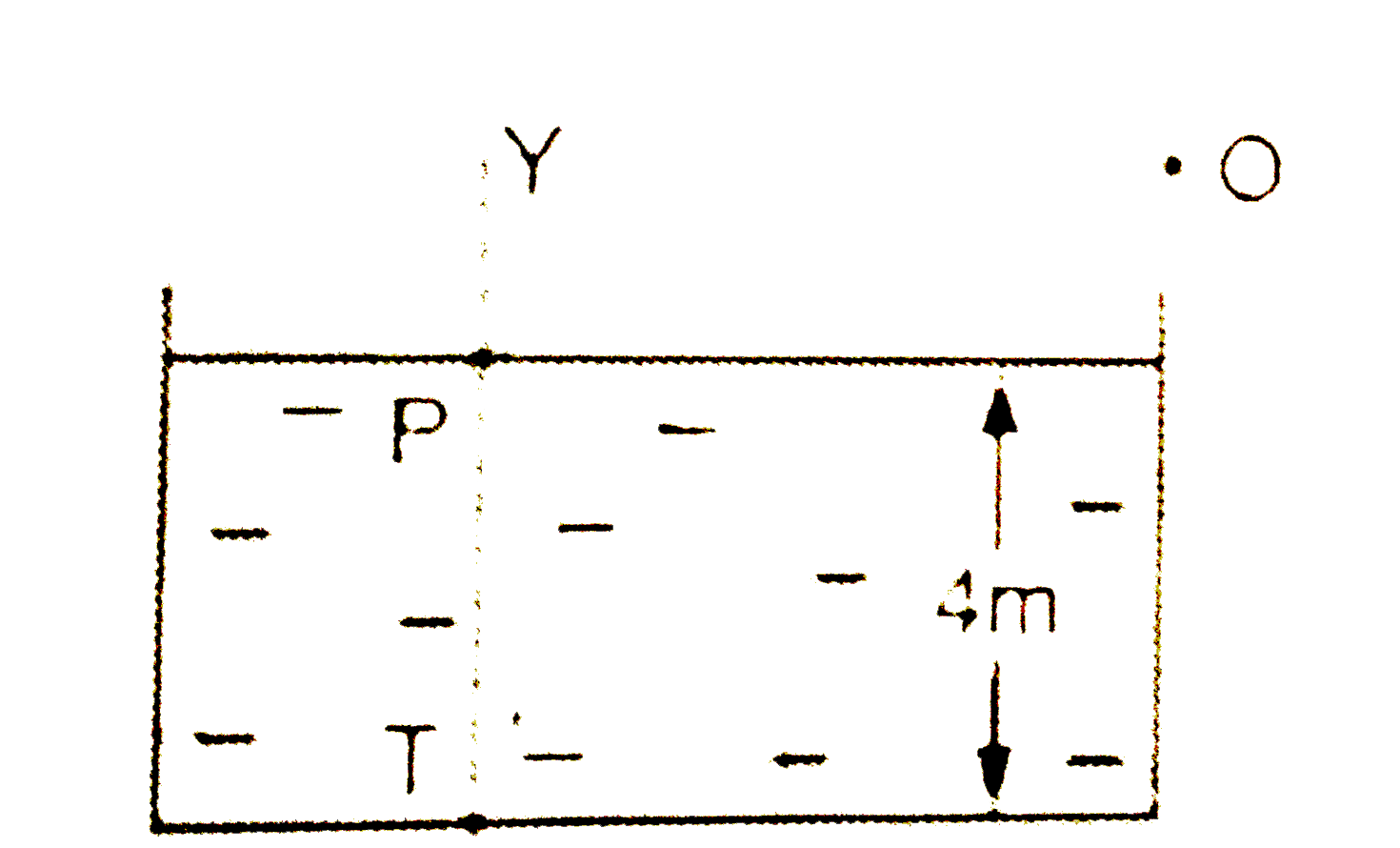
`T` is a point at the bottom of a tank filled with water, as shwon. The refractive index of water is `4//3`. YPT is the vertical line through `T`. To an observer at the position `O,T` will appear to be

A

to the left of YT

B

somewhere on YT

C

at a depth 3 m below T

D

at a depth

Text Solution

Verified by Experts

The correct Answer is:

A, B
Promotional Banner

Topper's Solved these Questions

  • OPTICS

    FIITJEE|Exercise COMPREHENSION- I|5 Videos
  • OPTICS

    FIITJEE|Exercise Comprehension -II|5 Videos
  • OPTICS

    FIITJEE|Exercise ASSERTION REASONING TYPE|3 Videos
  • MODERN PHYSICS

    FIITJEE|Exercise Numerical based questions|5 Videos
  • PHYSICS PART-III

    FIITJEE|Exercise NUMERICAL BASED QUESTIONS DECIMAL TYPE|11 Videos

Similar Questions

Explore conceptually related problems

The refractive index of water is 4//3. The speed of light in water is

Brewster angle for air to water transition is (refractive index of water is 4/3 )

A thin hollow prism of refracting angle 3°, filled with water gives a deviation of 1°. The refractive index of water is

A fish lies at the bottom of a 4 m deep water lake. A bird flies 6m above the water surface and refractive index of water is 4//3 . Then the distance between

The time taken by the sunlight to reach the bottom of a tank of depth 4.5 m filled completely with water is …………. Ns. The refractive index of water is 4/3 .

Find the refractive index of water with respect to glass if the refractive index of water is 4/3 and the refractive index of glass is 3/2.

A metal coin at the bottom of a beaker filled with a liquid of refractive index 4//3 to height of 6 cm . To an observer looking from above the surface of the liquid, coin will appear at a depth of (consider paraxial rays).

The apparent depth of an object at the bottom of tank filled with a liquid of refractive index 1.3 is 7.7 cm. what is the actual depth of the liquid in the tank ?

FIITJEE-OPTICS-ASSIGNMENT PROBLEMS (OBJECTIVE)(level 2)
  1. A point object is placed at 30 cm from a convex glass lens (mu(g) = (3...

    Text Solution

    |

  2. For which of the pairs of u and f for a-mirror image is smaller in siz...

    Text Solution

    |

  3. A convex lens made of glass (mu(g)= 3/2) has focal length f in air. Th...

    Text Solution

    |

  4. A converging lens is used to form an image on a screen. When the upper...

    Text Solution

    |

  5. In an interference arrangement similar to young's double slit experime...

    Text Solution

    |

  6. A brid flies down vertically towards a water surface. To a fish inside...

    Text Solution

    |

  7. A point object P moves towards a convex mirror with a constant speed V...

    Text Solution

    |

  8. T is a point at the bottom of a tank filled with water, as shwon. The ...

    Text Solution

    |

  9. A ray of light travels from a medium of refractive index mu to air. It...

    Text Solution

    |

  10. In the previous question

    Text Solution

    |

  11. A point object is placed at the centre of a glass sphere of radius 6cm...

    Text Solution

    |

  12. A tank of height 33.25 cm is completely filled with liquid (mu = 1.33)...

    Text Solution

    |

  13. A ray of light travelling in a transparent medium falls on a surface s...

    Text Solution

    |

  14. A solid transparent sphere made of glass (R.I.=mu gt 1) has a small, o...

    Text Solution

    |

  15. A watch glass has uniform thickness, and the average radius of curvatu...

    Text Solution

    |

  16. A thin concavo-convex lens has two surfaces of radii of curvature R an...

    Text Solution

    |

  17. In Young's double slit experiment intensity at a point is ((1)/(4)) of...

    Text Solution

    |

  18. In a two slit experiment with white light, a white fringe is observed ...

    Text Solution

    |

  19. The ratio of intensities of two waves are given by 4:1. The ratio of t...

    Text Solution

    |

  20. In the Young's double slit experiment with sodium light, the slits are...

    Text Solution

    |
