

Home
Class 11
PHYSICS
Cylindrical block of area of cross-secti...


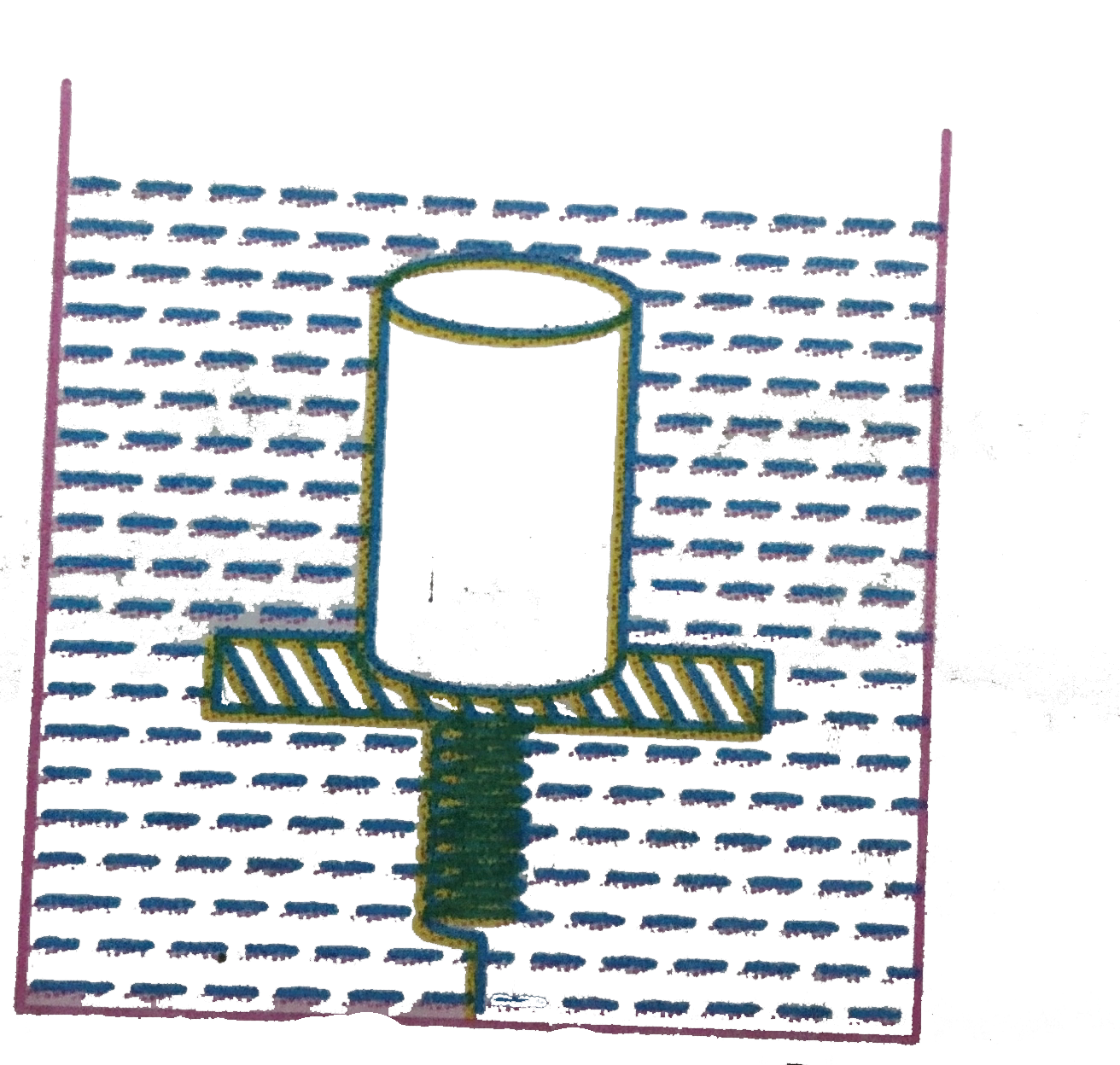
Cylindrical block of area of cross-section A and of material of density `rho` is placed in a liquid of density one third of density of block. The block compress in the spring is one-third of te length of the block. if acceleration due to gravity is g, the spring constant of the spring is

Promotional Banner

Similar Questions

Explore conceptually related problems

A block of density rho floats in a liquid with its one third volume immersed. The density of the liquid is

A block of density rho floats in a liquid with its one third volume immersed. The density of the liquid is

Passage XIV) A uniform cylindrical block of mass 2M and cross-sectional area A remains partially submerged in a non viscous liquid of density rho , density of the material of the cylinder is 3rho . The cylinder is connected to lower end of the tank by means of a light spring of spring constant K. The other end of the cylinder is connected to anotehr block of mass M by means of a light inextensible sting as shown in the figure. The pulleys shown are massless and frictionless and assume that the cross-section of the cylinder is very small in comparison to that of the tank. Under equilibrium conditions, half of the cylinder is submerged. [given that cylinder always remains partially immersed) Under equilibrium conditions

Passage XIV) A uniform cylindrical block of mass 2M and cross-sectional area A remains partially submerged in a non viscous liquid of density rho , density of the material of the cylinder is 3rho . The cylinder is connected to lower end of the tank by means of a light spring of spring constant K. The other end of the cylinder is connected to anotehr block of mass M by means of a light inextensible sting as shown in the figure. The pulleys shown are massless and frictionless and assume that the cross-section of the cylinder is very small in comparison to that of the tank. Under equilibrium conditions, half of the cylinder is submerged. [given that cylinder always remains partially immersed) Under equilibrium conditions

An open pan P filled with water of density (rho_w) is placed on a vertical rod, maintaining equilibrium. A block of density rho is placed on one side of the pan as shown. Water depth is more then height of the block.

An open pan P filled with water of density (rho_w) is placed on a vertical rod, maintaining equilibrium. A block of density rho is placed on one side of the pan as shown. Water depth is more then height of the block.

The block of mass m is released when the spring was in its natrual length. Spring constant is k. Find the maximum elongation of the spring.

The block of mass m is released when the spring was in its natrual length. Spring constant is k. Find the maximum elongation of the spring.

A block of volume V and density rho is floating in a liquid of density 2 rho filled in a vessel. Now the vesset starts falling freely with acceleration g . Then the volume of block inside the liquid in the falling condition is

A block of volume V and density rho is floating in a liquid of density 2 rho filled in a vessel. Now the vesset starts falling freely with acceleration g . Then the volume of block inside the liquid in the falling condition is