Home
Class 11
PHYSICS
Two inclined frictionless tracks, one gr...

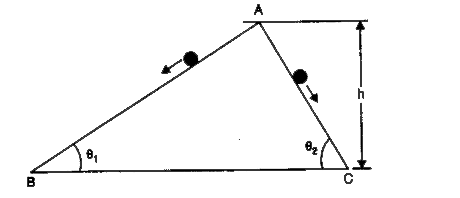
Two inclined frictionless tracks, one gradual and the other steep meet at A from where to stones are allowed to slide down from rest, one on each track (fig.) Will hte stones reach the bottom at the same time? Will they reach there with the same speed? Explain, given `theta_(1)=30^(@)`, `theta_92)=60^(@)` and h=10m. What are the speeds and time taken by the two stones?

Text Solution

Verified by Experts

Let AB and AC be two smooth planes inclined at angles `theta_(1) and theta_(2)` to the hrozontal . As the height of both the stones is same , therefore both will reach the bottom with same speed .
As the stones are intially at same height therefore potential energy at A = kinetic energy at B or C
`mgh = 1/2 mv^(2)`
`rArr " " v = sqrt(2gh)`
` = sqrt(2xx10xx10) = 14.14 " m "s^(-1)`
The acceleration of two stones are :
`a_(1) = g sin theta_(1) and a_(2)= g sin theta_(2)`
As `teta_(2) gt theta_(1) " " :. a_(2) gt a_(1)`
As `a prop 1/t`
` :. t_(2) lt t_(1)`
Thus second stone will reach earlier and will take less time than the Ist stone ( i.e `t_(2) ltt_(1)` ) .
Let the time taken by the stone moving along AB to reach the ground be `t_(1)` and that moving along AC be `t_(2)`
`AB = h/(sin 30^(@)) = (10 m)/(sin 30^(@)) = 20 m `
AC ` = h /(sin 60^(@)) = (10 m ) / (cos 30^(@)) = 20/(sqrt(3)) m `
The times `t_(1) and t_(2) ` can be calculated as :
`t_(1) = sqrt((AB)/( g sin 30^(@))) = sqrt((40)/(10 xx1 //2)) = 2sqrt(2)s `
`t_(2)= sqrt((2AC)/(g sin 60^(@)) ) = sqrt((40sqrt(3))/(10 xx (sqrt(3)//2)) ) = 2 sqrt(2/3) s `
Promotional Banner

Topper's Solved these Questions

  • WORK, ENERGY AND POWER

    MODERN PUBLICATION|Exercise NCERT FILE (Exemplar Problems Objective Questions)|21 Videos
  • WORK, ENERGY AND POWER

    MODERN PUBLICATION|Exercise NCERT FILE (NCERT Exemplar Problems (Very Short Answer Type Questions))|12 Videos
  • WORK, ENERGY AND POWER

    MODERN PUBLICATION|Exercise NCERT FILE (NCERT Textbook Exercise)|23 Videos
  • WAVES

    MODERN PUBLICATION|Exercise CHAPTER PRACTICE TEST|14 Videos

Similar Questions

Explore conceptually related problems

Two inclined frictionless tracks, one gradual and the other steep meet at O, from where two stones are allowed to slide down from rest, one on each track. Will the stones reach the bottom at the same time ? Will they reach there with the same speed ? Explain.

Two inclined frictionless tracks, one gradual and the other steep meet at a from where two stones are allowed to slide down from rest, one on each track as shown in Figure. Which of the following statement is correct ? .

Two inclined frictionless tracks , one gradual and the other sleep meet at A from where two stones are allowed to slide down from rest. One on each track as shown in figure. Which of the following statement is correct?

Two inclined frictionless tracks, one gradual and other steep meet at 'A' from where two stones are allowed to slide down from rest, one on each track as shown in figure. The speed of two stones on reaching at bottom are v_(1) and v_(2) respectively. v_(1) & v_(2) are related as

A smooth inclined plane is inclined at an angle theta with the horizontal. A body starts from rest and slides down the inclined surface. The time taken by the body to reach the bottom is

A stone is dropped from a height h. Simultaneously, another stone is thrown up from the ground which reaches a height 4 h. The two stones cross each other after time

A stone is dropped from a height h. simultaneously, another stone is thrown up from the ground which reaches a height 4h. The two stones will cross each other after time:-

Two stones are thrown from the top of a tower, one straight down with an initial speed u and the second straight up with the same speed u. When the two stones hit the ground they will have speeds in the ratio.

A stone is thrown up from the top of a tower and it takes time t_(1) to reach the ground. A second stone is thrown down with the same speed and it takes time t_(2) to reach the ground . How much time a third stone would take to reach the ground, if it is dropped down?

A stone thrown down with a seed u takes a time t_(1) to reach the ground , while another stone, thrown upwards from the same point with the same speed, takes time t_(2) . The maximum height the second stone reaches from the ground is
