Home
Class 11
PHYSICS
A 1kg block situated on a rough incline ...

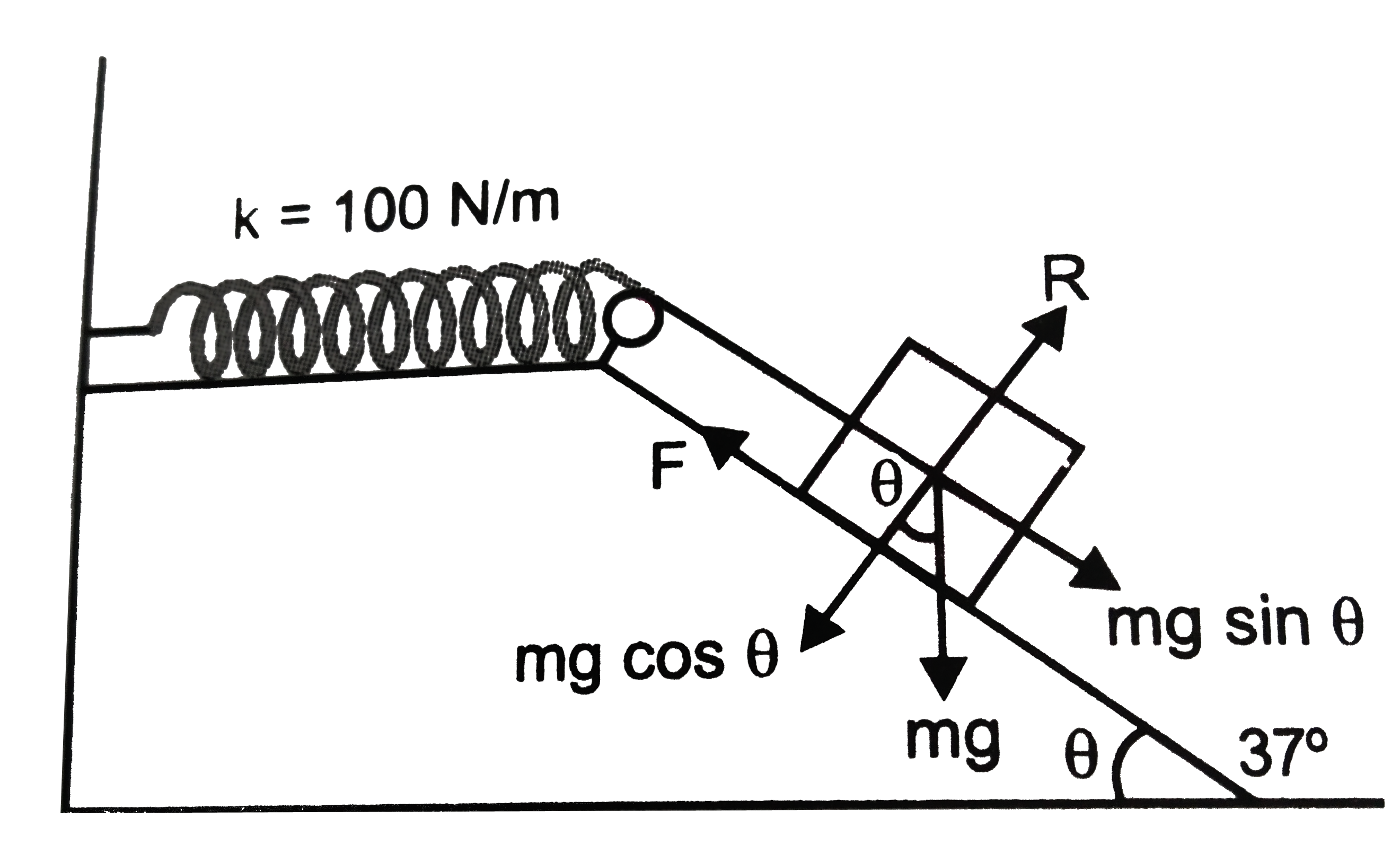
A 1kg block situated on a rough incline is connected to a spring of spring constant `100Nm^(-1)` as shown in figure,. The block is released from rest with the spring in the unstretched position. The block moves 10cm down the incline before coming to rest. Find the coefficient of friction between the block and the incline. Assume that the spring has negligible mass and the pulley is frictionless.

Text Solution

Verified by Experts

As `K = 100 " N "m^(-1)`
`R = mg cos theta ` , Force of friction `= F muR = mumg cos theta `
Net force on the block down the incline
` = mg sin theta - F `
` = mg sin theta - mu mg cos theta `
` = mg (sin theta - mu cos theta ) `
x = distance moved = 10 cm
0.1 m
At equilibrium
Work done = P.E of streched spring
` mg( sin theta - mu cos theta ) x = 1/2 Kx^(2)`
` 2 mg (sin theta - mu cos theta ) = Kx `
` 2xx1 xx10 ( sin 30^(@) - mu cos 37^(@)) = 100 xx1 `
Solving we get `mu = 0.126 `
Promotional Banner

Topper's Solved these Questions

  • WORK, ENERGY AND POWER

    MODERN PUBLICATION|Exercise NCERT FILE (Exemplar Problems Objective Questions)|21 Videos
  • WORK, ENERGY AND POWER

    MODERN PUBLICATION|Exercise NCERT FILE (NCERT Exemplar Problems (Very Short Answer Type Questions))|12 Videos
  • WORK, ENERGY AND POWER

    MODERN PUBLICATION|Exercise NCERT FILE (NCERT Textbook Exercise)|23 Videos
  • WAVES

    MODERN PUBLICATION|Exercise CHAPTER PRACTICE TEST|14 Videos

Similar Questions

Explore conceptually related problems

a. A 2-kg situated on a smooth fixed incline is connected to a spring of negligible mass, with spring constant k=100Nm^-1 , via a frictionless pulley. The block is released from rest when the spring is unstretched. How far does the block moves down the incline before coming (momentarily) to rest? What is its acceleration at its lower point? b. The experiment is repeated on a rough incline. If the block is observed to move 0.20m down along the incline before it comes to instantaneous rest, calculate the coefficient of kinetic friction.

A 2 kg block is connected with two springs of force constants k_(1)=100 N//m and k_(2)=300 N//m as shown in figure. The block is released from rest with the springs unstretched. The acceleration of the block in its lowest postion is (g=10 m//s^(2))

In the figure shown, the system is released from rest with both the springs in unstretched positions. Mass of each block is 1 kg and force constant of each spring is 10 N/m. Maximum speed of the block placed horizontally is:

The system is released from rest with both the springs in unstretched positions. Mass of each block is 1 kg and force constant of each spring is 10 N//m . In the equilibrium position, speed of the block placed horizontally is

The system is released from rest with both the springs in unstretched positions. Mass of each block is 1 kg and force constant of each spring is 10 N//m . Extension of horizontal spring in equilibrium is

The system is released from rest with both the springs in unstretched positions. Mass of each block is 1 kg and force constant of each spring is 10 N/m. Extension of horizontal spring in equilibrium is:

The block shown in figure is released from rest. Find out the speed of the block when the spring is compressed by 1 m

A 20-kg block attached to a spring of spring constant 5Nm^-1 is released from rest at A. The spring at this instant is having an elongation of 1m . The block is allowed to move in smooth horizontal slot with the help of a constant force 50N in the rope as shown. The velocity of the block as it reaches B is (assume the rope to be light)

A body freely released from A slides down a smooth inclined plane 'AB' and then a rough incline plane 'BC' such that BC = N (AB). If the block comes to rest at C, then coefficient of kinetic friction between the block and inclined plane is?
