Home
Class 12
PHYSICS
A cylindrical glass rod of radius 0.1m a...

A cylindrical glass rod of radius 0.1m and refractive index `sqrt(3)` lies on horizontal plane mirror. A horizontal ray of light moving perpendicular to the axis of the rod is incident on it. At what height from the mirror should the ray be incident so that it leaves the rod at a height of 0.1m above the plane mirror ? At what distance a second similar rod, parallel to the first, be placed on the mirror, such that the emergent ray from the second rod is in line with the incident ray on the first rod ?

Text Solution

Verified by Experts
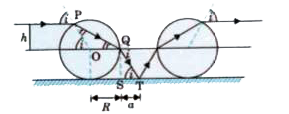
The ray diagram as described in question is as follows :

(a) From the figure we can write the following : `i=2r`
Further we can use this in Snell.s law as follows :
`mu sin theta =` constant
`implies " " 1 xx sin i= mu xx sin r`
`implies sin i= mu sin r`
`implies sin 2r = mu sin r`
`implies 2 sin r cos r = mu sin r`
`implies cos r = (mu)/(2) " " ... (i)`
`implies sin r = sqrt(1 - (mu^(2))/(4)) " " .... (ii)`
Using figure we can write the following :
sin i = `(h)/(R)`
`implies h = R sin i`
`implies h = R sin 2r`
`implies h = 2 R sin r cos r `
Substituting from equation (i) and (ii) we get the following :
`implies h = 2 R xx sqrt(1 - (mu^2)/(4)) xx (mu)/(2)`
`implies h = (muR)/(2) sqrt(4 - mu^(2))`
(b) Emergent ray from the first sphere strikes the mirror at point T . And after the point T other sphere is to be placed symmetrically as shown in the figure . Hence , distance between centres of the two spheres will be `2 (R + a)`. Hence , to calculate the distance of the other sphere we need to first find a , as shown in figure .
From the figure we can write the following :
a = R cot i
`implies a = R cot 2r`
Distance between the centres of spheres can be written as follows :
`d = 2 (R + a)`
`implies d = 2 (R + R cot 2r)`
`implies d = 2 R( 1 + cot r)`
`implies d = 2 R(1 + (cos 2r)/(sin 2r))`
`implies d = 2 R (1 + (2 cos^(2) r - 1)/(2 sin r cos r ))`
`implies d = 2 R ( 1 + (2 ((mu^(2))/(4)) - 1)/(2 xx sqrt(1 - (mu^(2))/(4)) xx (mu)/(2)))`
`implies d = 2 R (1 + (mu^(2) - 2)/(mu //sqrt(4 - mu^(2))))`
Promotional Banner

Topper's Solved these Questions

  • RAY OPTICS AND OPTICAL INSTRUMENTS

    MODERN PUBLICATION|Exercise NCERT FILE SOLVED (TEXT BOOK EXERCISES)|38 Videos
  • RAY OPTICS AND OPTICAL INSTRUMENTS

    MODERN PUBLICATION|Exercise NCERT (EXemplar Problems Obejective Questions) (Multiple Choice Questions (Type-I)|10 Videos
  • RAY OPTICS AND OPTICAL INSTRUMENTS

    MODERN PUBLICATION|Exercise Conceptual Questions|40 Videos
  • NUCLEI

    MODERN PUBLICATION|Exercise CHAPTER PRACTICE TEST FOR BOARD EXAMINATION|15 Videos
  • SEMICONDUCTOR ELECTRONICS METERIALS DEVICES AND SIMPLE CIRCUITS

    MODERN PUBLICATION|Exercise CHAPTER PRACTICE TEST FOR BOARD EXAMINATION|12 Videos

Similar Questions

Explore conceptually related problems

A prism having a refracting angle 4^(@) and refractive index 1.5 is located in front of a vertical plane mirror as shown. A horizontal ray of light is incident on the prism. What is the angle of incidence at the mirror ?

A ray of light incident on the first mirror and parallel to the second mirror in reflected from the second mirror parallel to the first mirror .The angle between the two mirrors is

Two plane mirrors are inclined at an angle theta to one another. A ray of light incident on the first mirror and parallel to the second mirror is reflected from the second mirror parallel to the first mirror. What is the value of theta ?

One end of a horizontal cylindrical glass rod (mu=1.5) of radius 0.5 cm is rounded in the shape of a hemisphere. An object 0.5mm high is placed perpendicular to the axis of the rod at a distance of 20.0cm from the rounded edge. Locate the image of the object and find its height

If angle fo incidence of a light ray on a plane mirror is 30^(@) , then

MODERN PUBLICATION-RAY OPTICS AND OPTICAL INSTRUMENTS-Tough & Tricky (PROBLEMS)
  1. There is a concave mirror of radius of curvature 30 cm. A U-shaped wir...

    Text Solution

    |

  2. There is a concave mirror of focal length 7.5 cm. Two objects P and Q ...

    Text Solution

    |

  3. There is one cylindrical vessel whose height and diameter are both equ...

    Text Solution

    |

  4. A hemispherical portion of the surface of a solid glass sphere (mu = 1...

    Text Solution

    |

  5. A ray of light passes through a transparent sphere of refractive inde...

    Text Solution

    |

  6. A cylindrical glass rod of radius 0.1m and refractive index sqrt(3) li...

    Text Solution

    |

  7. The convex surface of a thin concave-convex lens of glass of refractiv...

    Text Solution

    |

  8. A parallel beam of light travelling in water (refractive index =4//3)...

    Text Solution

    |

  9. A convex lens of focal length 30 cm and a concave lens of focal length...

    Text Solution

    |

  10. n अपवर्तनांक की एक पारदर्शी बेलनाकार छड़ के एक समतल सिरे पर alpha कोण प...

    Text Solution

    |

  11. A ray of light travelling in air is incident at grazing angle (incide...

    Text Solution

    |

  12. A small piece of wood is floating on the surface of a 2.5 m deep lake....

    Text Solution

    |

  13. A particle is moving at a constant speed V from a large distance towar...

    Text Solution

    |

  14. Cross section of a light pipe is shown in the following figure : ...

    Text Solution

    |

  15. A gun of mass M fires a bullet of mass m with a horizontal speed V. Th...

    Text Solution

    |

  16. In case of a concave mirror magnification is found to be m(1) = -0.5 f...

    Text Solution

    |

  17. In the following figure two mirrors M(1) and M(2) are placed in front ...

    Text Solution

    |

  18. A square-shaped planar object of edge length 3 cm is placed at a dista...

    Text Solution

    |

  19. A rod AB of length 5 cm is placed in front of a concave mirror of foca...

    Text Solution

    |

  20. There is a plano-convex lens whose radius of curvature for convex surf...

    Text Solution

    |

