Home
Class 12
PHYSICS
Answer the following questions : Does ...

Answer the following questions :
Does the apparent depth of a tank of water change if viewed obliquely ? If so, does the apparent depth increase or decrease ?

Text Solution

Verified by Experts
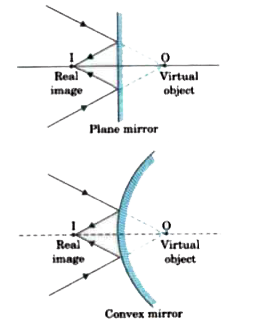
(a) Real images can be produced by plane and convex mirrors. When the rays that are converging to a point behind a plane or convex mirror are reflected to a point in front of the mirror on the screen, the image formed will be real. This is the case of a virtual object. In case of convex mirror if the converging rays tend to converge at focus or beyond focus then they will not be able to form the real image after reflection.

(b) Virtual image is formed when the reflected or refracted rays are divergent. The divergent rays can be converged on to a point with the help of an appropriate converging lens. The convex lens of the eye serves the same purpose. The virtual image here serves as an object for the lens to produce a real image on the retina. Hence, there is no contradiction.
(c) The rays starting from the head of the fisherman and incident on water become bent towards normal and appear to come from a higher point. So fisherman looks taller.
(d) The apparent depth of tank when viewed obliquely decreases from its value for near- normal viewing. This is due to the phenomenon of refraction of light.
(e) Refractive index of diamond is about 2.42, that is much larger than that of ordinary glass for which refractive index is about 1.5. Using,
`sin i_(c)=(1)/(mu)`
The critical angle for diamond is about `24^(@)`, and that for glass is `42^(@)`. A skilled diamond cutter utilises the large range of angles of incidence in the diamond, from `24^(@)` to `90^(@)`, to ensure that light entering the diamond is totally reflected from many faces before getting out. In this way, light entering the diamond produces a sparkling effect.
Promotional Banner

Topper's Solved these Questions

  • RAY OPTICS AND OPTICAL INSTRUMENTS

    MODERN PUBLICATION|Exercise NCERT (EXemplar Problems Obejective Questions) (Multiple Choice Questions (Type-I)|10 Videos
  • RAY OPTICS AND OPTICAL INSTRUMENTS

    MODERN PUBLICATION|Exercise NCERT (EXemplar Problems Obejective Questions) (Multiple Choice Questions (Type-II)|6 Videos
  • RAY OPTICS AND OPTICAL INSTRUMENTS

    MODERN PUBLICATION|Exercise Tough & Tricky (PROBLEMS)|20 Videos
  • NUCLEI

    MODERN PUBLICATION|Exercise CHAPTER PRACTICE TEST FOR BOARD EXAMINATION|15 Videos
  • SEMICONDUCTOR ELECTRONICS METERIALS DEVICES AND SIMPLE CIRCUITS

    MODERN PUBLICATION|Exercise CHAPTER PRACTICE TEST FOR BOARD EXAMINATION|12 Videos

Similar Questions

Explore conceptually related problems

Answer the following questions : (a) You have learnt that plane and convex mirrors produce virtual images of objects. Can they produce real images under some circumstances ? Explain. (b) A virtual image, we always say, cannot be caught on a screen. Yet when we see a virtual image, we bring it to screen i.e. retine of our eye. Is there a contradiction ? ( c) A diver under water looks obliquely at a fisherman standing on the bank of a lake. Would the fisherman look taller or shorter than what he actually is ? (d) Does the apparent depth of a tank of water change if viewed obliquely ? If so, does the apparent depth increase or decrease ? ( e) The refractive index of diamond is much greater than that of ordinary glass. Is this fact of some use to a diamond cutter ?

How does the density of sea water change with depth?

Answer the following questions. What gives a perception of depth or three dimensional vision to human eye?

In which of the following reaction does the heat change represent the heat of formation of water ?

See Fig. and answer the following question. a. Find apparent height of the bird. b. Find apparent depth of the fish. c. At what distance will the bird appear to the fish ? d. At what distance will the fish appear to the bird?

MODERN PUBLICATION-RAY OPTICS AND OPTICAL INSTRUMENTS-NCERT FILE SOLVED (TEXT BOOK EXERCISES)
  1. A small pin fixed on a table top is viewed from above from a distance ...

    Text Solution

    |

  2. (a) Fig. shows a cross-section of a 'light pipe' made of a glass fibre...

    Text Solution

    |

  3. Answer the following questions : Does the apparent depth of a tank o...

    Text Solution

    |

  4. The image of a small electric bulb fixed on the wall of a room is to b...

    Text Solution

    |

  5. A screen is placed 90 cm from an object. The image of the object on th...

    Text Solution

    |

  6. a) Determine the effective focal length of the combination of the two ...

    Text Solution

    |

  7. At what angle should a ray of light be incident on the face of a prism...

    Text Solution

    |

  8. You are given prism made of crown glass and flint glass with a wide va...

    Text Solution

    |

  9. For a normal eye, the far point is at infinity and the near point of d...

    Text Solution

    |

  10. Does short sightedness (myopia) or long sightedness (hypermetropia) im...

    Text Solution

    |

  11. A myopia person has been using spectacles of power - 1.0 dioptre for d...

    Text Solution

    |

  12. A person looking at a person wearing a shirt with a pattern comprisin...

    Text Solution

    |

  13. A man with normal near point (25 cm) reads a book with small print usi...

    Text Solution

    |

  14. A cardsheet divided into squares each of size 1 mm^(2) is being viewed...

    Text Solution

    |

  15. (i) At what distance should the lens be held from the card sheet in or...

    Text Solution

    |

  16. What should be the distance between the object and magnifying glass i...

    Text Solution

    |

  17. a) The anlge subtended at the eye by an object is equal to the angle s...

    Text Solution

    |

  18. An angular magnification (magnifying power) of 30 X is desired using a...

    Text Solution

    |

  19. A small telescope has an objective lens of focal length 140 cm and an ...

    Text Solution

    |

  20. (a) For the telescope described what is the separation between the obj...

    Text Solution

    |

