Home
Class 12
PHYSICS
In may experimental set-ups the source a...

In may experimental set-ups the source and screen are fixed at a distance say `D` and the lens is movable. Show that there are two positions for the lens for which an image is formed on the screen. Find the distance between these points and the ratio of the image sizes for these two points.

Text Solution

Verified by Experts
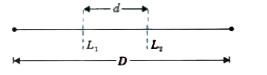
Let object be placed at a diatnce x from the lens then image distance becomes `(D-x)`. We can use lens formula as follows :
`(1)/(v)-(1)/(u)=(1)/(f)`
`rArr" "(1)/(D-x)-(1)/(-x)=(1)/(+f)`
`rArr" "(1)/(D-x)+(1)/(x)=(1)/(f)`
`rArr" "(x+D-x)/(x(D-x))=(1)/(f)`
`rArr" "fD=xD-x^(2)`
`rArr" "x^(2)-Dx+fD=0`
`x=(Dpmsqrt(D^(2)-4fD))/(2)`
Both the roots of x are valid when `D gt 4f`. Hence there are two positions of lens for which image can be formed on screen.
`x_(1)=(D+sqrt(D^(2)-4fD))/(2)`
`x_(2)=(D-sqrt(D^(2)-4fD))/(2)`
Separation between these two locations of lens can be written as :
`d=x_(1)-x_(2)`
`rArr" "d=sqrt(D^(2)-4fD)`

`"When "u=(D)/(2)+(d)/(2)`
`v=(D)/(2)-(d)/(2)`
`"Magnification , m"=(v)/(u)=(D-d)/(D+d)`
`"When "u=(D)/(2)-(d)/(2)`
`"Magnification, m."=(v)/(u)=(D+d)/(D-d)`
`therefore" "(m.)/(m)=((D+d)^(2))/((D-d)^(2))=((D+d)/(D-d))^(2)`
Promotional Banner

Topper's Solved these Questions

  • RAY OPTICS AND OPTICAL INSTRUMENTS

    MODERN PUBLICATION|Exercise Higher Order Thinking Skills & Advanced Level (QUESTIONS WITH ANSWERS)|20 Videos
  • RAY OPTICS AND OPTICAL INSTRUMENTS

    MODERN PUBLICATION|Exercise Revision Exercises (Very Short Answer Questions)|82 Videos
  • RAY OPTICS AND OPTICAL INSTRUMENTS

    MODERN PUBLICATION|Exercise NCERT (EXemplar Problems Obejective Questions) (Multiple Choice Questions (Type-II)|6 Videos
  • NUCLEI

    MODERN PUBLICATION|Exercise CHAPTER PRACTICE TEST FOR BOARD EXAMINATION|15 Videos
  • SEMICONDUCTOR ELECTRONICS METERIALS DEVICES AND SIMPLE CIRCUITS

    MODERN PUBLICATION|Exercise CHAPTER PRACTICE TEST FOR BOARD EXAMINATION|12 Videos

Similar Questions

Explore conceptually related problems

An object and a screen are kept at a distance of 120 cm A lens of focal length 22.5 cm is kept between them so that a real image is formed on the screen Find the possible location (s) of the lens.

A thin converging lens is placed between an object and a screen whose position are fixed. There are two positions of the lens at which the sharp image of the object is formed on the screen. Find the transverse dimension of the object if at one position of the lens the image dimension equal h' = 2.0 mm and at the other, h'' = 4.5 mm .

A thin convergent lens is placed between an object and a screen whose positions are fixed. There are two positions of a lens at which sharp image of the object is formed on the screen. If the size of the images in the two cases are 2 mm and 4.5 mm then the size of the object should be:-

A convex lens forms a real image on a screen placed at a distance 60 cm from the object. When the lens is shifted towards the screen by 20 cm , another image of the object is formed on the screen. The focal length of the lens is :

An object and a screen are placed 80 cm apart. There are two positions at which a convex lens forms a real image on the screen, the magnification in the cases being 3/2 and 2/3. Calculate the focal length of the lens.

The distance between the object and the screen is d (greater than 4 times the focal length of a convex lens). Real images of the object are obtained on the screen for two positions of the lens that are separated by distance x apart. The ratio of size of the images in the two positions of the lens are

A convex lens is placed between an object and a screen which are at a fixed distance apart for one position of the lens. The magnification of the image obtained on the screen is m_(1) . When the lens is moved by a distance d the magnification of the image obtained on the same screen m_(2) , Find the focal length of the lens.

