

Home
Class 12
PHYSICS
A symmetric biconvex lens of radius of c...

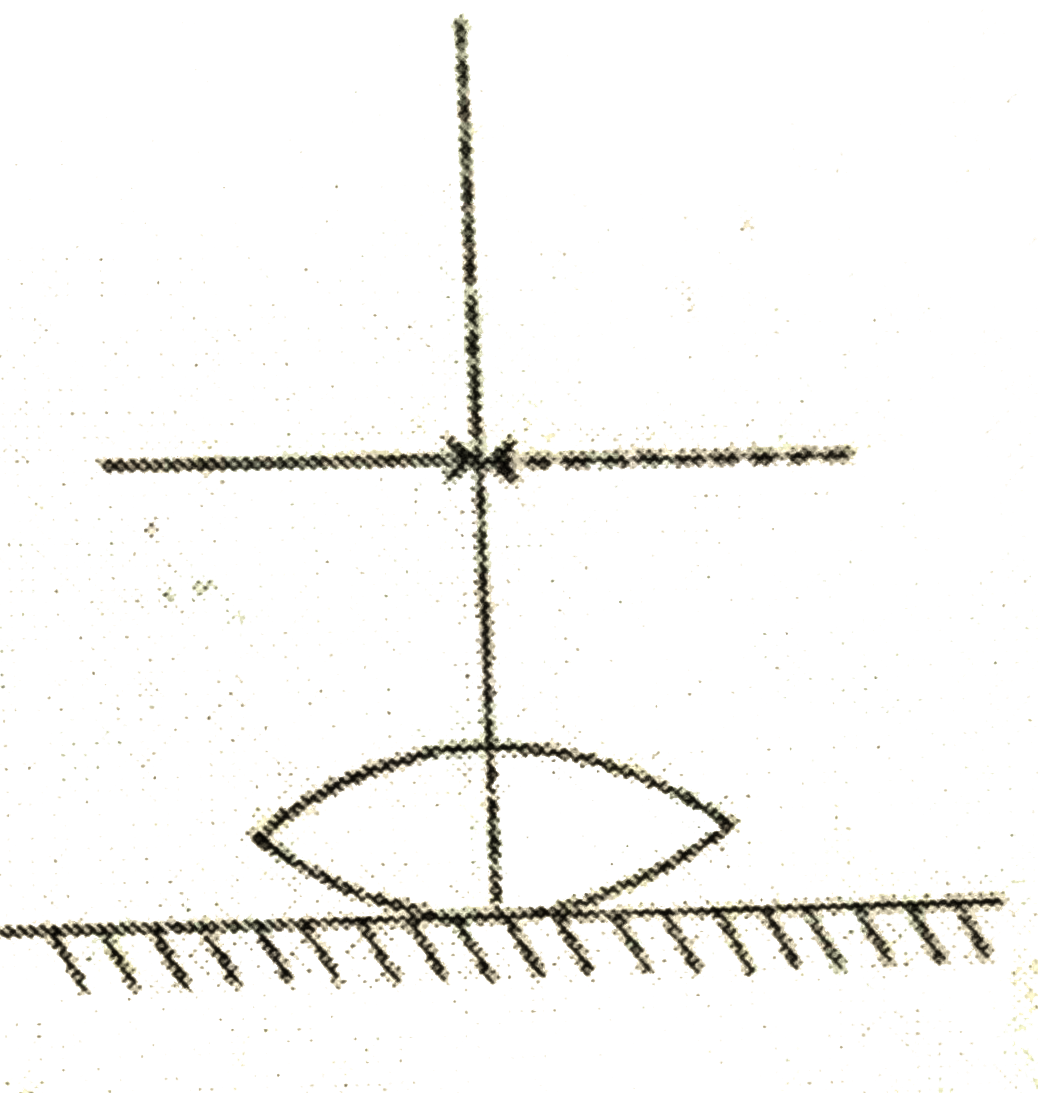
A symmetric biconvex lens of radius of curvature R and made of glass of refractive index 1.5, is placed on a layer of liquid placed on top of a plane mirror as shown in the figure. An optical needle with its tip on the principal axis of the lens is moved along the axis until its real, inverted image coincides with the needle itself. The distance of the needle from the lens is measured to be x. On removing the liquid layer and repeating the experiment, the distance is found to be y. Obtain the expression for the refractive index of the liquid in terms of x and y.

Promotional Banner

Topper's Solved these Questions

  • RAY OPTICS AND OPTICAL INSTRUMENTS

    MODERN PUBLICATION|Exercise Revision Exercises (Long Answer Questions)|20 Videos
  • RAY OPTICS AND OPTICAL INSTRUMENTS

    MODERN PUBLICATION|Exercise Revision Exercises (Numerical Problems)|36 Videos
  • RAY OPTICS AND OPTICAL INSTRUMENTS

    MODERN PUBLICATION|Exercise Revision Exercises (Fill in the Blanks)|10 Videos
  • NUCLEI

    MODERN PUBLICATION|Exercise CHAPTER PRACTICE TEST FOR BOARD EXAMINATION|15 Videos
  • SEMICONDUCTOR ELECTRONICS METERIALS DEVICES AND SIMPLE CIRCUITS

    MODERN PUBLICATION|Exercise CHAPTER PRACTICE TEST FOR BOARD EXAMINATION|12 Videos

Similar Questions

Explore conceptually related problems

A synunetdc bionvex fens of radius of curvature Rand made of glass of refractive index 1.5, is placed on a placed on top of a plane mirror as shown in the figure.An optical needle with with its tip on the principal axis of the lens is moved along the axis until its real, inverted images conicides with the needle itself. The distance from the lens in measured to be x. On removing the liquid layer and repeating the experiment, the distance is found to be y . Obtain the expression for the refractive index of the liquid in terms of x and y.

An equiconvex lens with radii of curvature of magnitude R each is put over a liquid layer poured on top of a plane mirror. A small needle, with its tip on the principal axis of the lens, is moved along the axis until its inverted real image coincides with the needle itself. The distance of the needle from the lens is measured to be 'a'. On removing the liquid layer and repeating the experiment the distance is found to be 'b'. Given that the two values of distances measured represent the focal length values in the two cases, obtain a formula for the refractive index of the liquid.

Fig. shows an equiconvex lens (of refractive index 1.5 ) in contact with a liquid layer on top of a plane mirror. A small needle with its tip on the principal axis is moved along the axis until its inverted image is found at the position of the needle. The distance of the needle from the lens is measured to be 45.0 cm . The liquid is removed and the experiment is repeated. The new distance is measured to be 30.0 cm . What is the refractive index of the liquid ?

MODERN PUBLICATION-RAY OPTICS AND OPTICAL INSTRUMENTS-Revision Exercises (Short Answer Questions)
  1. Explain the term critical angle for a pair of media. Derive a relation...

    Text Solution

    |

  2. State the conditions under which total internal reflection occurs. One...

    Text Solution

    |

  3. A symmetric biconvex lens of radius of curvature R and made of glass o...

    Text Solution

    |

  4. Obtain an expression for focal length of a combination of thin lenses ...

    Text Solution

    |

  5. Two convex lenses of same focal length but of paerture A(1) and A(2)(A...

    Text Solution

    |

  6. Draw the schematic diagram of a Cassegrain telescope.

    Text Solution

    |

  7. Deduce the equivalent focal length of two convex lenses of focal lengt...

    Text Solution

    |

  8. An equiconvex lens of refractive index mu(1), focal length 'f' and ra...

    Text Solution

    |

  9. The image of a candle is formed by a convex lens on a screen. The lowe...

    Text Solution

    |

  10. A figure divided into squares, each of size 1.0 mm^2 is being viewed a...

    Text Solution

    |

  11. Two monochromatic rays of light are incident normally on the face AB o...

    Text Solution

    |

  12. Obtain an expression for the combined focal length for two thin convex...

    Text Solution

    |

  13. लेंस समीकरण (1)/(v) -(1)/(u) =(1)/(f) की सहायता से दर्शाइए कि अवतल ल...

    Text Solution

    |

  14. A ray of light falling at an angle of 50^@ is refracted through a pris...

    Text Solution

    |

  15. How does angle of deviation vary with the angle of incidence in case o...

    Text Solution

    |

  16. Sky appears blue in colour. Explain.

    Text Solution

    |

  17. Why does the sun appear red at sunset ?

    Text Solution

    |

  18. Why does the Sun visible before the actual sunrise and sunset look red...

    Text Solution

    |

  19. Why is there no dispersion of light refracted through a rectangular gl...

    Text Solution

    |

  20. Eye is more sensitive to yellow colour but danger signals are made wit...

    Text Solution

    |