Home
Class 12
PHYSICS
Two monochromatic rays of light are inci...

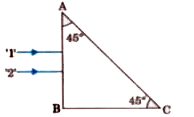
Two monochromatic rays of light are incident normally on the face AB of an isosceles right angled prism ABC. The refractive indices of the glass prism for the two rays '1' and '2' are respectively 1.35 and 1.45. Trace the path of these rays after entering through the prism.

Text Solution

Verified by Experts
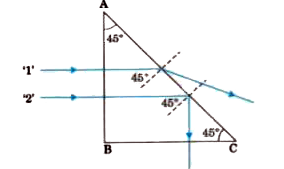
The critical angle for ray 1 is
`n=(1)/(sinc_(1))`
`sin c_(1)=(1)/(1.35)=0.741`
`"Therefore, "c_(1)=47.8^(@)`
`n=(1)/(sin c_(2)) or sin c_(2)=(1)/(1.45)`
`=0.6896`

The two rays will fall at an angle of incidence `45^(@)` at the face AC.
For ray .2. the angle of incidence is greater than the critical angle `43.6^(@)`. Hence it suffers total internal reflection, while ray .1. doen not. Hence the path of rays is as shown in the figure.
Promotional Banner

Topper's Solved these Questions

  • RAY OPTICS AND OPTICAL INSTRUMENTS

    MODERN PUBLICATION|Exercise Revision Exercises (Long Answer Questions)|20 Videos
  • RAY OPTICS AND OPTICAL INSTRUMENTS

    MODERN PUBLICATION|Exercise Revision Exercises (Numerical Problems)|36 Videos
  • RAY OPTICS AND OPTICAL INSTRUMENTS

    MODERN PUBLICATION|Exercise Revision Exercises (Fill in the Blanks)|10 Videos
  • NUCLEI

    MODERN PUBLICATION|Exercise CHAPTER PRACTICE TEST FOR BOARD EXAMINATION|15 Videos
  • SEMICONDUCTOR ELECTRONICS METERIALS DEVICES AND SIMPLE CIRCUITS

    MODERN PUBLICATION|Exercise CHAPTER PRACTICE TEST FOR BOARD EXAMINATION|12 Videos

Similar Questions

Explore conceptually related problems

Two monochromatic rays of light are incident normally on the face AB of an isosceles right-angled prism ABC . The refractive indices of the glass prism for the two rays '1' and '2' are respectively 1.38 and 1.52 . Trace the path of these rays after entering through the prism.

Two monochromatic ray of light are incident normally on the face AB of an isosceles right - angled 'I' and '2' are respectively 1.35 and 1.45. Trace path of these rays after entering through the prism.

A ray of light is incident normally on one face of a right-angled isosceles prism and then it grazes the hypotenuse. The refractive index of the material of the prism is

A ray of light incident normally on an isosceles right angled prism travels as shown in the figure. The least value of the refractive index of the prism must be

When a ray of light is incident normally on one refracting surface of an equilateral prism (Refractive index of the material of the prism =1.5

A ray of light is incident normally on one of the faces of a prism of apex angle 30^(@) and refractive index sqrt(2) . The angle of deviation through prism is

A light ray is incident normally on the face AB of a right-angled prism ABC (mu==1.50) as shown in figure. What is the largest angle phi for which the light ray is totally reflected at the surface AC ?

A ray of light is incident normally on one of the faces of a prism of apex angle 30 degree and refractive index sqrt2. The angle of deviation of the ray is…degrees.

MODERN PUBLICATION-RAY OPTICS AND OPTICAL INSTRUMENTS-Revision Exercises (Short Answer Questions)
  1. The image of a candle is formed by a convex lens on a screen. The lowe...

    Text Solution

    |

  2. A figure divided into squares, each of size 1.0 mm^2 is being viewed a...

    Text Solution

    |

  3. Two monochromatic rays of light are incident normally on the face AB o...

    Text Solution

    |

  4. Obtain an expression for the combined focal length for two thin convex...

    Text Solution

    |

  5. लेंस समीकरण (1)/(v) -(1)/(u) =(1)/(f) की सहायता से दर्शाइए कि अवतल ल...

    Text Solution

    |

  6. A ray of light falling at an angle of 50^@ is refracted through a pris...

    Text Solution

    |

  7. How does angle of deviation vary with the angle of incidence in case o...

    Text Solution

    |

  8. Sky appears blue in colour. Explain.

    Text Solution

    |

  9. Why does the sun appear red at sunset ?

    Text Solution

    |

  10. Why does the Sun visible before the actual sunrise and sunset look red...

    Text Solution

    |

  11. Why is there no dispersion of light refracted through a rectangular gl...

    Text Solution

    |

  12. Eye is more sensitive to yellow colour but danger signals are made wit...

    Text Solution

    |

  13. A convex lens of focal length 20 cm and a concave lens of focal length...

    Text Solution

    |

  14. What is hypermetropia (far-sightedness) ? What are its causes ? How ca...

    Text Solution

    |

  15. Calculate the radius of the curvature an equi-concave lens refrective ...

    Text Solution

    |

  16. An equilateral glass prism has a refrective index 1.6 in air. Calculat...

    Text Solution

    |

  17. What is astigmatism ? How can it be removed ?

    Text Solution

    |

  18. Draw a ray diagram for the formation of image by a compound microscope...

    Text Solution

    |

  19. Objective of a compound microscope should have small focal length. Why...

    Text Solution

    |

  20. Draw a schematic ray diagram of reflecting telescope showing how...

    Text Solution

    |

