Home
Class 12
PHYSICS
Three light rays red (R), green (G) and ...

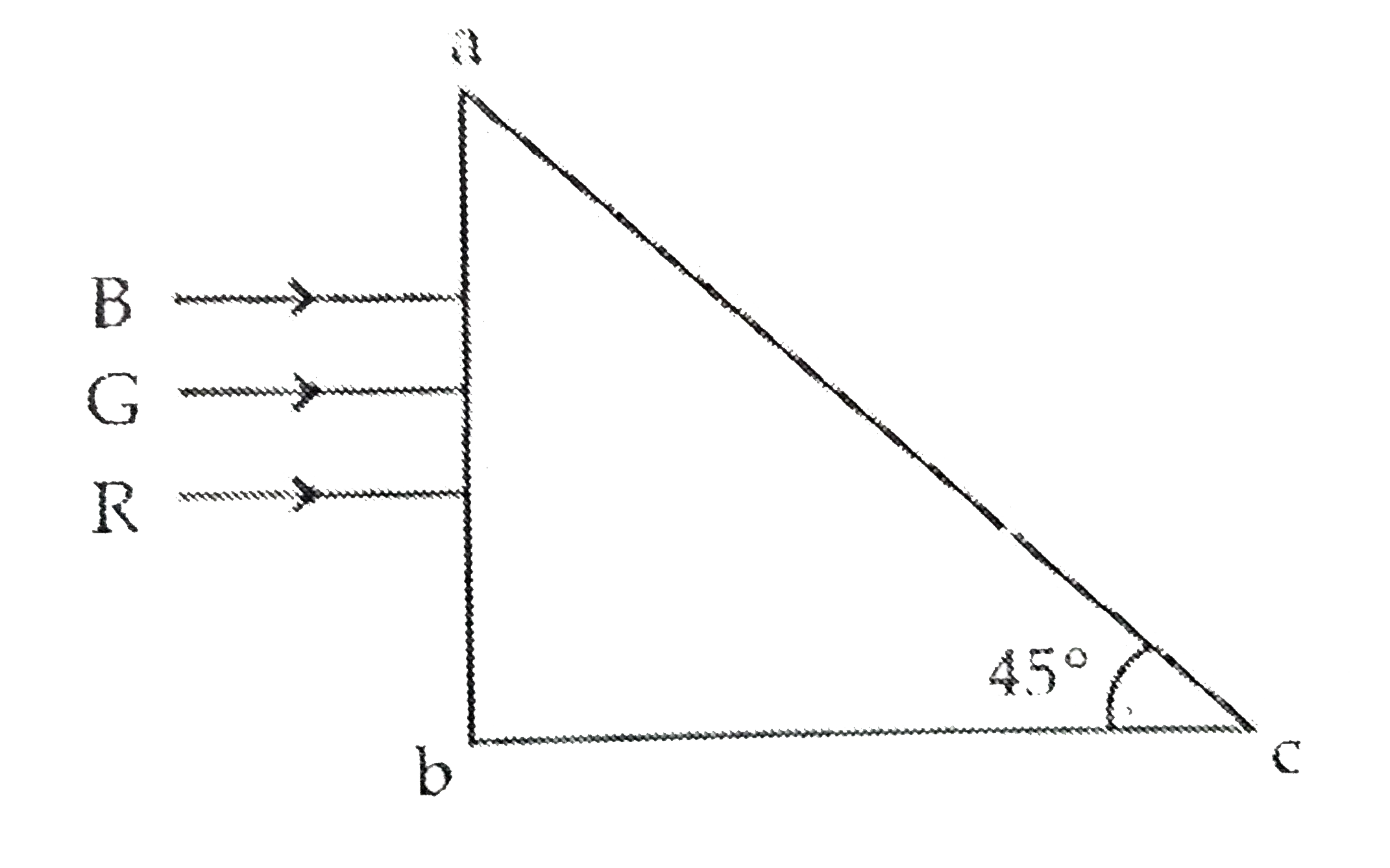
Three light rays red (R), green (G) and blue (B) are incident on a right angled prism 'abc' at face 'ab'. The refractive indices of the material of the prism for red, green and blue wavelengths are 1.39 , 1.44 and 1.47 respectively. Out of the time three which colour ray will emerge out of face 'ac' ? Justify your answer. Trace the path of these rays after passing through face 'ab'

Text Solution

Verified by Experts
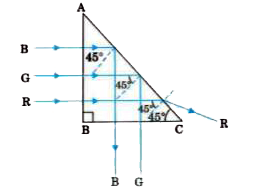
As `mu=(1)/(sinC),C=sin^(-1)((1)/(mu))`
`"Critical angle for red rays, "=C_(R)=sin^(-1)((1)/(1.39))=46^(@)`
`"Critical angle for green rays"=C_(G)=sin^(-1)((1)/(1.44))=44^(@)`
`"Critical angle for blue rays "=C_(B)=sin^(-1)((1)/(1.47))=42^(@)52.`
As the red, green and blue rays fall at an angle of `45^(@)` on the face AC.
For green and blue rays fall at an angle of `45^(@)` on the face AC.
For green and blue rays, incident angle is greater than the critical angle. Hence, the rays undergo total internal reflection. But in case of red rays, incident angle is smaller than the critical angle the hence, the rays are refracted as shown in figure.
Promotional Banner

Topper's Solved these Questions

  • RAY OPTICS AND OPTICAL INSTRUMENTS

    MODERN PUBLICATION|Exercise OBJECTIVE TYPE QUESTIONS (A. MULTIPLE CHOICE QUESTIONS)|40 Videos
  • RAY OPTICS AND OPTICAL INSTRUMENTS

    MODERN PUBLICATION|Exercise OBJECTIVE TYPE QUESTIONS (B. MULTIPLE CHOICE QUESTIONS)|21 Videos
  • RAY OPTICS AND OPTICAL INSTRUMENTS

    MODERN PUBLICATION|Exercise Revision Exercises (Long Answer Questions)|20 Videos
  • NUCLEI

    MODERN PUBLICATION|Exercise CHAPTER PRACTICE TEST FOR BOARD EXAMINATION|15 Videos
  • SEMICONDUCTOR ELECTRONICS METERIALS DEVICES AND SIMPLE CIRCUITS

    MODERN PUBLICATION|Exercise CHAPTER PRACTICE TEST FOR BOARD EXAMINATION|12 Videos

Similar Questions

Explore conceptually related problems

A beam of light consisting of red, green and blue colours is incident on a right angled prism. The refractive index of the material of the prism for the above red, green and blue wavelengths are 1.39, 1.44 and 1.47, respectively.

A beam of light consisting of red, green and blue colours is incident on right angled prism. The refractive indices of the material of the prism for the above red, green and blue wavelengths are 1.39,1.44 and 1.47 respectively. The prism will. .

A beam of light consisting of red, green, and blue colors is incident on a right-angled prism. The refractive indices of the material of the prism for the above red, green and blue wavelengths are 1.39, 1.44 and 1.47, repectively. The prism will

Three rays of light, namely red (R), green (G) and blue (B) are incident on the face PQ of a right angled prism PQR as showns in the figure. The refractive indices of the material of the prism for red green and blue wavelength are 1.27, 1.42 and 1.49 respectively. The colour of the ray(s) emerging out of the face PR is:

Figure shows a mixture of blue, green and red coloured rays incident normally on a right angled prism. The critical angles of the material of the prism for red, green and blue are 46^@ , 44^@ and 43^@ respectively. The arrangement will separate

The refractive indices of material of a prism for blue and red colours are 1.532 and 1.514 respectively. Calculate angular dispersion produced by the prism if angle of prism is 8^(@)

A ray of light is incident normally on one face of a right-angled isosceles prism and then it grazes the hypotenuse. The refractive index of the material of the prism is

In Fig. 6(b).80, light rays of blue, green and red wavelength are incident on an isoscels right angled prism. Explain with reason which ray of light will be transmitted through the face AC . The refractive index of the prism for red, green and blue light are 1.39, 1.424 and 1.476 respectively.

MODERN PUBLICATION-RAY OPTICS AND OPTICAL INSTRUMENTS-Revision Exercises (Numerical Problems)
  1. A beam of light converges to a point P. A lens is placed in the path o...

    Text Solution

    |

  2. A concave lens is kept in contact with convex lens of focal length 20 ...

    Text Solution

    |

  3. A convex lens of refractive index 1.5 has a focal length of 18 cm in a...

    Text Solution

    |

  4. A convex lens of power +5 D is placed in contact with a concave lens o...

    Text Solution

    |

  5. Two identical equiconvex lenses of refractive index 3//2 and focal len...

    Text Solution

    |

  6. A prism of refractive index 1.53 is placed in water of refractive inde...

    Text Solution

    |

  7. A thin prism of 2^(@) angle gives a deviation of 1^(@). What is the va...

    Text Solution

    |

  8. A ray of light passes through an equilateral prism in such a way that ...

    Text Solution

    |

  9. Three light rays red (R), green (G) and blue (B) are incident on a rig...

    Text Solution

    |

  10. For a glass (mu= sqrt(3) ) the angle of minimum deviation is equal to...

    Text Solution

    |

  11. Calculate the speed of light in the prism if a ray of light is passing...

    Text Solution

    |

  12. A ray PQ is incident normally on the face AB of a triangular prism of ...

    Text Solution

    |

  13. Calculate the angle of minimum deviation for an equilateral triangular...

    Text Solution

    |

  14. What will be the refractive index for yellow colour if the refractive ...

    Text Solution

    |

  15. Calculate the dispersive power of flint glass if deviations produced b...

    Text Solution

    |

  16. The far point of a person having myopia is 200 cm in front of the eye....

    Text Solution

    |

  17. The near point of a person having hypermetropia is 60 cm in front of t...

    Text Solution

    |

  18. Being myopic, the far point for the left eye of a person has shifted t...

    Text Solution

    |

  19. For a normal relaxed eye, a simple microscope is rated as 3X. What wil...

    Text Solution

    |

  20. If a convex lens of focal length 20 cm is held close to the eye of obs...

    Text Solution

    |

