Home
Class 12
PHYSICS
A converging lens forms a real image I o...

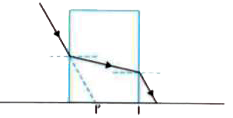
A converging lens forms a real image `I` on its optic axis. A rectangular galss slab of refractive index `mu` and thickness `t` is introduced between the lens and `I`. `I` will move

A

towards the lens by `t(1-(1)/(mu))`

B

away from the lens by `t(1-(1)/(mu))`

C

towards the lens by `t(mu - 1)`

D

away from the lens by `t(mu - 1)`

Text Solution

Verified by Experts

The correct Answer is:
B

Shift due to glass slab is given by `t(1-(1)/(mu))` and for the directed refer ray diagram.

From ray diagram we can see that new location of I is shifted further away from lens on its principal axis.
Promotional Banner

Topper's Solved these Questions

  • RAY OPTICS AND OPTICAL INSTRUMENTS

    MODERN PUBLICATION|Exercise OBJECTIVE TYPE QUESTIONS (B. MULTIPLE CHOICE QUESTIONS)|21 Videos
  • RAY OPTICS AND OPTICAL INSTRUMENTS

    MODERN PUBLICATION|Exercise OBJECTIVE TYPE QUESTIONS (JEE (MAIN) & OTHER STATE BOARDS FOR ENGINEERING ENTRANCE)|40 Videos
  • RAY OPTICS AND OPTICAL INSTRUMENTS

    MODERN PUBLICATION|Exercise Revision Exercises (Numerical Problems)|36 Videos
  • NUCLEI

    MODERN PUBLICATION|Exercise CHAPTER PRACTICE TEST FOR BOARD EXAMINATION|15 Videos
  • SEMICONDUCTOR ELECTRONICS METERIALS DEVICES AND SIMPLE CIRCUITS

    MODERN PUBLICATION|Exercise CHAPTER PRACTICE TEST FOR BOARD EXAMINATION|12 Videos

Similar Questions

Explore conceptually related problems

A point object O is placed at a distance of 41 cm from a convex lens of focal length f = 20 cm on its principal axis. A glass slab of thickness 3 cm and refractive index mu = 1.5 is placed between the lens and the object with its faces perpendicular to the principal axis of the lens. Image of the object is formed at point I_(1) . Now the glass slab is tilted by an angle of theta = 1° (as shown in the Figure) and the final image is formed at I_(2) . Calculate the distance between points I_(1) and I_(2) . Consider only paraxial rays for the lens and near normal incidence for the glass slab.

P is a point on the axis of a concave mirror. The image of P, formed by the mirror, coincides with P. A rectangular glass slab of thickness t and refractive index mu is now introduced between P and the mirror. For the image of P to coincide with P again, the mirror must be moved

An object 240 cm in front of a lens forms a sharp image on a screen 12 cm behind the lens. A glass slab 1 cm thick, having refractive index 1.50 is placed between the lens and the screen with its refracting faces perpendicular to the principal axis of the lens. (a) By how much distance the object must be moved so as to again cast a sharp image on the screen? (b) Another identical glass slab is interposed between the object and the lens. How much further the object shall be moved so as to form a sharp image on the screen.

A parallel beam of light is incident on a lens of focal length 10 cm. A parallel slab of refractive index 1.5 and thickness 3 cm is placed on the other side of the lens. Find the distance of the final image from the lens. .

A parallel beam of light is incident on a lens of focal length 10cm. A parallel slab of refractive index 1.5 and thickness 3 cm is placed on the other side of the lens. The nature of the final image from the lens slab combination is: (Assume rays paraxial)

A point object is placed at a distance of 25cm from a convex lens. Its focal length is 22cm. A glass slab of refractive index 1.5 is inserted between the lens and the object, then the image is formed at infinity. Find the thickness of the glass slab (in cm).

A convex lens form a real image of a point object placed on its principal axis. If the upper half of the lens is painted black, the image will

Rays from a lens are converging toward a point P, a shown in Figure. How much thick glass plate having refractive index 1.6 must be located between the lens and point P, so that the image will be formed at P^(') ?

A convex forms a real image of a poinnt object placed on its principal axis. If the upper half of the lens is painted black

A point object is placed at a distance of 25cm from a convex lens of focal length 20cm .If a glass slab of thickness t and refractive index 1.5 is inserted between the lens and object.The image is formed at infinity .Find the thickness?

MODERN PUBLICATION-RAY OPTICS AND OPTICAL INSTRUMENTS-OBJECTIVE TYPE QUESTIONS (A. MULTIPLE CHOICE QUESTIONS)
  1. The image formed by a convex lens

    Text Solution

    |

  2. A medium of refractive index mu is separated from air using a plane su...

    Text Solution

    |

  3. A converging lens forms a real image I on its optic axis. A rectangula...

    Text Solution

    |

  4. Find the focal length of plano-convex lens of material having refracti...

    Text Solution

    |

  5. A piece of glass is not visible in a colourless transparent liquid. It...

    Text Solution

    |

  6. There is a sphere of radius R and refractive index mu. At what distanc...

    Text Solution

    |

  7. Which of the following depend on whether rays are paraxial or not for ...

    Text Solution

    |

  8. Screen is placed at a distance 60 cm from an object. A convex lens of ...

    Text Solution

    |

  9. An air bubble inside water. The refractive index of water is 4/3 . At ...

    Text Solution

    |

  10. An object is kept at a distance 20 cm from a convex mirror of focal le...

    Text Solution

    |

  11. A point source of light is kept on the surface of a sphere and it is f...

    Text Solution

    |

  12. Two concave lenses are kept in contact and magnitude of equivalent foc...

    Text Solution

    |

  13. Focal length of a double convex lens is 20 cm in air. If this lens is ...

    Text Solution

    |

  14. A thin lens is made of glass of refractive index 1.6. Both the surface...

    Text Solution

    |

  15. Two thin concave lenses of focal lengths 10 cm and 30 cm and a thin co...

    Text Solution

    |

  16. There is a convex lens of focal length 20 cm and a point object is pla...

    Text Solution

    |

  17. A very small object of length a is kept along the axis of a concave mi...

    Text Solution

    |

  18. There is symmetric bi-convex lens and it is cut in two pieces by a pla...

    Text Solution

    |

  19. There is a symmetric bi-convex lens and it is cut in two equal parts b...

    Text Solution

    |

  20. There is an equilateral prism of material of refractive index 1.5. Lig...

    Text Solution

    |

