Home
Class 12
PHYSICS
Consider a concave mirror and a convex l...

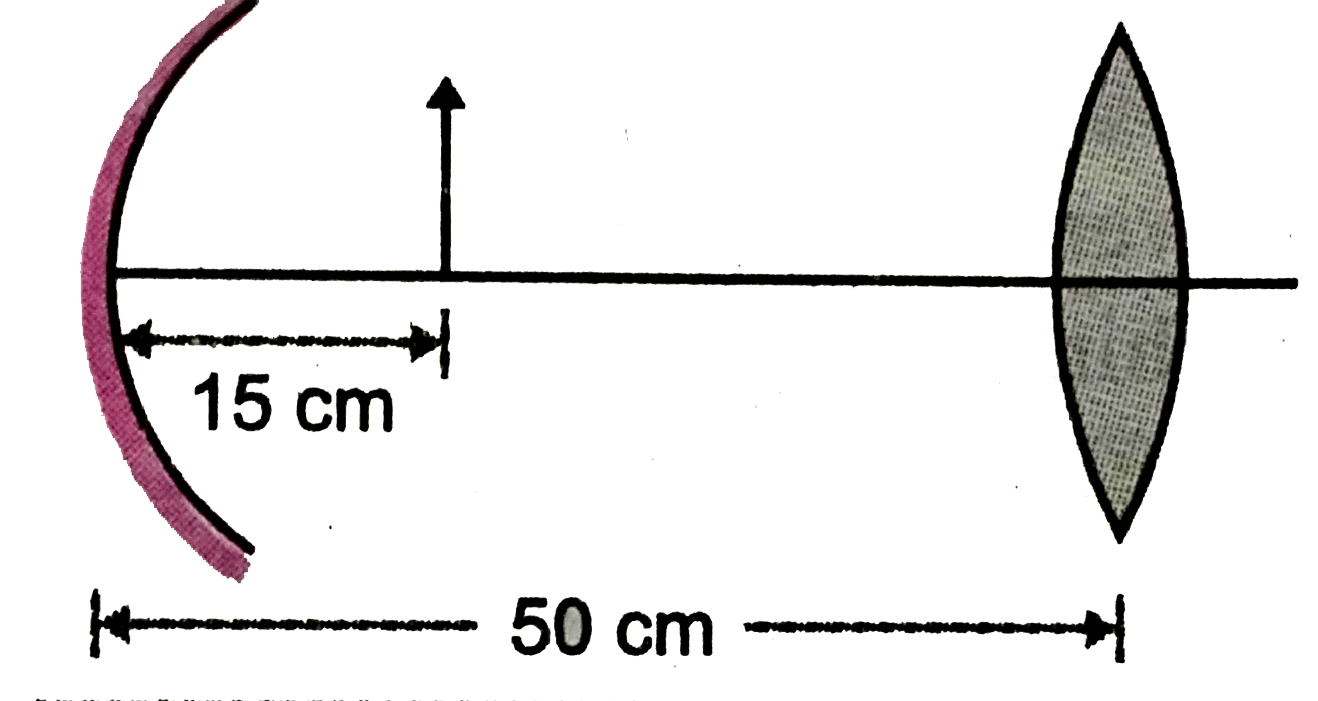
Consider a concave mirror and a convex lens (refractive index 1.5) of focal length `10 cm` each separated by a distance of `50 cm` in air (refractive index = 1) as shown in the Fig. An object is placed at a distance of `15 cm` from the mirror. Its erect image formed by this combination has magnification `M_1`. When this set up is kept in a medium of refractive index `7//6`, the magnification becomes `M_2`. The magnitude `((M_2)/(M_1))` is :
.

Text Solution

Verified by Experts

The correct Answer is:

7

First we can apply mirror formula to find the location of image formed by mirror and this location is independent of surrounding material medium. So it will remain same in both the cases.
`(1)/(f) = (1)/(v) + (1)/(u) rArr (1)/(-10) = (1)/(v) + (1)/(-15)`
`rArr (1)/(v) = (1)/(15) - (1)/(10) = (2-3)/(30)`
`rArr v = -30 cm`
Hence image by mirror is at a distance 20 cm from the lens.
Applying lens formula in air we get the following :
`(1)/(f) = (1)/(v) - (1)/(u) rArr (1)/(10) = (1)/(v) - (1)/(-20)`
`rArr v = 20 cm`
`m = v//u = -1`
Note that overall magnification is multiplication of magnification produced by lens mirror. But here in both the cases magnification of mirror is same and hence ratio of the magnification achieved by the lens two cases will be the answer.
magnitude of magnification of lens in the first case is `m_(1) = 1`
To the find magnification in the second case we need to first find changed focal length when liquid is there in the surrounding.
`((1)/(10))/((1)/(f)) =((1.5-1)((1)/(R_(1))-(1)/(R_(2))))/(((1.5)/(7//6)-1)((1)/(R_(1))-(1)/(R_(2))))`
On solving we get `f = 3.5//2 cm`.
Applying lens formula we get the following :
`(1)/(f) = (1)/(v) - (1)/(u) rArr (2)/(35) = (1)/(v) - (1)/(20)`
`rArr (1)/(v) = (2)/(35) - (1)/(20) = (8-7)/(140)`
`rArr v = 140 cm`
`m_(2) = v//u = 140//(-20) = -7`
Ratio of the magnitudes of magnification
`M_(2)//M_(1) = (2 xx 7)/(2 xx 1) = 7`
Hence answer is 7.
Promotional Banner

Topper's Solved these Questions

  • RAY OPTICS AND OPTICAL INSTRUMENTS

    MODERN PUBLICATION|Exercise CHAPTER PRACTICE TEST|14 Videos
  • RAY OPTICS AND OPTICAL INSTRUMENTS

    MODERN PUBLICATION|Exercise OBJECTIVE TYPE QUESTIONS (MATRIX MATCH TYPE QUESTIONS)|1 Videos
  • NUCLEI

    MODERN PUBLICATION|Exercise CHAPTER PRACTICE TEST FOR BOARD EXAMINATION|15 Videos
  • SEMICONDUCTOR ELECTRONICS METERIALS DEVICES AND SIMPLE CIRCUITS

    MODERN PUBLICATION|Exercise CHAPTER PRACTICE TEST FOR BOARD EXAMINATION|12 Videos

Similar Questions

Explore conceptually related problems

Focal length of a convex lens of refractive index 1.5 is 2 cm. Focal length of lens when immersed in a liquid of refractive index 1.25 will be

A biconvex lens of refractive index "1.5" has a focal length of "20cm" in air.Its focal length when immersed in a liquid of refractive index "1.6" will be:

A thin lens of refractive index 1.5 has focal length of 15 cm in air. When the lens is placed is a medium of refractive index (4)/(3), its focal length will become …..cm.

A double convex lens made of glass of refractive index 1.56 has both radii of curvature of magnitude 20 cm . If an object is placed at a distance of 10 cm from this lens, find the position of image formed.

A thin convex lens of refractive index 1.5cm has 20cm focal length in air. If the lens in completely immersed in a liquid of refractive index. 1.6, then its focal length will be

A convex lens of refractive index 1.5 has a focal length of 20 cm in air. Calculate the change in its focal length when it is immersed in water of refractive index 4/3.

An image is formed at a distance of 100 cm from the glass surface with refractive index 1.5, when a point object is placed in the air at a distance of 100 cm from the glass surface. The radius of curvature is of the surface is
