Home
Class 12
CHEMISTRY
Giving plausible explanation for each of...

Giving plausible explanation for each of the following:
i. Cyclohexanone forms cyanohydrin good yield but 2,2,6-trimethylcyclohexanone does not.
ii. There are two `(-NH_(2))` groups in semicarbazide. However, only one is involved in the formation of semicarbazones.
iii. During the preparation of esters from a carboxylic acid and an alcohol in the easter should be removed as soon as it is formed.

Text Solution

Verified by Experts
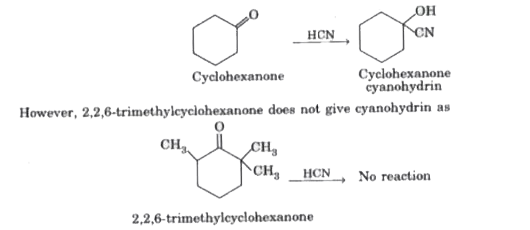
(i) cyclohexanone forms cyanohydrin in in good yield

this is because of the presence of three methy l group at ` alpha ` - position with respect to carbonyl group which hinder the nucleophlic attack of `CN^(-)` group due to steric hindrance . However , there is no such steric hindrance in cyclohexanone and therefore the nucleophilic attack by `CN^(-)` ion occurs readily to fiorm cyanohydrin .
(ii ) semicarbozide has two `-NH_2` group but one of these which is directly attached to`c=o` is involved in resonance as shown below :

As a result of resonance , electron density on `NH_2` group decrease and hence it does not act as a nucleophile . in contrast the lone pair of electrons on the `NH_2` group ( i.e, attached to NH ) is not involved in resonance and is therefore ,available for nucleophilic attack on the C=O group of the aldehydes and ketons
(iii ) The formation of esters from carboxylic acid and an alcohol in the presence of an acid cataylst is a reversible reaction
` underset("Carboxylic acid ") (RCOOH ) + underset(" alcohol ") ( R.OH overset(H^+) hArr underset("Ester ")RCOOR. ) +H_2 O`
therefore to shift the equilibrium in the forward direction the water of formed should be removed as fast as it is formed .
Promotional Banner

Topper's Solved these Questions

  • ALDEHYDES ,KETONES AND CARBOXYLIC ACIDS

    MODERN PUBLICATION|Exercise NCERT FILE (NCERT EXEMPLAR PROBLEMS ) (MULTIPLE CHOICE QUESTIONS ( TYPE -I)|12 Videos
  • ALDEHYDES ,KETONES AND CARBOXYLIC ACIDS

    MODERN PUBLICATION|Exercise NCERT FILE (NCERT EXEMPLAR PROBLEMS ) (MULTIPLE CHOICE QUESTIONS ( TYPE -II)|6 Videos
  • ALDEHYDES ,KETONES AND CARBOXYLIC ACIDS

    MODERN PUBLICATION|Exercise NCERT FILE (NCERT IN TEXT QUESTIONS )|8 Videos
  • ALCOHOLS, PHENOLS AND ETHERS

    MODERN PUBLICATION|Exercise UNIT PRACTICE TEST (FOR BOARD EXAMINATION)|12 Videos
  • BIOMOLECULES

    MODERN PUBLICATION|Exercise UNIT PRACTICE TEST FOR BOARD EXAMINATION|13 Videos

Similar Questions

Explore conceptually related problems

(a) Give a plausible expianation for each one of the following : - (i) There are two - NH_(2) groupsin semicarbazide. However, only one such group is involvedin the formation of semicarbazones. (ii) Cyclohexanone forms cyanohydrin in good yield but 2,4,6 -trimethylcyclohexanone does not. (b) An organic compound with molecular formula C_(9)H_(10)O forms, 2,4 - DNP derivative, reduces Tollens' reagent and undergoes Cannizzaro reaction. On vigorous oxidation it gives 1,2-benzene-di-carboxylic acid. Identify the compound.

Three isomeric tetracarboxylic acids (I),(II) , and (III) are given. They can be distinguised by anhydride formation by treating with one equivalent and two equivalents of SOCl_2 . Which tetracarboxylic acid on reaction with one equivalent of SOCl_2 gives only one monoaanhydride ?

Statement. It is reported that during the last fortnight there has been three cases of near-miss situation involving two aircrafts over the busy city airport. In all these cases, both the aircraft came perilously close to each other and could avoid collision as the pilots acted just in time. Assuming the above statement to be true which of the following course of action will follow. Courses of action : I. The pilots of all the six aircraft involved in these incidents should be de-rostered immediately. II. Some flights should be diverted to other airports for the next few months to decongest the sky over the city airport. III. Air traffic controllers of the city airport should be sent for refresher courses in batches to prepare themselves to handle such a pressure situation. 1) Only I follows 2) Only II follows 3) Only III follows 4) Only II and III follow

A carboxylic acid C_(2)H_(4)O_(2) reacts with an alcohol in the presence of H_(2)SO_(4) to form a compound 'X'. The alcohol on oxidation with alkaline KMnO_(4) gives the same carboxylic acid, C_(2)H_(4)O_(2) . Write the name and structure of (i) Carboxylic acid, (ii) alcohol and (iii) the compound 'X'.

Read the passage given below and answer the following questions: Aldehydes, ketones and carboxylic acids are few of the major classes of organic compounds containing carbonyl group. Aldehydes are prepared by dehydrogenation or controlled oxidation of primary alcohols and controlled or selective reduction of acyl halides. Ketones are prepared by oxidation of secondary alcohols and hydration of alkynes. Carboxylic acids are prepared by the oxidation of primary alcohols, aldehydes and alkenes by hydrolysis of nitriles and by treatment of Grignard reagents with carbon dioxide. Name the main compounds A and B formed in the following reaction: CH_3CN underset((ii) H_2O^(+) ) overset( (i) CH_3MgBr) to A overset( Zn( Hg) //conc. HCl) to B

MODERN PUBLICATION-ALDEHYDES ,KETONES AND CARBOXYLIC ACIDS-NCERT FILE (NCERT TEXTBOOK EXERCISES )
  1. What is meant by the following terms ? Give an example of the reaction...

    Text Solution

    |

  2. Name the following compounds according to IUPAC system of nomoen...

    Text Solution

    |

  3. Draw the structures of following compound: i. 3-Methylbutanal ii. ...

    Text Solution

    |

  4. Write the IUPAC names of the ketons and aldehydes wherever poss...

    Text Solution

    |

  5. Draw the structure of following derivatives: i. 2,4-Dinitrophylhydra...

    Text Solution

    |

  6. Predict the product formed when cyclohexanecarbaldehyde reacts wi...

    Text Solution

    |

  7. Which of the following compounds would undergo aldol condensation or t...

    Text Solution

    |

  8. How will you convert ethnal into the following compounds ? i. Butane...

    Text Solution

    |

  9. Write structure formulae and names of four possible aldol condensation...

    Text Solution

    |

  10. An organic compound with the molecular folmula C(9)H(10)O form 2,4-DNP...

    Text Solution

    |

  11. An organic compound (A) (molecular formula C(8)H(16)O(2)) was hydrolys...

    Text Solution

    |

  12. Arrange the following compounds in the increasing order of their prope...

    Text Solution

    |

  13. Give simple chemical test to distinguish between the following pairs o...

    Text Solution

    |

  14. How will you prapare the following compounds from benzene ? You may us...

    Text Solution

    |

  15. How will you bring about the following conversions in not more than tw...

    Text Solution

    |

  16. Describe the following i. Acetylation ii. Cannizzaro reaction i...

    Text Solution

    |

  17. complete each synthesis by giving missing starting material , r...

    Text Solution

    |

  18. Giving plausible explanation for each of the following: i. Cyclohexa...

    Text Solution

    |

  19. An organic compound contains 69.77% carbon, 11.63% hydrogen, and rest ...

    Text Solution

    |

  20. Although phenoxide ion has more number of resonating structures than c...

    Text Solution

    |


