

Home
Class 11
PHYSICS
Two masses A and B of mass M and 2M resp...

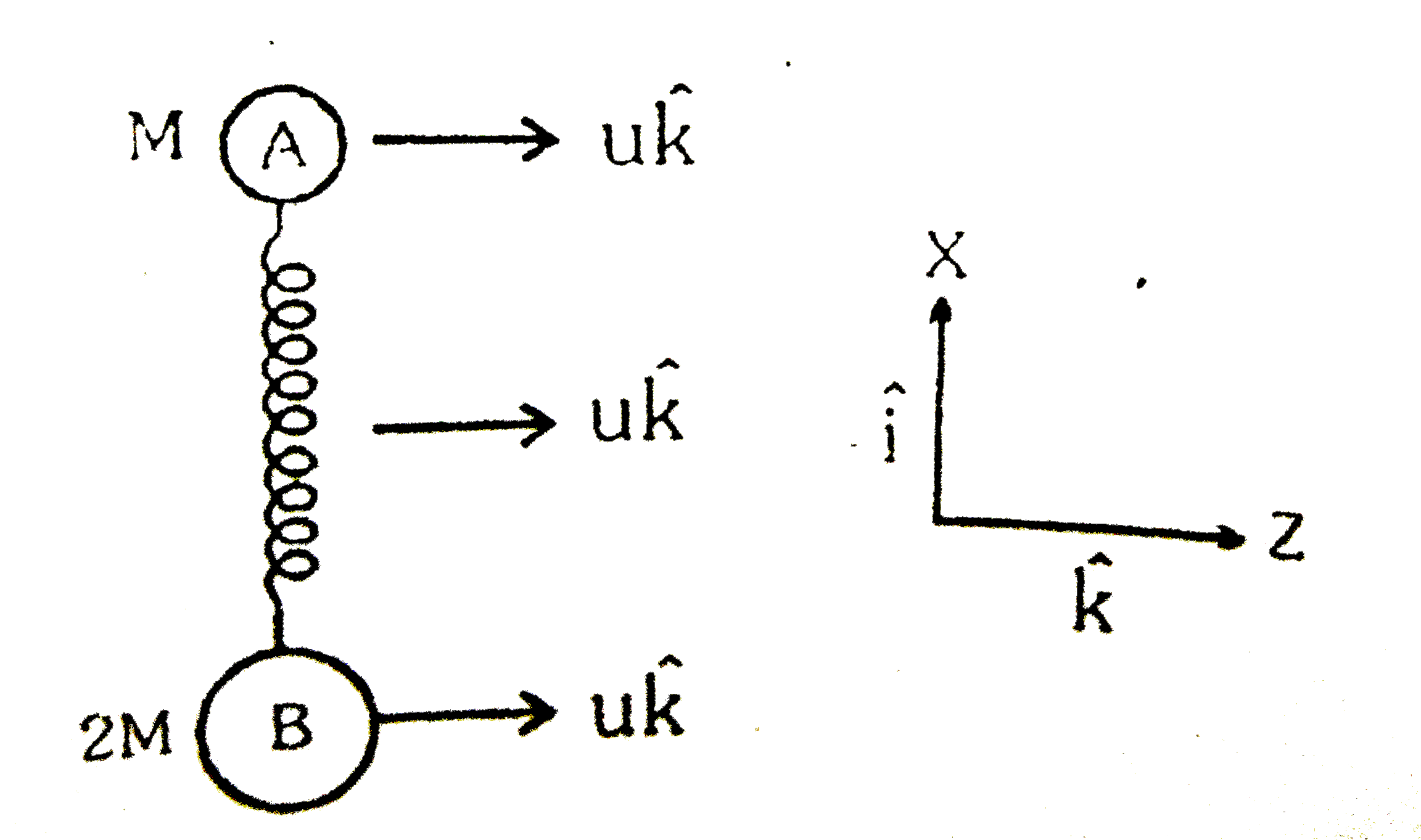
Two masses A and B of mass M and `2M` respectively are connected by a compressed ideal spring. The system in placed on a horizontal frictionless table and given a velocity `uhat(k)` in the z-direction as shown in the figure. The spring is then released. In the subsequent motion the line from B to A alwyas points along the `hat(i)` unit vector. All some instant of time mass B has a x-component of velocity as `v_(x)hat(i)`. The velocity `vec(v)_(A)` of mass A at that instant is :-

Promotional Banner

Similar Questions

Explore conceptually related problems

Two blocks A and B of the same mass are connected to a light spring and placed on a smooth horizontal surface B is given velocity v_(0) (as shown in the figure) when the spring is in natural length. In the subsequent motion.

Two rectangular blocks A and B of masses 2 kg and 3 gk respectively are connected by a spring of spring constant 10.8Nm^(-1) and are placed on a frictionless horizontal surface. The block A was given an initial velocity of 0.15 ms^(-1) in the direction shown in the figure. The maximum compression of the spring during the motion is

Two blocks A and B of mass 2 m and m respectively are connected to a massless spring of spring constant K. if A and B moving on the horizontal frictionless surface with velocity v to right. If A collides with C of mass m elastically and head on, then the maximum compressions of the spring will be

Two blocks A and B of mass 2 m and m respectively are connected to a massless spring of spring constant K. if A and B moving on the horizontal frictionless surface with velocity v to right. If A collides with C of mass m elastically and head on, then the maximum compressions of the spring will be

Two blocks A and B of masses m_A and m_B are connected together by means of a spring and are resting on a horizontal frictionless table. The blocks are then pulled apart so as to stretch the spring and then released. Show that the kinetic energies of the blocks are, at any instant inversely proportional to their masses.

Two blocks A and B of masses m_A and m_B are connected together by means of a spring and are resting on a horizontal frictionless table. The blocks are then pulled apart so as to stretch the spring and then released. Show that the kinetic energies of the blocks are, at any instant inversely proportional to their masses.

Two blocks of masses m and M are placed on a horizontal frictionless table connected by light spring as shown in figure. The Mass M is pulled to the right with a force F It the acceleration of mass m is a then the acceleration of M will be .

The figure shows two blocks of mass m each, connected by an ideal unstretched spring and then placed on a frictionless floor. If the blocks are given velocities v_(0) and 2v_(0) as shown, then the maximum extension in the spring is

The figure shows two blocks of mass m each, connected by an ideal unstretched spring and then placed on a frictionless floor. If the blocks are given velocities v_(0) and 2v_(0) as shown, then the maximum extension in the spring is