

Home
Class 12
PHYSICS
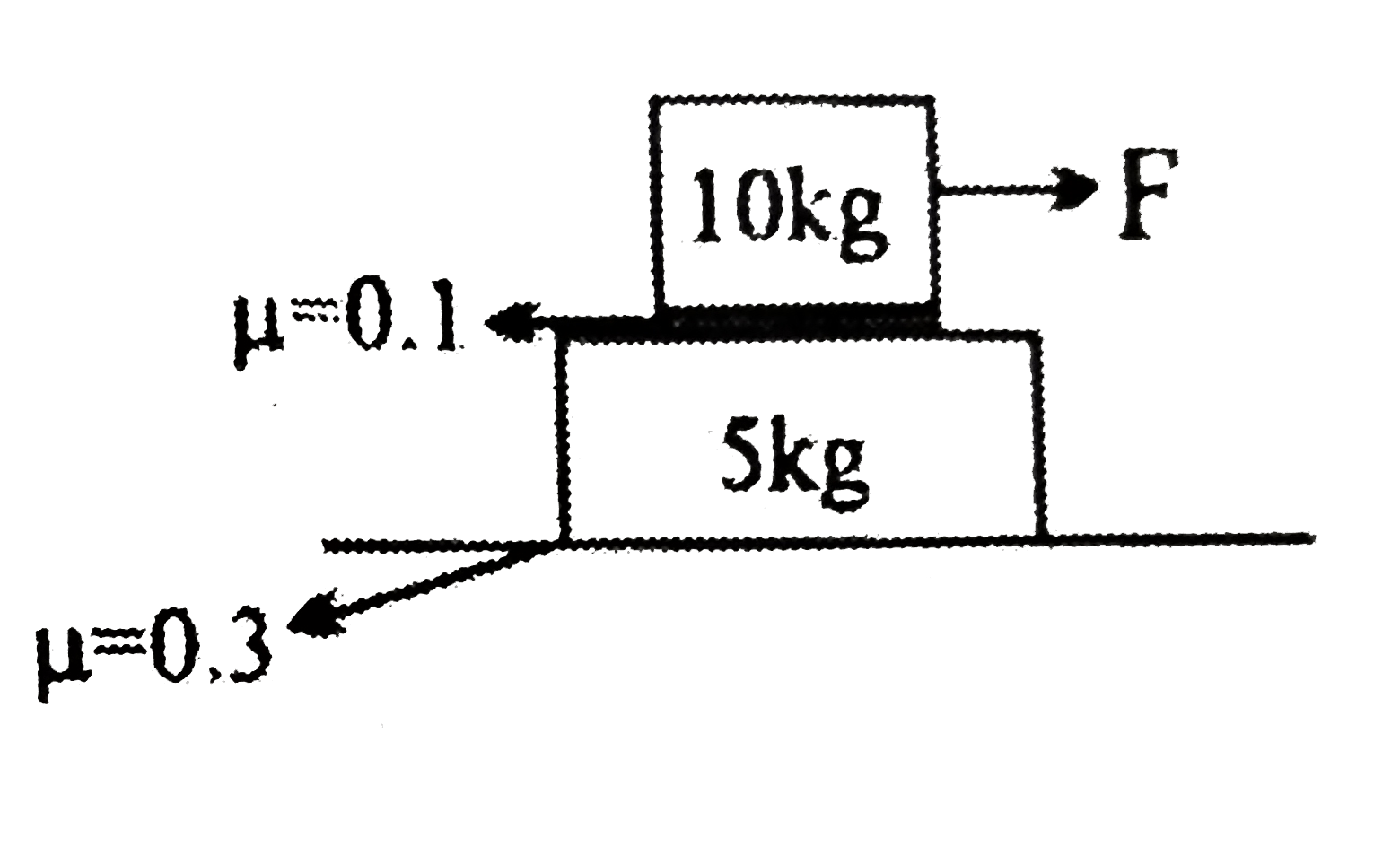
The maximum F which will not cause motio...


The maximum F which will not cause motion of any of the blocks is

Promotional Banner

Similar Questions

Explore conceptually related problems

A block of mass m is at rest on an another block of same as shown in figure lower block is atteched to the spring than the maximum amplitude of motion as than both the block will remain as mat both the block will remain in contact is

The coefficient of friction between block of mass m and 2m is mu=2tantheta . There is no friction between block of mass 2 m and inclined plane. The maximum amplitude of the two block system for which there is no relative motion between both the blocks is

The coefficient of friction between block of mass m and 2m is mu=2tantheta . There is no friction between block of mass 2 m and inclined plane. The maximum amplitude of the two block system for which there is no relative motion between both the blocks is

The coefficient of friction between block of mass m and 2m is mu=2tantheta . There is no friction between block of mass 2 m and inclined plane. The maximum amplitude of the two block system for which there is no relative motion between both the blocks is

For the arrangement as shown in the figure the maximum force F, for no relative motion between blocks is

For the arrangement as shown in the figure the maximum force F, for no relative motion between blocks is

In the given arrangement the maximum value of F for which there is no relative motion between the blocks

In the given arrangement the maximum value of F for which there is no relative motion between the blocks

Choose the correct options The rough surface of a horizontal table offers a definite maximum opposing force to initiate the notion of a block along the table, which is the motion of a block along the table, which is proportional to the resultant normal force given by the table. Forces F_1 and F_2 act at the same angle theta with the horizontal and both are just initiating the slide motion of the block along the table. Force F_1 is a pulling force while the force F_2 is a pushing force. F_2>F_1 , because