Home
Class 12
PHYSICS
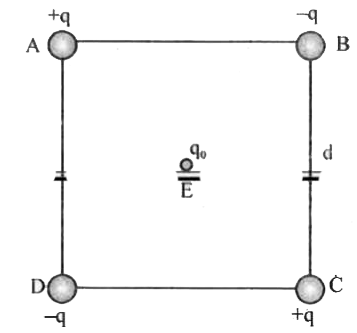
Four charges are arranged at the comers ...

Four charges are arranged at the comers of a square ABCD of side d, as shown in Fig.
a. Find the work required to put together this arrangement
b. A charge `q_(0)` is brought to the centre E of the square, the four charges being held fixed at its corners. How much extra work is needed to do this?n

Text Solution

Verified by Experts

Since the work done depends on the final arrangement of the charges, and not on how they are put togeth calculate work needed for one way of putting the charges at A, B, C and D. Suppose, first the charge +q is brought to A, and then the charges -q, +q, and -q are brought to B, C and D, respectively.
The total work needled oan be caloulated in steps:
i. Work needed to bring charge +q to A when no charge is present elsewhere, this is zero. i. Work nooded to bring - q to B when + q is at A. This is given by (charge at B) `xx` (eleectrostatic potential at B due to charge +q at A) `=-q xx q/(4pi epsi_(0) d)=-(q^(2))/(4pi epsi_(0)d)`
iii. Work needed to bring charge +q to C when +q is at A and - is at B. This is given by `"(charge at C) "xx` (potential at C due to charges at A and B)
`=+q ((+q)/(4pi epsi_(0)dsqrt2) +(-q)/(4pi epsi_(0) d))= (-q^(2))/(4pi epsi_(0)d) (1-1/sqrt2)`
iv. Work needed to bring -q to D when +q at A, - q at B, and + q at C. This is given by (charge at D) `xx` (potential at D due to charges at A, B and C)
`=-q ((+q)/(4pi epsi_(0)d) +(-q)/(4pi epsi_(0) dsqrt2) +(q)/(4pi epsi_(0) d))=(-q^(2))/(4pi epsi_(0) d) (2-1/sqrt2)`
Add the work done in steps (i), (ii), (iii) and (iv). The total work required is `=(-q^(2))/(4pi epsi_(0) d) {(0)+(1)(1-1/sqrt2) +(2-1/sqrt2)}=(-q^(2))/(4pi epsi_(0) d) (4-sqrt2)`
The work done depends only on the arrangement of the charges, and not how they are assembled. By definition, this is the total electrostatic energy of the charges.
b. The extra work necessary to bring a charge `q_(0)` to the point E when the four charges are at A, B, C and D is `q_(0) xx` (electrostatic potential at E due to the charges at A, B, C and D). The electrostatic potential at E is clearly zero since potential due to A and C is cancelled by that due to B and D. Hence no work is required to bring any charge to point E.
Promotional Banner

Topper's Solved these Questions

  • ELECTROSTATIC POTENTIAL AND CAPACITANCE

    NEW JOYTHI PUBLICATION|Exercise Solution To Exercises From Ncert Texation|36 Videos
  • ELECTROSTATIC POTENTIAL AND CAPACITANCE

    NEW JOYTHI PUBLICATION|Exercise Practice Problems For Self Assessment|23 Videos
  • ELECTROMAGNETIC WAVES

    NEW JOYTHI PUBLICATION|Exercise COMPETITIVE EXAM CORNER|16 Videos
  • MAGNETISM AND MATTER

    NEW JOYTHI PUBLICATION|Exercise COMPETITIVE EXAM CORNER|13 Videos

Similar Questions

Explore conceptually related problems

Four charges are arranged at the corners of the square PQRS of side a as shown in the figure . (a) Find the work required to assemble these charges in the given configuration . (b) Suppose a charge q is brought to the center of the square by keeping the four charges fixed at the corners how much extra work is required for this ?

Four charges, each of value q, are placed at the four corners of a square of side a. What is the potential at the centre of the square

Four point charges q_(A) = 2 muC, q_(B)=-5muC, q_(C)=2mu C and q_D=-5 muC are located at the corners of a square ABCD of side 10cm. What is the force on a charge of 1muC placed at the centre of the square?

Four equal charges 2.0xx10^(-6) C each are fixed at the four corners of a square of side 5 cm. Find the coulomb force experienced by one of the charges due to the rest three.

Three equal charges, 2.0xx 10^(-6) C each, are held fixed at the three corners of a square of side 5 cm. find the Coulomb force experienced by one of the charges due to the rest two.

Four long, straight wires, each carrying a current of 5.0 A, are placed in a plane as shown in figure . The points of intersection form a square of side 5.0 cm. (a) Find the magnetic field at the centre P of the square. (b) Q_1, Q_2, Q_3 and Q_4 are points situated on the diagonals of the square and at a distance from P that is equal to the length of the diagonal of the square. Find the magnetic fields at these points.

A current of 2 A enters at the corner d of a square frame abcd of side 20 cm and leaves at the opposite corner b. A magnetic field B= 0.1 T exists in the space in a direction perpenducular to the plane of the frame as shown in Find the magnitude and direction of the magnetic forces on the four sides of the frame.

charges 2.0xx10^(-6)C and 1.0 xx 10^(-6) C are placed at. corners A and B of a square of side 5.0cm as shown in. figure .how much work will be done against. the electric field in moving a charge of 1.0 xx 10^(-6) C from. C to D?.

NEW JOYTHI PUBLICATION-ELECTROSTATIC POTENTIAL AND CAPACITANCE-Competitive Exam Corner
  1. Four charges are arranged at the comers of a square ABCD of side d, as...

    Text Solution

    |

  2. From the figure find x and y.

    Text Solution

    |

  3. Two point charges +5muC and -2 muC are kept at a distance of 1m in fre...

    Text Solution

    |

  4. The equivalent capacitance betweeen A and B is ("in "muF)

    Text Solution

    |

  5. Identify the false statement.

    Text Solution

    |

  6. Two conducting spheres of radii 3 cm and 1 cm are separated by a dista...

    Text Solution

    |

  7. The work done in carrying a charge 'a' once round a circle of radius '...

    Text Solution

    |

  8. A parallel plate capacitor is charged to a potential difference of V v...

    Text Solution

    |

  9. Two particles A and B having equal charges +6 C, after being accelerat...

    Text Solution

    |

  10. Two identical thin rings, each of radius 10 cm carrying charges 10 C a...

    Text Solution

    |

  11. The electric potential V at any point (x, y, z) in space is given by V...

    Text Solution

    |

  12. Choose the correct statement.

    Text Solution

    |

  13. In a parallel plate capacitor, if the intervening medium of permittivi...

    Text Solution

    |

  14. The percentage error in measuring resistance with a metre bridge can b...

    Text Solution

    |

  15. An uncharged parallel plate capacitor filled with a dielectric of diel...

    Text Solution

    |

  16. Choose the wrong statement about equipotential surfaces.

    Text Solution

    |

  17. Three capacitors connected in series have an effective capacitance of ...

    Text Solution

    |

  18. A soap bubble is charged to a potential 12 V. If its radius is doubled...

    Text Solution

    |

  19. The energy stored in a capacitor of capacitance Chaving a charge Q und...

    Text Solution

    |

  20. A point charge of 2 C experiences a constant force of 1000 N when move...

    Text Solution

    |

  21. A charge Q is distributed over two concentric hollow spheres of radii ...

    Text Solution

    |
