Home
Class 12
PHYSICS
Describe schematically the equipotential...

Describe schematically the equipotential surfaces corresponding to
a. a constant electric field in the z-direction.
b. a field that uniformly increases in magnitude but remains in a constant (say,z) direction.
c. a single positive charge at the origin, and
d. a uniform grid consisting of long equally spaced parallel charged wires in a plane.

Text Solution

Verified by Experts
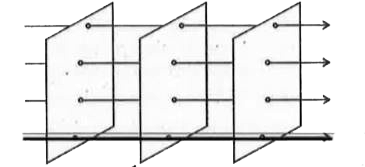
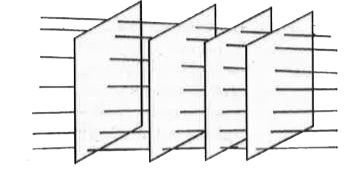
a. Equally spaced x-y planes.
b. x-y planes getting closer and closer along the z-direction.

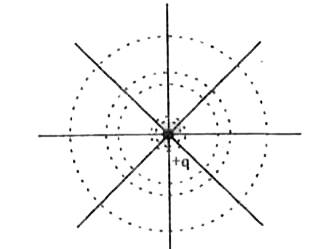
c. Concentric spherical surfaces gradually increasing in spacing.
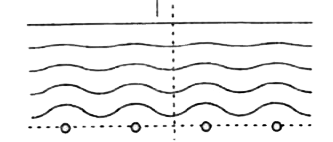
d. A periodically varying shape near the grid which gradually reaches the shape of the planes parallel to the grid at far distances.
Promotional Banner

Topper's Solved these Questions

  • ELECTROSTATIC POTENTIAL AND CAPACITANCE

    NEW JOYTHI PUBLICATION|Exercise Practice Problems For Self Assessment|23 Videos
  • ELECTROSTATIC POTENTIAL AND CAPACITANCE

    NEW JOYTHI PUBLICATION|Exercise Evaluation Questions And Answers|41 Videos
  • ELECTROSTATIC POTENTIAL AND CAPACITANCE

    NEW JOYTHI PUBLICATION|Exercise Competitive Exam Corner|22 Videos
  • ELECTROMAGNETIC WAVES

    NEW JOYTHI PUBLICATION|Exercise COMPETITIVE EXAM CORNER|16 Videos
  • MAGNETISM AND MATTER

    NEW JOYTHI PUBLICATION|Exercise COMPETITIVE EXAM CORNER|13 Videos

Similar Questions

Explore conceptually related problems

Describe qualitatively the path of a charged particle moving in a uniform magnetic field with initial velocity a. Parallel to the field b. Perpendicular to the field and C. At an arbitrary angle with the field direction.

A copper wire bent in the shape of a semicircle of radius r translates in its plane with a constant velocity v. A uniform magnetic field B exists in the direction perpendicular to the plane of the wire. Find the emf induced between the ends of the wire if (a) the velocity is perpendicular ot the diameter joining free ends, (b) the velocity is parallel to this diameter.

A square loop of side 12 cm with its sides parallel to X and Y axes is moved with a velocity of 8cms^(-1) in the possitive x-direction in an environment containing a magnetic field in the positive z- direction. The field is neither uniform in space nor constant in time. It has a gradient of 10^(-3)Tcm^(-1) along the negative x-direction (that is it increases by 10^(-3)T as one moves in the negative x-direction), and it is decreasing in time at the rate of 10^(-3)Ts^(-1) . Determine the direction and magnitude of the induced current in the loop of its resistance is 4.50mOmega .

Figure. gives a speed-time graph of a particle in motion along a constant direction. Three equal intervals of time are shown. In which interval is the average acceleration greatest in magnitude ? In which interval is the average speed greatest ? Choosing the positive direction as the constant direction of motion, give the signs of v and a in the three intervals. What are the accelerations at the points A, B, C and D ?

In a certain region of space, electric field is along the z-direction throughout. The magnitude of electric field is, however, not constant but increases uniformly along the positive z- direction, at the rate of 10^5 NC^(-1) per metre. What are the force and torque experienced by a system having a total dipole moment equal to 10^(-7) Cm in the negative Z-direction?

A particle of charge q moves with velocity vec(v) along positive y - direction in a magnetic field vec(B) . Compute the Lorentz force experienced by the particle (a) when magnetic field is along positive y-direction (b) when magnetic field points in positive z -direction (c ) when magnetic field is in zy - plane and making an angle theta with velocity of the particle. Mark the direction of magnetic force in each case.

A particle is projected at an angle of theta with respect to the horizontal direction. Match the following for the above motion. (a) V_(x)" "-" decrease and increases" (b) V_(y)" "-" remains constant" (c) "Acceleration - varies" (d) "Position vector "-" remains downward"

NEW JOYTHI PUBLICATION-ELECTROSTATIC POTENTIAL AND CAPACITANCE-Solution To Exercises From Ncert Texation
  1. A long charged cylinder of linear charge density lambda is surrounded ...

    Text Solution

    |

  2. The potential energy of a system increases, if work is done

    Text Solution

    |

  3. If one of the two electrons of a H(2) molecule is removed, we get a hy...

    Text Solution

    |

  4. Two charged conducting spheres of radii a and b are connected to each ...

    Text Solution

    |

  5. Two charges -q and +q are located at points (0,0,-a) and (0,0,a) respe...

    Text Solution

    |

  6. Figure shows a charge array known as an electric quadrupole. For a poi...

    Text Solution

    |

  7. An electrical technican requires a capacitance fo 2 muF in a circuit...

    Text Solution

    |

  8. What is the area of plates of 2F parallel capacitor, given that the se...

    Text Solution

    |

  9. Obtain the equivalent capacitance of the network in figure below. For ...

    Text Solution

    |

  10. The plates of a parallel plate capacitor have an area of 90 cm^(2) eac...

    Text Solution

    |

  11. A 4muF capacitor is charged by a 200V supply. It is then disconnected ...

    Text Solution

    |

  12. Show that the force on each plate of a parallel plate capacitor has a ...

    Text Solution

    |

  13. A spherical capacitor has an inner sphere of radius 12cm and an outer ...

    Text Solution

    |

  14. Two large conducting spheres carrying charges Q1, and Q2, are brought ...

    Text Solution

    |

  15. A cylindrical capacitor has two co-axial cylinders of length 15 cm and...

    Text Solution

    |

  16. A parallel plate capacitor is to be designed with a voltage rating 1kV...

    Text Solution

    |

  17. Describe schematically the equipotential surfaces corresponding to a...

    Text Solution

    |

  18. In a Van de Graaff type generator, a spherical metal shell is to be a ...

    Text Solution

    |

  19. A small sphere of radius r1 and charge q1 is enclosed by a spherical s...

    Text Solution

    |

  20. a. The top of the atmosphere is at about 400 kV with respectto the sur...

    Text Solution

    |