Home
Class 12
PHYSICS
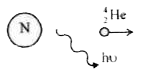
A nuclear event is shown in the diagram....

A nuclear event is shown in the diagram.

a. Name the nuclear phenomenon.
b. What happens to the residual nucleus? Explain.
c. Compare the binding energy per nucleon of the daughter and the parent.
d. At what time the `h upsilon` is emitted ? Explain.

Text Solution

Verified by Experts

a. Radiactivity .
b. It rebounds (or recoils): due to momentum conservation principle.
c. The BE per nucleon increases by the activity.
d. There is no specific time. It is spontaneous `gamma`- emission can be independent or followed by `alpha`- decay.
Promotional Banner

Topper's Solved these Questions

  • NUCLEI

    NEW JOYTHI PUBLICATION|Exercise CONTINUOUS EVALUATION|2 Videos
  • NUCLEI

    NEW JOYTHI PUBLICATION|Exercise CONTINUOUS EVALUATION(ASSIGNMENT)|9 Videos
  • NUCLEI

    NEW JOYTHI PUBLICATION|Exercise PRACTICE PROBLEMS FOR SELF ASSESSMENT|18 Videos
  • MOVING CHARGES AND MAGNETISM

    NEW JOYTHI PUBLICATION|Exercise COMPETITIVE EXAM CORNER|28 Videos
  • RAY OPTICS AND OPTICAL INSTRUMENTS

    NEW JOYTHI PUBLICATION|Exercise COMPETITIVE EXAM CORNER|26 Videos

Similar Questions

Explore conceptually related problems

A conducting wire ab of length l, resistance r and mass m starts sliding at t = 0 down a smooth, vertical, thick pair of connected rails as shown in . A uniform magnetic field B exists in the space in a diraction perpendicular to the plane of the rails. (a) Write the induced emf in the loop at an instant t when the speed of the wire is v. (b) what would be the magnitude and direction of the induced current in the wire? (c) Find the downward acceleration of the wire at this instant. (d) After sufficient time, the wire starts moving with a constant velocity. Find this velocity v_m. (e) Find the velocity of the wire as a function of time. (f) Find the displacement of the wire as a functong of time. (g) Show that the rate of heat developed inte wire is equal to the rate at which the gravitational potential energy is decreased after steady state is reached.

Figure shows a metal rod PQ resting on the smooth rails AB and positioned between the poles of a permanent magnet. The rails, the rod and the magnetic field are in three mutually perpendicular directions. A galvonometer G connects the rails through a switch K. Length of rod = 15 cm, B = 0.50 T, resistance of the closed loop containing the rod = 9.0mOmega . Assume the field to be uniform. a. Suppose K is open and the rod is moved with a speed of 12cms^(-1) in the direction shown. Give the polarity and magnitude of the induced emf. b. Is there an excess charge built up at the ends of the rods when K is open? What if K is closed? c. With K open and the rod moving uniformly, there is no net force on the electrons in the rod PQ eventhough they do experience magnetic force due to the motion of the rod. Explain. d. What is the retarding force on the rod when K is closed? e. How much power is required (by an external agent) to keep the rod moving at the same speed (=12cms^(-1)) when K is closed? How much power is required when K is open? f. How much power is dissipated as heat in the closed circuit? What is the source of this power? g. What is the induced emf in the moving rod if the magnetic field is parallel to the rails instead of being perpendicular?

a. Are the equations of nuclear reactions such as ""_(7)^(14)N + ""_(2)^(4)He to ""_(8)^(16)O + ""_1^2H 'balanced' in the sense a chemical equation 2H_2 + O_2 to 2H_2O is ? If not, in what sense are they balanced on both sides? b. If the number of protons and number of neutrons are conserved in a nuclear reaction, in what way the mass is converted into energy (or vice versa) in a nuclear reaction? c. A general impression exists that mass energy inter-conversion takes place only in nuclear reaction and never in chemical reaction. Strictly speaking, this is incorrect Explain.

The following is the illustration of the sequence of ovarian events (a-i) in a human female. (a) Identify the figure that illustrates ovulation and mention the stage of oogenesis it represents. (b) Name the ovarian hormone and the pituitary hormone that have caused the above mentioned events. (c) Explain the changes that occurs in the uterus simultaneously in anticipation. (d) Write the difference between C and H.

In a fusion reactor, the reaction occurs in two stages. (i) Two deuterium (""_(1)^(2)D) nuclei fuse to form a tritium (""_(1)^(3)T) nucleus with a proton as product. (ii) A tritium nucleus fuses with another deuterium nucleus to form a helium (""_(2)^(4)He) nucleus with neutron as another product. Find (a) the energy released in each stage. (b) the energy released in the combined reaction per deuterium and (c) what percentage of the mass energy of the initial deuterium is released? Given : ""_(1)^(2)D=2.014102u,""_(1)^(3)T=3.016049u,""_(2)^(4)He=4.002603u,""_(1)^(1)H=1.007825u,""_(0)^(1)n=1.008665u Take 1u = 931 MeV

For scattering by an 'inverse square field' (such as that produced by a charged nucleus in Rutherford's model) the relation between impact parameter b and the scattering angle theta is given by b (Ze^2 cot (theta/2))/(4 pi epsi_0 ((mv^2)/(2))) a. What is the scattering angle for b =0? b. For a given impact parameter h, does the angle of deflection increase or decrease with increasing energy? c .What is the impact parameter at which the scattering angle is 90^@ for Z = 79 and initial energy of 10 MeV? d. Why is it that the mass of the nucleus does not enter the formula above but the charge does? e. For a given energy of the projectile, does the scattering angle increase or decrease with decrease in impact parameter?

Answer the following questions . a. The earth's magnetic field varies from point is space. Does it also change with time ? It so , on what time scate does it change appreciably ? b. The earth's core is known to contain iron. Yet geologists do not regard this as a source of the earth's magnetism why ? c. The charged currents in the outer conducting regions of the earth's core are thought to be responsible for earth's magnetism . What might be the ' battery ' (i.e., the source of energy) to sustain these currents ? d. The earth may have even reversed the direction of its field several times during its history of 4 to 5 billion years. How can geologists know about the earth's field in such distant past ? e. The earth's field departs from its dipole substantially at large distances (greater than about 30,000 km) what agencies may be responsible for this distortion ? f. Interstellar space has an extremely weak magnetic field of the order of 10^(-12) T, Can such a weak field be of any significant consequence ? Explain. [Note : Exercise 2 is meant mainly to arouse your curiosity . Answers to some question above are tentative or unknown . Brief answers wherever possible are given at the end . For details , you should consult a good text on geomagnetism.]

Answer the following questions a. Explain qualitatively on the basis of domain picture the irreversibility in the magnetisation curve of a ferromagnet. b. The hysteresis loop of soft iron piece has a much smaller area than that of a carbon steel piece. If the material is to go through repeated cycles of magnetisation , which piece will dissipate greater heat energy ? c. 'A system displaying a hysteresis loop such as a ferromagnet , is a device for storing memory ? ' Explain the meaning of this statement. d. What kind of ferromagnetic material is used for coating magnetic tapes in a cassette player , or for building ' memory stores ' in a modern computer ? e. A certain region of space is to be shielded from magnetic fields . Suggest a method.

NEW JOYTHI PUBLICATION-NUCLEI-EVALUATION QUESTIONS AND ANSWERS
  1. Z,A and M represent the atomic number, mass number and rest mass of a ...

    Text Solution

    |

  2. ""(Z)^(A)X to ""(Z + 1)^(A)Y + ""(-1)^(0)e + barupsilon + "energy" a...

    Text Solution

    |

  3. A nuclear event is shown in the diagram. a. Name the nuclear phen...

    Text Solution

    |

  4. The radioacitve decay of an element is shown in the graph. a. What i...

    Text Solution

    |

  5. Mention the different units of radioactivity.

    Text Solution

    |

  6. Why are neutrons very effective as bombarding particles?

    Text Solution

    |

  7. ""(72)^(180)A overset(a)(rarr)B overset(beta)(rarr)C overset(alpha)(ra...

    Text Solution

    |

  8. From the above table we can see that the ratio of their atomic masses ...

    Text Solution

    |

  9. a. What is positron ? " " b. What is its charge ?

    Text Solution

    |

  10. What is " " i. neutrino " " ii. antineutrino? Explain with exa...

    Text Solution

    |

  11. alpha-particles have a high ionizing power. Justify your answer.

    Text Solution

    |

  12. a. Are the equations of nuclear reactions such as ""(7)^(14)N + ""(2)^...

    Text Solution

    |

  13. Complete the nuclear reaction a. ""(5)^(10)B + ………… to ""3^7Li + ""(...

    Text Solution

    |

  14. a. Which is more stable , ""(3)^(7)Li " or " ""(3)^(4)Li ? b. Give...

    Text Solution

    |

  15. What is meant by chain reaction ?

    Text Solution

    |

  16. a. Are heavy nuclei stable or unstable ? b. Give reason.

    Text Solution

    |

  17. You are given two nuclides ""(3)^(7)X and ""(3)^(4)Y. a. Are they th...

    Text Solution

    |

  18. What is the ratio of nuclear densities of two nucleus having mass num...

    Text Solution

    |

  19. a. Give the expression for the radius of a nucleus. b. What is the r...

    Text Solution

    |

  20. a. Is free neutron a stable particle? b. Give reason.

    Text Solution

    |
