Home
Class 12
PHYSICS
The radioacitve decay of an element is s...


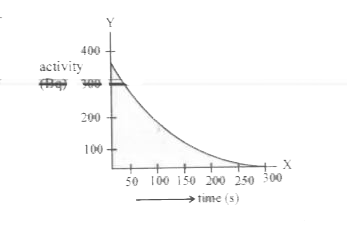
The radioacitve decay of an element is shown in the graph.
a. What is the sort of functional decay shown here?
b. What is the change in activity in equal intervals of time?
c. Find the half-life.
d. Can you find the decay constant? If so, what is its value ?

Text Solution

Verified by Experts

a. Exponential decay
b. y decreases by the same ratio
c. Approximately 70s.
d . Hint : Apply `lambda = (0.931)/(T_(1/2))`
Promotional Banner

Topper's Solved these Questions

  • NUCLEI

    NEW JOYTHI PUBLICATION|Exercise CONTINUOUS EVALUATION|2 Videos
  • NUCLEI

    NEW JOYTHI PUBLICATION|Exercise CONTINUOUS EVALUATION(ASSIGNMENT)|9 Videos
  • NUCLEI

    NEW JOYTHI PUBLICATION|Exercise PRACTICE PROBLEMS FOR SELF ASSESSMENT|18 Videos
  • MOVING CHARGES AND MAGNETISM

    NEW JOYTHI PUBLICATION|Exercise COMPETITIVE EXAM CORNER|28 Videos
  • RAY OPTICS AND OPTICAL INSTRUMENTS

    NEW JOYTHI PUBLICATION|Exercise COMPETITIVE EXAM CORNER|26 Videos

Similar Questions

Explore conceptually related problems

Shows a smooth pair of thick metallic rails connected across a battery of emf epsilon having a negligible internal resistance. A wire ab of length l and resistance r can slide smoothly on the rails. The entire system lien in a horizontal plane and is immersed in a uniform vertical magnetic field B. At an instant t, the wire is given a small velocity v towards right. (a) find the current in it at this instant. What is the direction of the current? (b) What is the force acting on the wire at this instant? (c) Show that after some time the wire ab will slide with a constant velocity. Find this velocity.

A certain sample of a radioactive marerial decays at the rate of 500 per second at a cartain time .the count rate falls to 200 per second after 50 minutes .(a) What is decay constant of the sample? (b) what is its half-life?

a. Draw the graph showing the variation of potential with frequency of incident radiation. b. What does the slope of the graph represent? c. From the slope how will you find the value of 'h' ?

The above graph shows frequency of an incident photon and maximum kinetic energy of a photoelectric effect a. What is the value of threshold frequency and threshold wave-length? b. What is the work function of the cathode in eV? c. Find the maximum kinetic energy, if the frequency of photon is 9xx10^(14) Hz. d. Also find the value of Planck's constant (h).

A nuclear event is shown in the diagram. a. Name the nuclear phenomenon. b. What happens to the residual nucleus? Explain. c. Compare the binding energy per nucleon of the daughter and the parent. d. At what time the h upsilon is emitted ? Explain.

A track consists of two circular pars ABC and CDE of equal radius 100 m and joined smoothly as shown in figure.Each part subtends a right angle at its centre. A cycle weighing 100 kg together with rider travels at a constant speed of 18 km/h on the track. A. Find the normal contact force by the road on the cycle when it is at B and at D. b.Find the force of friction exerted by the track on the tyres when the cycle is at B,C and D. c. Find the normal force between the road and the cycle just before and just after the cycle crosses C. d. What should be the minimum friction coefficient between the road and the tyre, which will ensure that the cyclist can move with constant speed? Take g=10 m/s^2

An electric field of magnitude 1000 NC ^(-1) is produced between two parallel platees having a separation of 2.0 cm as shown in figure(29.E4) (a) What is the potential difference between the plates? (b) With what minimum speed should an electron be projected from the lower plate in the direction of the field so that it may reach the upper plate? ( c) Suupose the electron is projected from the lower plate with the speed calculated in part (b) . The direction of projection makes an angle of 60@ with the field. Find the mazimum height reached by the electron.

On your birthday, you measure the activity of the sample ""^(210)Bi which has a half - life of 5.01 days. The initial activity that you measure is 1muCi . (a) What is the approximate activity of the sample on your next birthday? Calculate (b) the decay constant (c) the mean life (d) initial number of atoms.

NEW JOYTHI PUBLICATION-NUCLEI-EVALUATION QUESTIONS AND ANSWERS
  1. ""(Z)^(A)X to ""(Z + 1)^(A)Y + ""(-1)^(0)e + barupsilon + "energy" a...

    Text Solution

    |

  2. A nuclear event is shown in the diagram. a. Name the nuclear phen...

    Text Solution

    |

  3. The radioacitve decay of an element is shown in the graph. a. What i...

    Text Solution

    |

  4. Mention the different units of radioactivity.

    Text Solution

    |

  5. Why are neutrons very effective as bombarding particles?

    Text Solution

    |

  6. ""(72)^(180)A overset(a)(rarr)B overset(beta)(rarr)C overset(alpha)(ra...

    Text Solution

    |

  7. From the above table we can see that the ratio of their atomic masses ...

    Text Solution

    |

  8. a. What is positron ? " " b. What is its charge ?

    Text Solution

    |

  9. What is " " i. neutrino " " ii. antineutrino? Explain with exa...

    Text Solution

    |

  10. alpha-particles have a high ionizing power. Justify your answer.

    Text Solution

    |

  11. a. Are the equations of nuclear reactions such as ""(7)^(14)N + ""(2)^...

    Text Solution

    |

  12. Complete the nuclear reaction a. ""(5)^(10)B + ………… to ""3^7Li + ""(...

    Text Solution

    |

  13. a. Which is more stable , ""(3)^(7)Li " or " ""(3)^(4)Li ? b. Give...

    Text Solution

    |

  14. What is meant by chain reaction ?

    Text Solution

    |

  15. a. Are heavy nuclei stable or unstable ? b. Give reason.

    Text Solution

    |

  16. You are given two nuclides ""(3)^(7)X and ""(3)^(4)Y. a. Are they th...

    Text Solution

    |

  17. What is the ratio of nuclear densities of two nucleus having mass num...

    Text Solution

    |

  18. a. Give the expression for the radius of a nucleus. b. What is the r...

    Text Solution

    |

  19. a. Is free neutron a stable particle? b. Give reason.

    Text Solution

    |

  20. a. Give two radioacitve elements which are not formed in observable qu...

    Text Solution

    |
