Home
Class 12
MATHS
Let the functions defined in Column I ha...

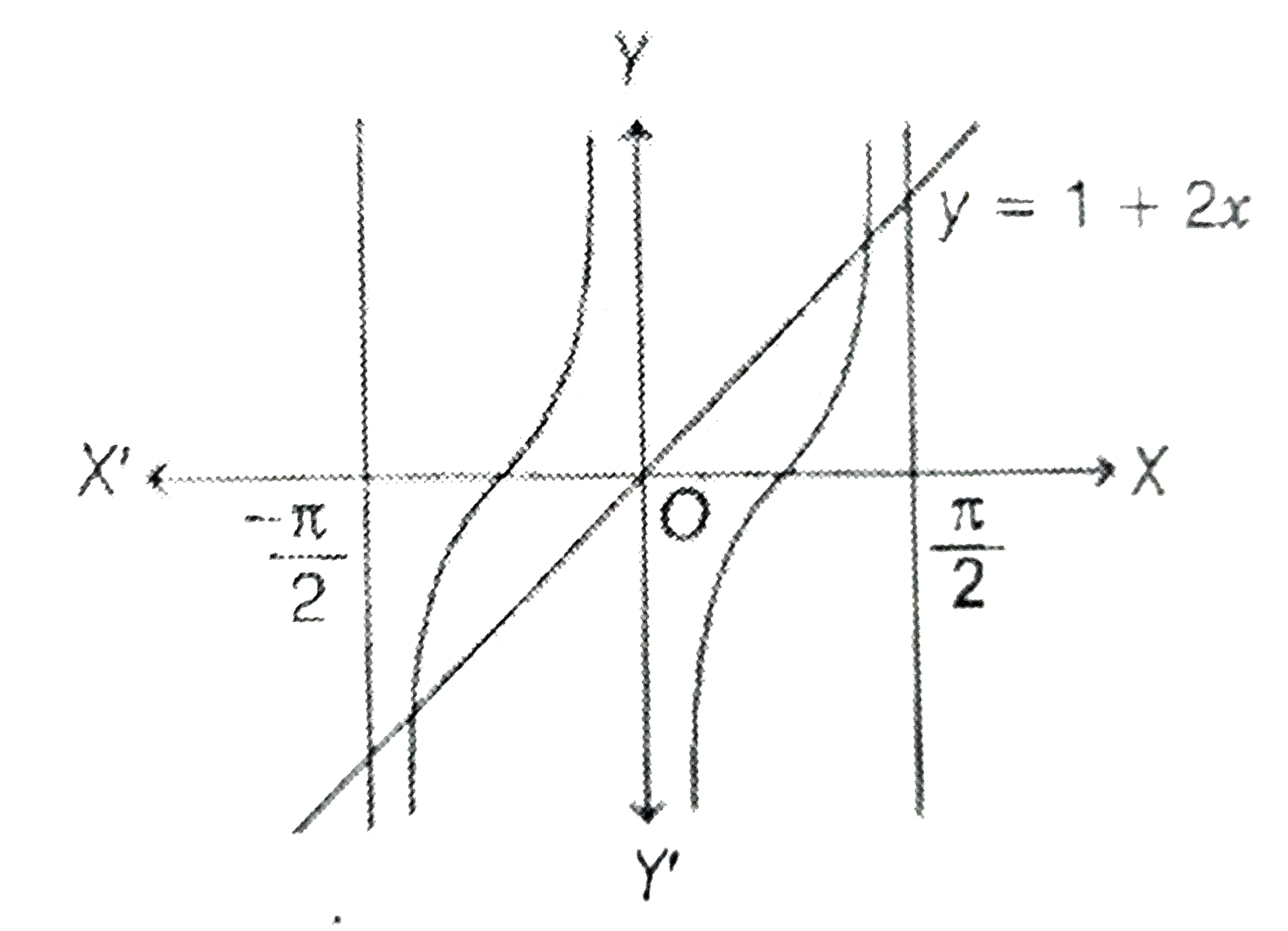
Let the functions defined in Column I have domain `(-pi/2, pi/2)` and range `(-oo, oo)`

Text Solution

Verified by Experts

The correct Answer is:
`A to q; B to r`

`y=1+2x` is linear function, therefore it is one-one and its range is `(-pi+1,pi+1).` Therefore (1 + 2x) is one-one but not onto so `(A) to (q)`. Again, see the figure.

It is clear from the graph that y = tan x is one-one and onto, therefore `(B) to (r).`
Promotional Banner

Similar Questions

Explore conceptually related problems

Match the conditions/ expressions in Column I with statements in Column II. Let the functions defined in Column I have domain (-pi//2, pi//2) . (##41Y_SP_MATH_C10_E02_025_Q01.png" width="80%">

If function f(x) = (1+2x) has the domain (-(pi)/(2), (pi)/(2)) and co-domain (-oo, oo) then function is

Let f be a function defined on [-(pi)/(2), (pi)/(2)] by f(x) = 3 cos^(4) x-6 cos^(3) x - 6 cos^(2) x-3 . Then the range of f(x) is

Let the domain and range of inverse circular functions are defined as follows: If xepsilon((-pi)/2,(pi)/2), cosec^(-1)cosecx is

Let the function f'(x)=sin x be one- one and onto. Then a possible domain of f is O [0,2 pi] O [0,pi] O [-(pi)/(2),(pi)/(2)] O [-pi, pi]

Let the function g: (-oo,oo)rarr (-pi //2,pi//2) be given by g(u) = 2 tan^(-1) (e^u)-pi/2 Then g is

f(x)=int(2-(1)/(1+x^(2))-(1)/(sqrt(1+x^(2))))dx then fis (A) increasing in (0,pi) and decreasing in (-oo,0)(B) increasing in (-oo,0) and decreasing in (0,oo)(C) increasing in (-oo,oo) and (D) decreasing in (-oo,oo)

Let f(x) be a increasing function defined on (0,\ oo)dot If f(2a^2+a+1)>f\ (3a^2-4a+1)dot Find the range of adot

Which function's range is the interval (-oo,4]?

The number of real solutions of the equation sin^(-1)(sum_(i=1)^oox^(i+1)-xsum_(i=1)^oo(x/2)^i)=pi/2-cos^(-1)(sum_(i=1)^oo(-x/2)^i-sum_(i=1)^oo(-x)^i) lying in the interval (-1/2,1/2) is ____. (Here, the inverse trigonometric function =sin^(-1)x and cos^(-1)x assume values in [pi/2,pi/2] and [0, pi] , respectively.)

