

Home
Class 12
PHYSICS
A semicircle of radius R = 5m with diame...

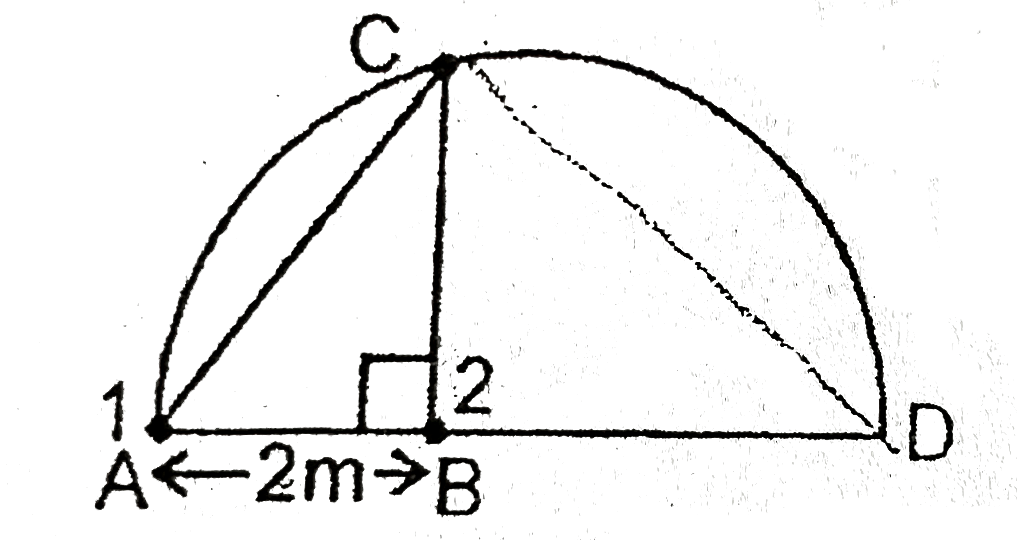
A semicircle of radius R = 5m with diameter AD as shown in figure. Two particles 1 and 2 are at points A and B on shown diameter at t = 0 and move along segments AC and BC with constant speeds `u_(1)` and `u_(2)` respectively. Then the value of `(u_(1))/(u_(2))` for both particles to reach point C simultaneously will be :

Promotional Banner

Similar Questions

Explore conceptually related problems

Two bodies A and B are projected simultaneously from points X and Y as shown in the figure, with velocities u_(A) and u_(B) respectively. Find the ratio of (u_(A))/(u_(B)) for both the bodies to collide .

Speed of light through two media of refractive indices mu_(1) and mu_(2) are u_(1) and u_(2) respectively, then

Two particles A and B are moving in uniform circular motion in concentric circles of radii r_(A) and r_(B) with speed u_(A) and u_(B) respectively. Their time period of rotation is the same. The ratio of angular speed of a to that of B will be:

Two particles A and B are moving in uniform circular motion in concentric circles of radii r_(A) and r_(B) with speed u_(A) and u_(B) respectively. Their time period of rotation is the same. The ratio of angular speed of a to that of B will be:

A body is projected with the velocity u_(1) from the point A as shown in Figure. At the same time another body is projectd vertically upwards with the velocity u_(2) from the point B. What shold be the value of (u_(1))/(u_(2)) for both the bodies to collide.

Two particles are thrown simultaneously from points A and B with velocities u_1 = 2ms^(-1) and u_2 - 14 ms^(-1) , respectively, as shown in figure. The relative velocity of B as seen from A in

Two particles are thrown simultaneously from points A and B with velocities u_1 = 2ms^(-1) and u_2 - 14 ms^(-1) , respectively, as shown in figure. The relative velocity of B as seen from A in

Two path 1 and 2 are shown in figure. If the change in internal energies are U_1 , and U_2 for path 1 and 2 respectively, then