

Home
Class 11
PHYSICS
A cylinder is fitted with a piston, bene...

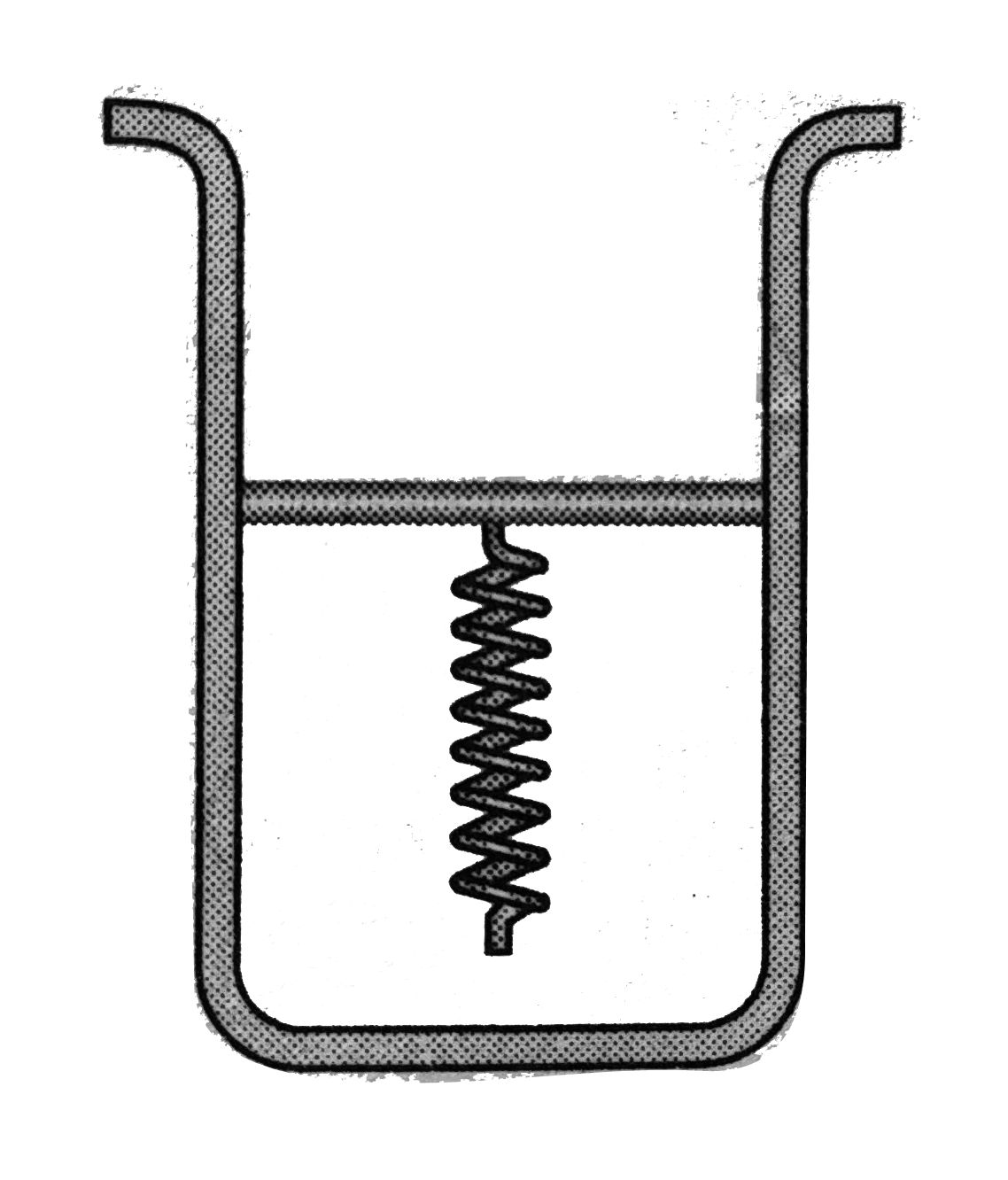
A cylinder is fitted with a piston, beneath which is a spring, as in the figure. The cylinder is open at the top. Friction is absent. The spring is `3600 N//m`. The piston has a negligible mass and a radius of 0.025m (a) when air beneath the piston is conpletely pumped out, how much does the atmospheric pressure cause the spring to compress? (b) How much work does the atmospheric pressure do in compressing the spring?

Promotional Banner

Similar Questions

Explore conceptually related problems

If the smaller piston is pushed in through 6cm , how much does the longer piston move out?

A fixed thermally conducting cylinder has a radius R and height L_0 . The cylinder is open at the bottom and has a small hole at its top. A piston of mass M is held at a distance L from the top surface, as shown in the figure. The atmospheric pressure is P_0 . The piston is now pulled out slowly and held at a distance 2L from the top. The pressure in the cylinder between its top and the piston will then be

A fixed thermally conducting cylinder has a radius R and height L_0 . The cylinder is open at the bottom and has a small hole at its top. A piston of mass M is held at a distance L from the top surface, as shown in the figure. The atmospheric pressure is P_0 . The piston is now pulled out slowly and held at a distance 2L from the top. The pressure in the cylinder between its top and the piston will then be

A spring has spring constant k = 200 N//m . How much work does it take to stetch the spring 10 cm from equilibrium ?

A fixed thermally conducting cylinder has a radius R and height L_0 . The cylinder is open at ita bottom and has a small hole at its top. A piston of mass M is held at a distance L from the top surface, as shown in the figure. The atmospheric pressure is P_0 . The piston is now pulled out slowly and held at a distance 2L from the top. The pressure in the cylinder between its top and the piston will then be

A fixed container is fitted with a piston which is attached to a spring of spring constant k . The other and of the spring is attached to a rigid wall. Initially the spring is in its natural length and the length of container between the piston and its side wall is L . Now an dideal diatomic gas is slowly filled in the container so that the piston moves quasistatically. It pushed the piston by x so that the spring now is compressed by x . The total rotaional kinetic energy of the gas molecules in terms of the displacement x of the piston is (there is vacuum outside the container)

A fixed container is fitted with a piston which is attached to a spring of spring constant k . The other and of the spring is attached to a rigid wall. Initially the spring is in its natural length and the length of container between the piston and its side wall is L . Now an dideal diatomic gas is slowly filled in the container so that the piston moves quasistatically. It pushed the piston by x so that the spring now is compressed by x . The total rotaional kinetic energy of the gas molecules in terms of the displacement x of the piston is (there is vacuum outside the container)

A cylindrical vessel containing a liquid is closed by a smooth piston of mass "100g" as shown in the figure.The radius of the piston is "10cm" .If the atmospheric pressure is P_(0) then the pressure difference of the liquid just below the piston and the atmospheric pressure is (g=10m/s^(2))