The proof will be taken up in two steps.
Step 1 : We initially prove that any point equidistant from the endpoints of a line segment lies on the perpendicular bisector of the line segment.
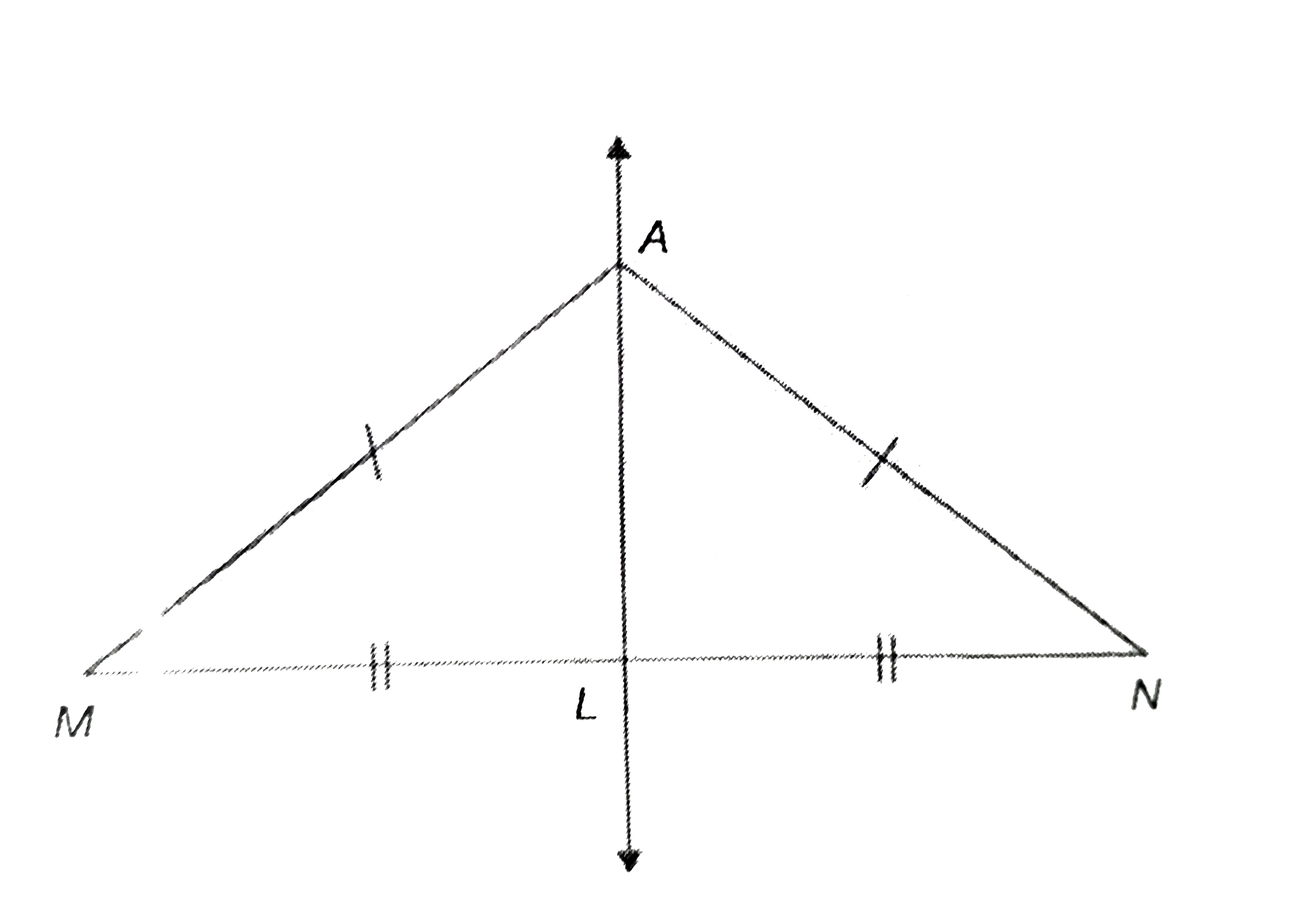
Given : M and N are two points on a plane. A is a point in the same plane such that AM = AN
To prove : A lies on the perpendicular bisector of MN.
Proof: Let L be the mid point of `overline(MN)`
If A coincides with L, then A lies on the bisector of MN.
Suppose A is different From L
Then, in `Delta MLA` and `Delta NLA`
ML = NL, AM = AN and AL is a common side.
`:.` By SSS congruence property, `Delta MLA ~= Delta NLA`
`implies /_ MLA = /_ NLA` ( `:'` The corresponding elements of congruent triangles are equal)
But, `/_ MLA + /_ NLA = 180^(@)` ( `:'` Linear pair)
`implies 2 /_ MLA = 180^(@)` (from eq. (1))
`:. /_ MLA = /_ NLA = 90^(@)`
So, `overline(AL) _|_ overline(MN)` Hence, `overline(AL)` is the perpendicular bisector of MN.
`:.` A lies on the perpendicular bisector of `overline(MN)`
Step : 2 Now, we prove that any point o the perpendiculat bisector of the line segment is equidistant from the end points of the line segments.
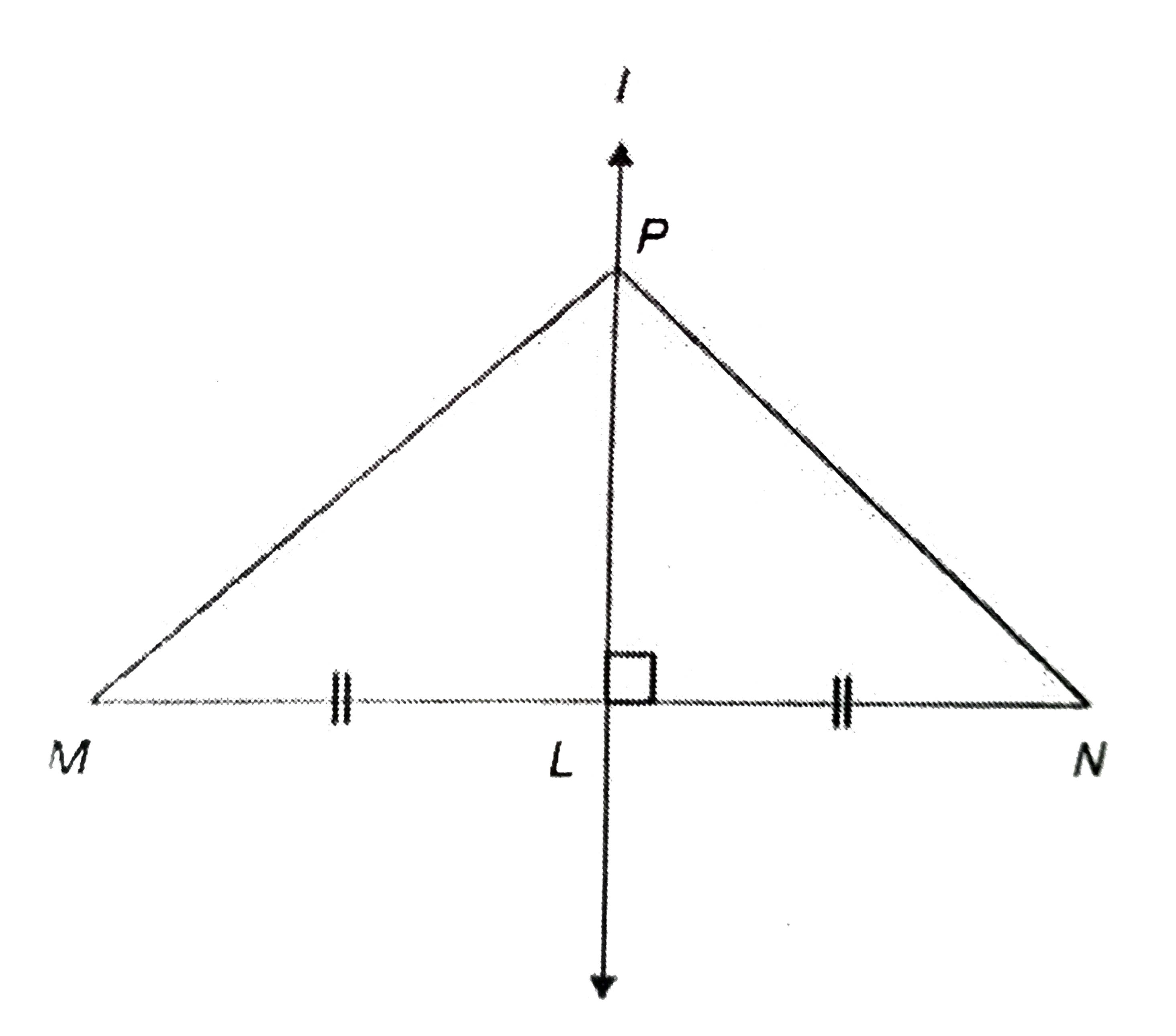
Given : MN is a line segment and P is point the perpendicualr bisector. L is the mid-point of MN
To prove : MP = NP.
Proof: If P coincides with L, then MP = NP .
Suppose P is different from L. Then, in `Delta MLP` and `Delta NLP, ML = LN`.
LP is the common side and `Delta MLP = Delta NLP = 90^(@)`
`:.` By the SAS congruence side and `Delta MLP = Delta NLP`
So, MP = PN( `:'` The corresponding elements of congruent triangles are equal. )
`:.` Any point on the perpendicular bisector of `overline(MN)` is equidistant from point M and N.
Hence, from step I and step II of the proof, it can be said that the loucs of point equidistant from two fixed points is the perpendicualr bisector of the line segment joining the two points.