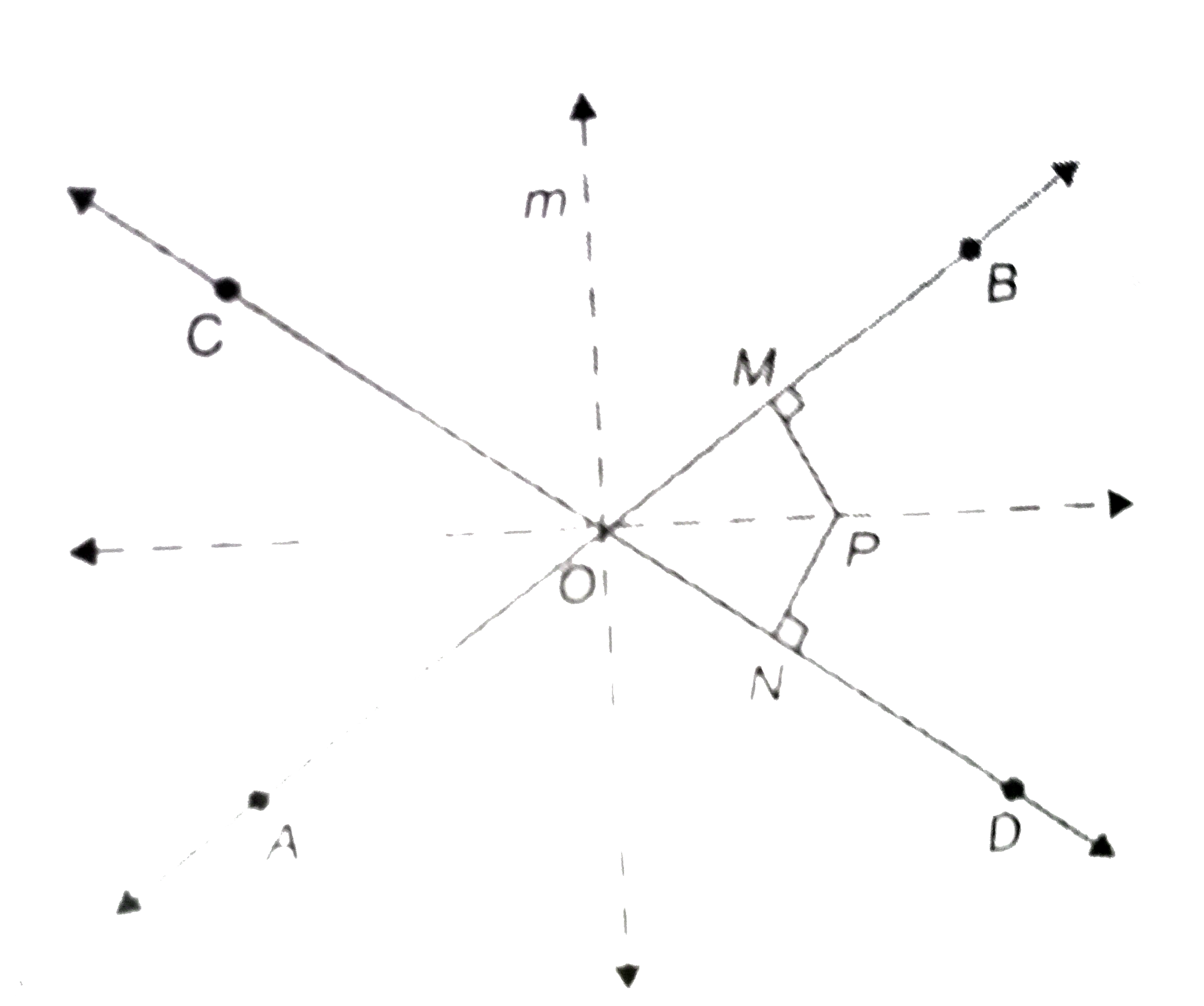
Step I : We initially prove that any point equidistant from two given intersecting lines lies on one of of the lies bisecting the angles fromed by the given lines.
Given : `overline(AB)` and `overline(CD)` are two line intersecting a O. P is the point on the plane such that PM = PN
Line I is the bisector of `/_ BOC` and `/_ AOC`
LIne m is the bisector of `/_ BOC` and `/_AOD`
To proves : P lies either on the line I or on the line m
Proof : In `Delta POM` and `Delta PON`, PM = PN
OP is ommon side and `/_PMO = /_ PNO = 90^(@)`
`:.` By RHS congrunce property, `Delta POM ~= Delta PON`
So, `/_POM = /_ PON`, i.e P lies on the angles bisector of `/_BOD`
As l is the bisector of `/_BOD` and `/_ AOC`, P lies on the line l.
Similarly, if P lies in any of the regions of `/_ BOC /_ AOC` or `/_ AOD`, such that it is equidistant from `overline(AB)` and `overline(CD)` then we can conclude that P lies on the angle bisector l or on the angle bisector m.
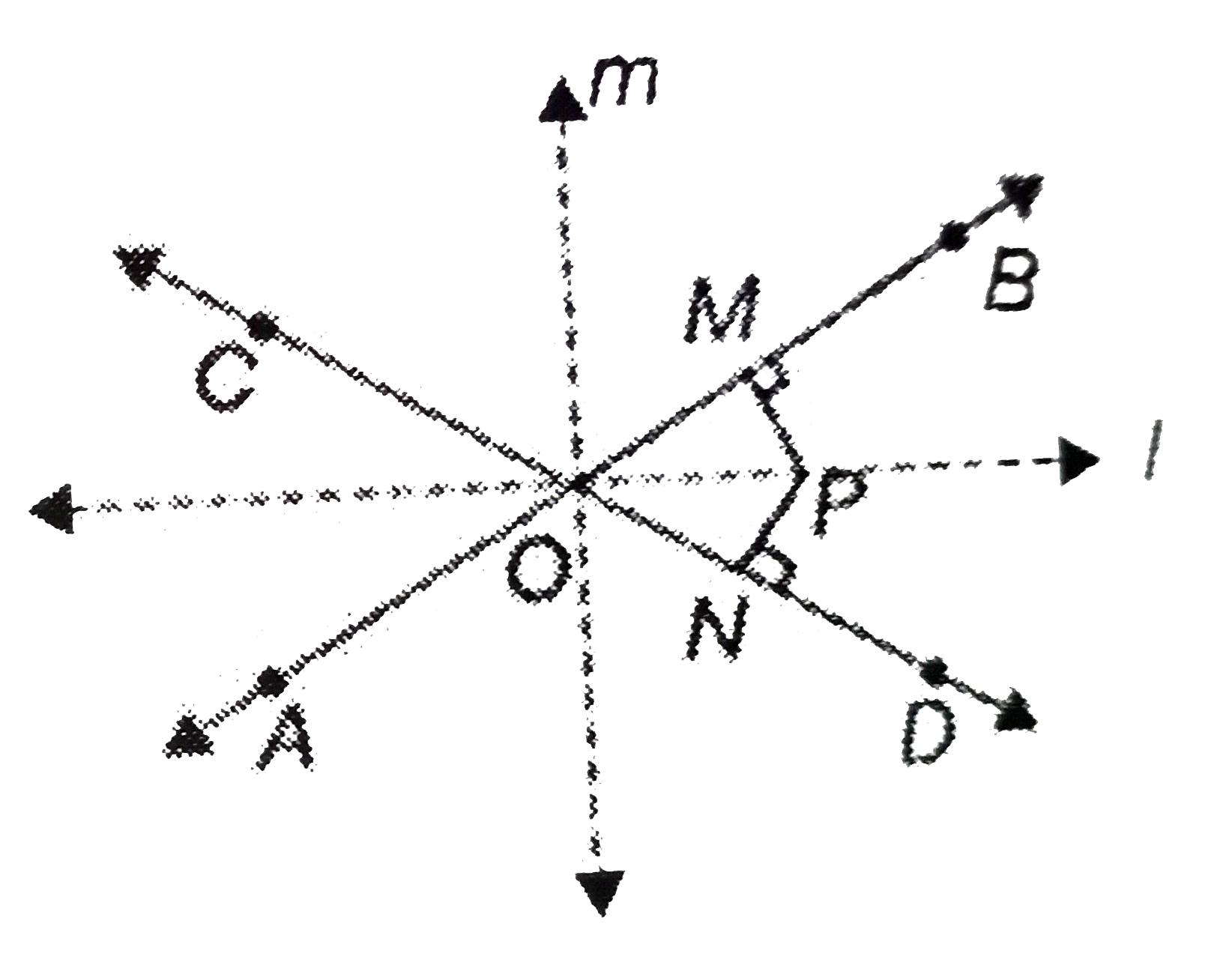
Step 2 : Now, we prove that any two point on the bisector of one of the angle formed by two intersecting lines is equidistant from the lines.
Given `overline(AB)` and `overline(CD)`, intersect at O lines l and m are the angle bisectors.
proof : Let l be the angle bisector of `/_ BOD` and `/_ AOC` and m be the angle bisector of `/_BOC` and `/_AOD`
Let P be a point on the angle bisector l, as shown in
If P coinclides with O, then P is equidistant line `overline(AB)` and `overline(CD)`
Suppose P is different O
Draw the perpendicular `overline(PM)` and `overline(PN)` from the point P onto the lines `overline(AB)` and `overline(CD)` respectively.
Then in `Delta POM = /_ PON, /_ PNO = /_ PMO = 90^(@)` and OP is a common side.
`:.` By the AAS congruance property.
`Delta POM ~= Delta PON`
So, PN = PM ( `:'` The corresponding sides in congruent triangles.
That is P is equidistant from lies `overline(AB)` and `overline(CD)`
Hence, from Step I and Step II of the proof, it can be said that the locus of the point, which is equidistant from the two intersecting lines is the pari of the angle bisectors of the two pairs of vertically oppoiste angles formed by the lines.