

Home
Class 11
PHYSICS
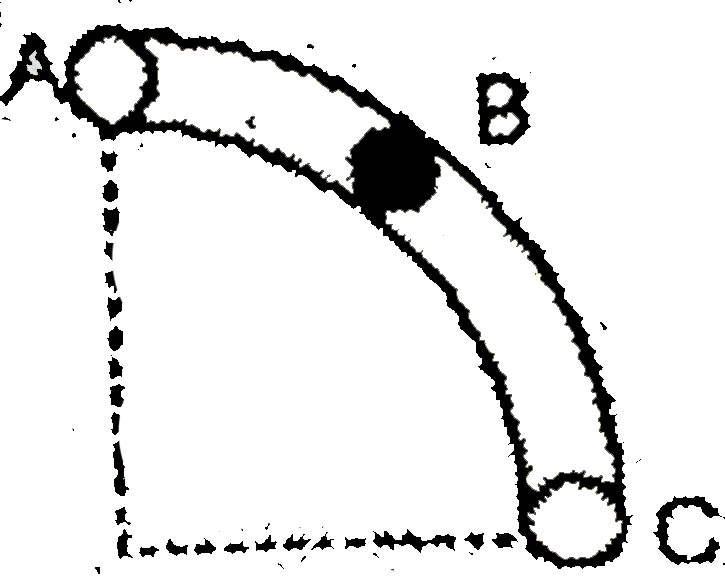
The narrow tube AC forms a quarter circl...

The narrow tube AC forms a quarter circles in a vertical plane. A ball B has an area of cross-section slighly smaller than that of the tube and can move without friction through it. B is placed at A and displaced slightly. During the motion from A to C it will :

Promotional Banner

Similar Questions

Explore conceptually related problems

The tube AC forms a quarter circule in a vertical plane. The ball B has an area of cross - section slightly smaller than that of the tube and can move without friction through it. B is placed at A and displaced slightly. It will

The tube AC forms a quarter circule in a vertical plane. The ball B has an area of cross - section slightly smaller than that of the tube and can move without friction through it. B is placed at A and displaced slightly. It will

A ball of mass m is moved with speed v_0 at the highest point in a closed circular tube of radius R kept in the vertical plane. The cross-section of the tube is such that the block just fits in it. The block makes several oscillations inside the tube and finally stops at the lowest point. Find the work done by the tube on the block during the process.

In the track shown in figure -3.94 section AB is a quadant of a circle of 1 metre radius in vertical plane. A block is released at A and slides without friction until it reaches at B. After B it moves on a rough horizontal floor and comes to rest at D, 3 metres from B the coefficient of friction between floor and the body will be :

A wire, which passes through the hole in a small bead, is bent in the form of quarter of a circle. The wire is fixed vertically on ground as shown in the figure. The bead is released from near the top of the wire and it slides along the wire without friction. As the bead moves from A to B, the force it applies on the wire is

A wire, which passes through the hole in a small bead, is bent in the form of quarter of a circle. The wire is fixed vertically on ground as shown in the figure. The bead is released from near the top of the wire and it slides along the wire without friction. As the bead moves from A to B, the force it applies on the wire is

A wire, which passes through the hole in a small bead, is bent in the form of quarter of a circle. The wire is fixed vertically on ground as shown in the figure. The bead is released from near the top of the wire and it slides along the wire without friction. As the bead moves from A to B, the force it applies on the wire is

A thin rod of length L and area of cross section S is pivoted at its lowest point P inside a stationary, homogeneous and non-viscous liquid. The rod is free to rotate in a vertical plane about a horizontal axis passing through P. The density d_(1) of the rod is smaller than the density d_(2) of the liquid. The rod is displaced by a small angle theta from its equilibrium position and then released. Shown that the motion of the rod is simple harmonic and determine its angular frequency in terms of the given parameters ___________ .