

Home
Class 11
PHYSICS
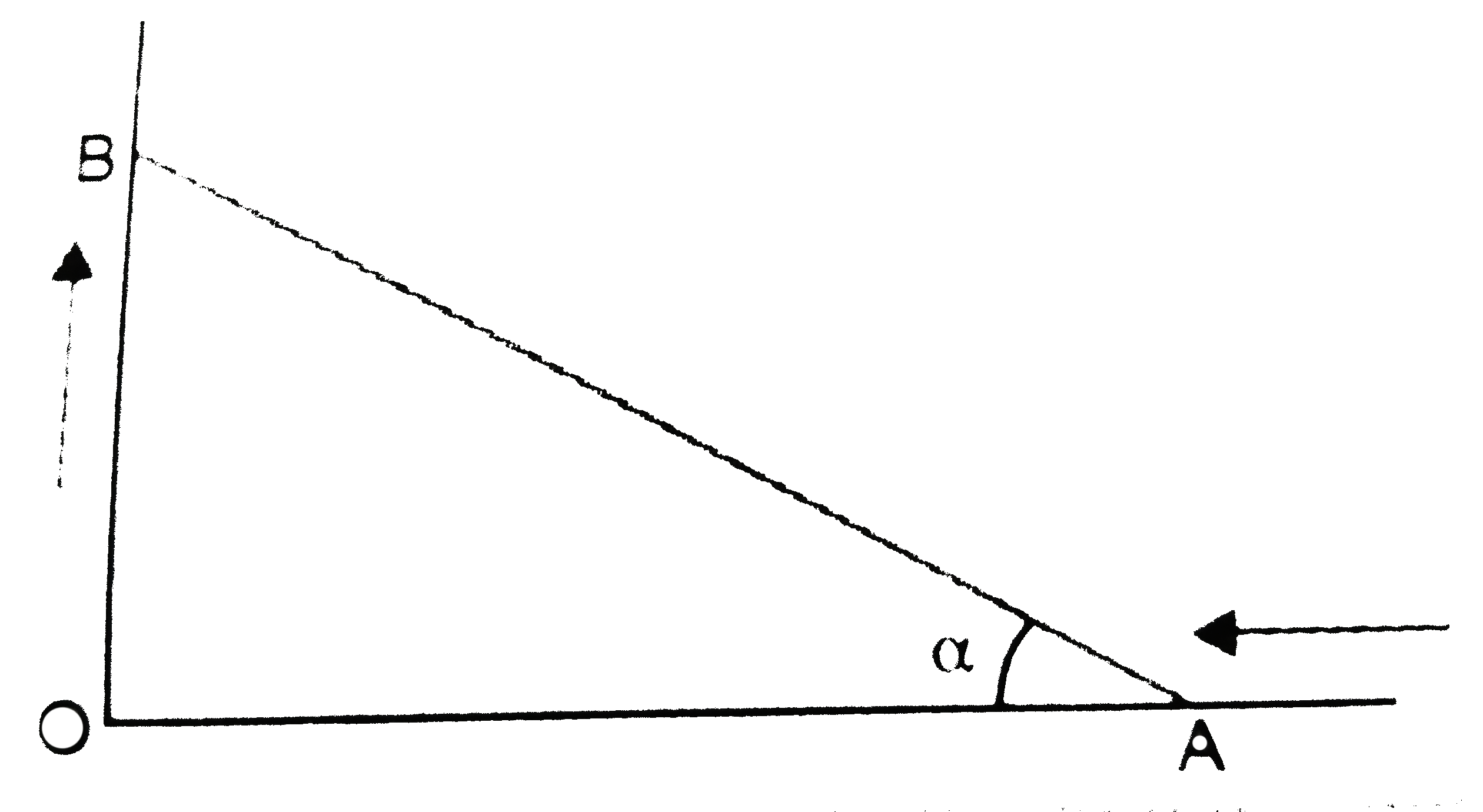
Two particles (A) and (B) are connected ...

Two particles (A) and (B) are connected by a rigid rod ` AB`. The rod slides along perpendicular rails as shown here. The velocity of (A) to the left is ` 10 m//s`.
What is the velocity of (B) ange ` alpha = 30^@`.
.

Promotional Banner

Similar Questions

Explore conceptually related problems

Two particles A and B are connected by a rigid rod AB. The rod slides along perpendicular rails as shown here. The velocity of A to the left is 10 m/s . What is the velocity of B when angle alpha = 60^(@) ?

Two particles A and B are connected by a rigid rod AB. The rod slides along perpendicular rails as shown here. The velocity of A to the left is 10 m/s . What is the velocity of B when angle alpha = 60^(@) ?

Two particles A and B are connected by a rigid rod AB. The rod slides along perpendicular rails as shown. The velocity of A to the left is 10 ms^(-1) What is the velocity of B when angle alpha=60^(@) ?

Two particles A and B connected by a rigid rod AB. The rod slides along two perpendicular rails as shown. The velocity of A to the left is 10 m/s. What is the velocity of B, when angle theta is 37^(@) ?

Two particles A and B connected by a rigid rod AB. The rod slides along two perpendicular rails as shown. The velocity of A to the left is 10 m/s. What is the velocity of B, when angle theta is 37^(@) ?

A rod of length L is sliding on a frictionless surface as shown in the figure. Velocity of end A is 4m//s along the wall. Find the velocity of end B, when end B makes 30^(@) with wall PQ.

A rod of length L is sliding on a frictionless surface as shown in the figure. Velocity of end A is 4m//s along the wall. Find the velocity of end B, when end B makes 30^(@) with wall PQ.

Two particles of masses m_(1) and m_(2) are connected with a rigid rod of length l . If a force F acts perpendicular to the rod then ( a_(1) & a_(2) are instantaneous of m_(1) & m_(2) )

Two particles each of mass M are connected by a massless rod. The rod is lying on the smooth horizontal surface. If one of the particle is given an impulse MV as shown in the figure then angular velocity of the system would be:

Two particles each of mass M are connected by a massless rod. The rod is lying on the smooth horizontal surface. If one of the particle is given an impulse MV as shown in the figure then angular velocity of the system would be: