

Home
Class 12
PHYSICS
A particle moves along the loop A–B–C–D–...

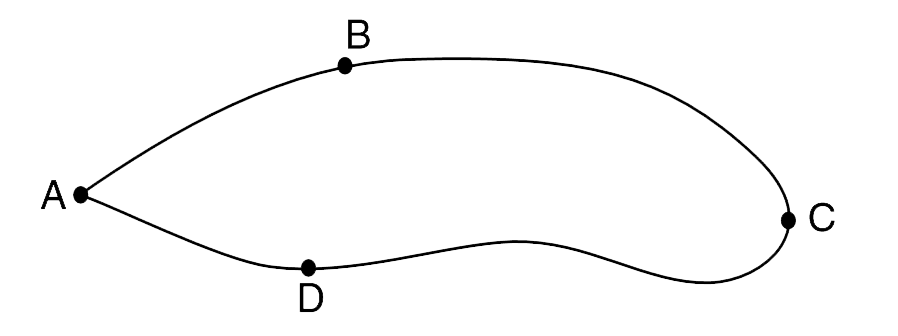
A particle moves along the loop A–B–C–D–A while a conservative force acts on it. Work done by the force along the various sections of the path are `-W_(AtoB)=-50 J, W_(BtoC) =25 J, W_(CtoD)=60 J`. Assume that potential energy of the particle is zero at A. Write the potential energy of particle when it is at B and D.

Promotional Banner

Similar Questions

Explore conceptually related problems

Force acting on a particle is F=-8x in S.H.M. The amplitude of oscillation is 2 (in m) and mass of the particle is 0.5 kg. The total mechanical energy of the particle is 20 J. Find the potential energy of the particle in mean position (in J).

The potential energy of a particle executing S H M is 25 J. when its displacement is half of amplitude. The total energy of the particle is

A single conservative force F(x) acts on a particle that moves along the x - axis. The graph of the potential energy with x is given. At x=5m, the particle has a kinetic energy of 50 J and its potential energy is related to position 'x' as U=15+(x-3)^(2) Joule where x is in meter. Then:

A partical moves in a conservation filed with no other forces acting on it. At a given instant, the kinetic energy of the particle is 0.5 J and potential energy is -0.3H. STATEMENT 1 The particle must escape the field at same instant of time STATEMENT 2. The total machanical energy of the particle is positive.

The potential energy of a particle execuring S.H.M. is 2.5 J, when its displacement is half of amplitude. The total energy of the particle be

A charged partile is moved infinitesimally slowly from point A to B in a region of space containing electric field by an external agent. Work done by the external agent is 50 J . Two students calculate the potential energy of the particle at A and B. Student X reports to the teacher the values of potential energy at A and B are 50 J and 100 J while student Y reports then to be 70 J and 120 J . Which of the two students is wrong ?

A particle of mass m = 1 kg is free to move along x axis under influence of a conservative force. The potential energy function for the particle is U=a[(x/b)^(4)-5(x/b)^(2)] joule Where b = 1.0 m and a = 1.0 J. If the total mechanical energy of the particle is zero, find the co-ordinates where we can expect to find the particle and also calculate the maximum speed of the particle.

A particle is acted upon by a force F which varies with position x is shown in figure .If the particle at x = 0 kinetic energy of 25J then the kinetic energy of the particle at x = 16 m is

A particle can move along a straight line. It is at rest when a force (F) starts acting on it directed along the line. Work done by the force on the particle changes with time(t) according to the graph shown in the fig. Can you say that the force acting on the particle remains constant with time?