

Home
Class 11
PHYSICS
Two point charges Q1 and Q2 lie along a ...

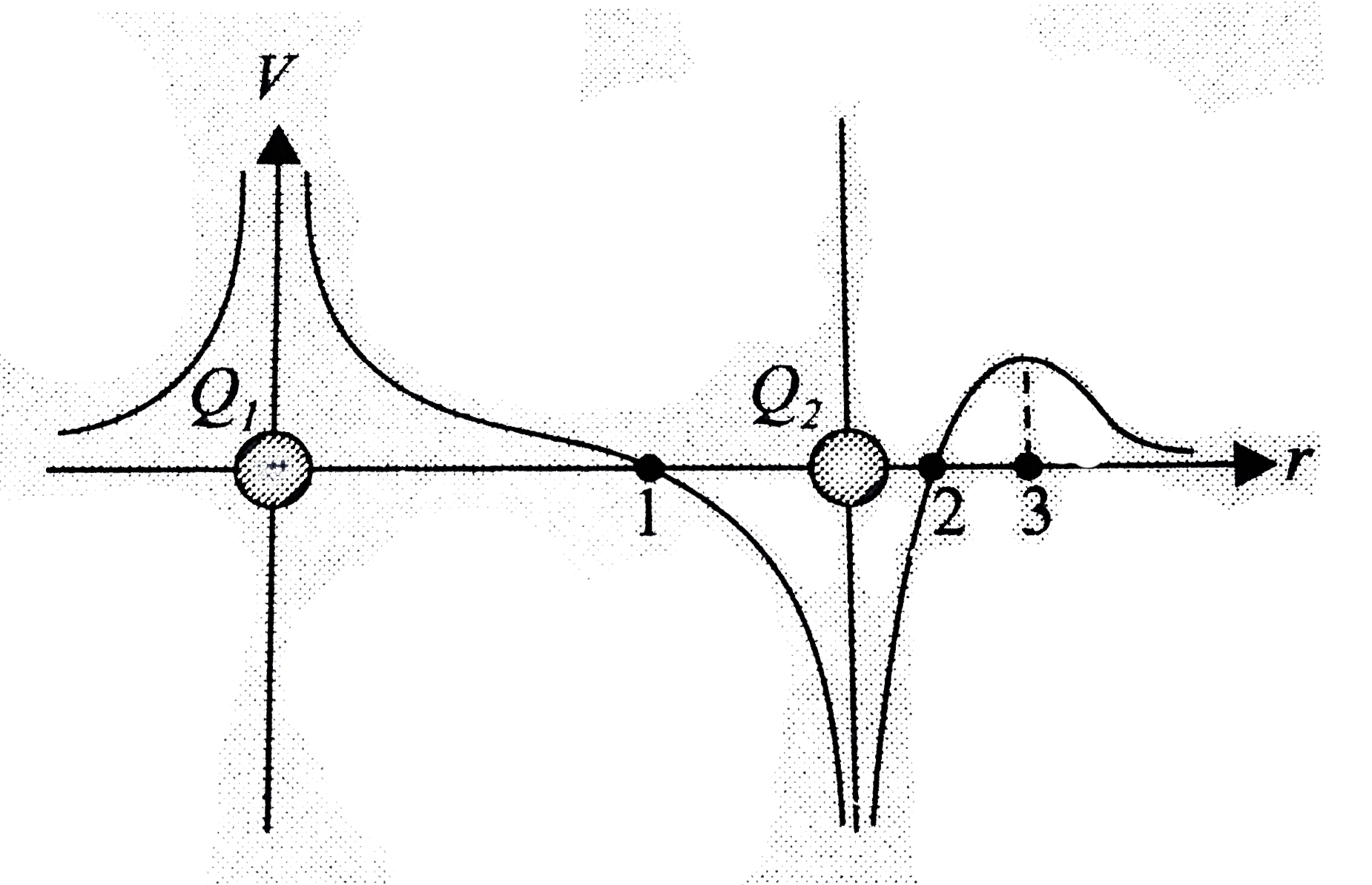
Two point charges `Q_1` and `Q_2` lie along a line at a distance from each other. Figure 3.7 shows the potential variation along the line of charges. At which of the points 1, 2, and 3 is the electric field zero ? What are the singns of the charges `Q_1` and `Q_2` and which of the two charges is greater in magnitude ?
.

Promotional Banner

Similar Questions

Explore conceptually related problems

Two point charges, Q_1 and Q_2 are positioned at a certain distance from each other. Tho curves in the figure represent the distri bution of the potential along the straight line connecting the two charges. At which points (1, 2, and /or 3) is the electric field strength zero? What are tho signes of the charges Q_1 and Q_2 and which of the two is greater in magnitude?

Two point charges are kept at a certain distance from one another. The graph represents the variartion of the potential along the straight line connecting the two charges. At what point is the electric field zero ?

Two point charge Q and 4Q are fixed at a distance of 12cm from each other. Sketch lines of force and locate the neutral point, if any .

Fig.1 shows the variation of electric potential V with 1//r , where r is the distance from the two charges Q_(1) and Q_(2) . Determine (i) signs of two charges Q_(1) and Q_(2) (ii) Which of the two charges has a larger magnitude ? Justify.

The given figure gives electric line of force due to two charges q_(1) and q_(2) . What are the signs of the two charges ?

Two point charges +4q and +q are placed 30cm apart. At what point on the line joining them is the electric field zero

Two point charges+ q and-q are placed at distanced apart. What are the points at which the resultant field is parallel to the line joining the two charges ?

Two point electric charges of value q and 2q are kept at a distance d apart from each other in air. A third charge Q is to be kept along the same line in such a way that the net force action on q and 2q is zero. Calculate the position of charge Q in terms of q and d .