

Home
Class 11
PHYSICS
The given graph represents the total for...


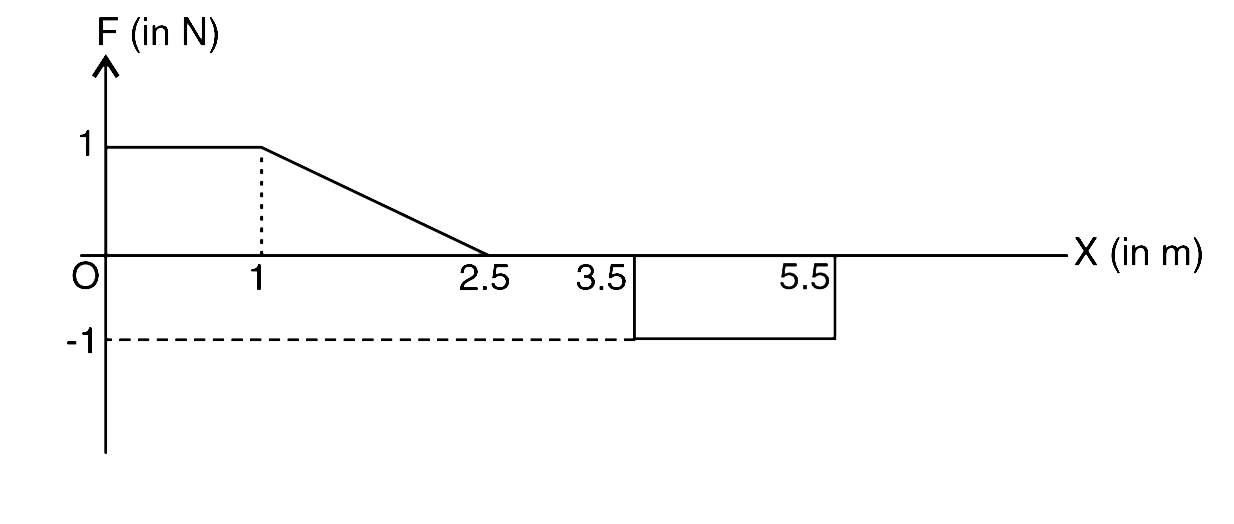
The given graph represents the total force in x direction being applied on a particle of mass m = 2 kg that is constrained to move along x axis. What is the minimum possible speed of the particle when it was at x = 0?

Promotional Banner

Similar Questions

Explore conceptually related problems

The force acting on a particle of mass m moving along the x-axis is given by F (x) = Ax^(2) - Bx. Which one of the following is the potential energy of the particle?

A time varying force, F=2t is acting on a particle of mass 2kg moving along x-axis. velocity of the particle is 4m//s along negative x-axis at time t=0 . Find the velocity of the particle at the end of 4s.

A force F = alpha +beta x acts on a particle of mass m along the X . Axis . Here alpha and beta are constants . Find the work done by this force when particle moves form x = 0 to x = d .

The given figure shows a plot of the time dependent force F_(x) acting on a particle in motion along the x-axis. What is the total impulse delivered by this force to the particle from time t = 0 to t = 2second?

V_(x) is the velocity of a particle of a particle moving along the x- axis as shown. If x=2.0m at t=1.0s , what is the position of the particle at t=6.0s ?

The figure shows the force (F) versus displacement (s) graph for a particle of mass m=2kg initially at rest. (i) The maximum speed of the particle occurs at x = …..m (ii) The maximum speed of the particle is …. ms^(-1) (iii) The particle once again has its speed zero at x =....m

The position (X)-time (t) graph for a particle of mass 1 kg moving along x-axis is shown in figure. Find impulse on particle at t = 4 s.

Position-time graph for a particle moving along x- direction is as shown in the figure. Average speed of the particle from t = 0 to t = 4 is :

A particle of mass m=1kg lying on x-axis experiences a force given by law F=x(3x-2) Newton. Where x is the x-coordinate of the particle in meters. vec(x=0x=4 (a) Locate the point on x-axis where the particle is in equilibrium. (b) Draw the graph of variation of force F (y-axis) with x-coordinate of the particle (x-axis). Hence or otherwise indicate at which positions the particle is in stable or unstable equilibrium. (c ) What is the minimum speed to be imparted to the particle placed at x=4 meters such that it reaches tha origin.