

Home
Class 12
PHYSICS
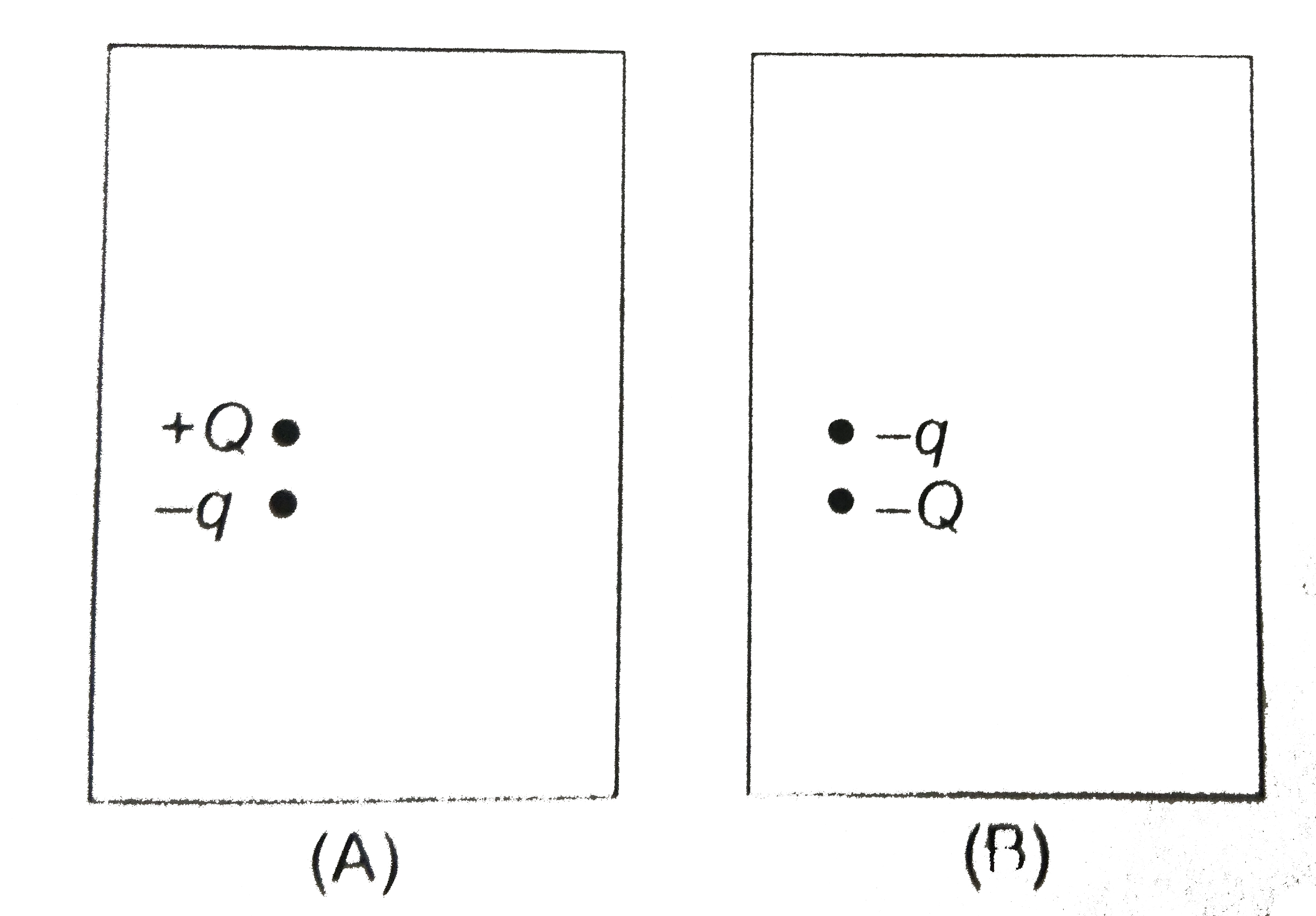
In the following diagrams a particle wit...

In the following diagrams a particle with small charge `-q` is free to move up or down , but not sideways near a larger fixed charge `Q`.The small charge is in equilibrium because in the positions shown ,the electrical upward force is equal to the weight of the particle .Which statement os true?

Promotional Banner

Similar Questions

Explore conceptually related problems

A charged particle always move in the direction of electric field. Is this statement true or false?

A charged particle always move in the direction of electric field. Is this statement true or false?

Two charged particles each having a charge +q and mass m are kept at a distance d. if they are in equilibrium under the gravitational force and the electric force between them, then the ratio q/m or specific charge of each particle is

Figure shows two charge particles on an axis. The charges are free to move. At one point, however, a third charged particle can be placed such that all three particles are in equilibrium. (a) Is that point to the left of the first two particles to their rightm or between them? (b) should the third paricle be positively or negatively charged? (c ) Is the equilibrium stable or unstable?

A charge particle q_(1) , is at position (2, -1, 3). The electrostatic force on another charged particle q_(2) at (0, 0, 0) is :

A charge particle q_(1) , is at position (2, -1, 3). The electrostatic force on another charged particle q_(2) at (0, 0, 0) is :

A positive point charge +Q is fixed in space .A negative point charge -q of mass m revolves around a fixed charge in elliptical orbits .The fixed charge +Q is at one focus of the ellipse.The only force acting on negative charge is the electrostatic force due to positive charge is the electrostatic force due to positive charge.Then which of the following statement is true

Two particles (free to move) with charges +q and +4q are a distance L apart. A third charge is placed so that the entire system is in equilibrium. (a) Find the location, magnitude and sign of the third charge. (b) Show that the equilibrium is unstable.