

Home
Class 12
PHYSICS
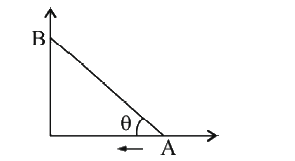
Two particles A and B connected by a rig...

Two particles A and B connected by a rigid rod AB. The rod slides along two perpendicular rails as shown. The velocity of A to the left is 10 m/s. What is the velocity of B, when angle `theta` is `37^(@)` ?

Promotional Banner

Similar Questions

Explore conceptually related problems

Two particles A and B are connected by a rigid rod AB. The rod slides along perpendicular rails as shown here. The velocity of A to the left is 10 m/s . What is the velocity of B when angle alpha = 60^(@) ?

Two particles A and B are connected by a rigid rod AB. The rod slides along perpendicular rails as shown here. The velocity of A to the left is 10 m/s . What is the velocity of B when angle alpha = 60^(@) ?

Two particles A and B are connected by a rigid rod AB. The rod slides along perpendicular rails as shown. The velocity of A to the left is 10 ms^(-1) What is the velocity of B when angle alpha=60^(@) ?

Two particles (A) and (B) are connected by a rigid rod AB . The rod slides along perpendicular rails as shown here. The velocity of (A) to the left is 10 m//s . What is the velocity of (B) ange alpha = 30^@ . .

A rod of length L is sliding on a frictionless surface as shown in the figure. Velocity of end A is 4m//s along the wall. Find the velocity of end B, when end B makes 30^(@) with wall PQ.

A rod of length L is sliding on a frictionless surface as shown in the figure. Velocity of end A is 4m//s along the wall. Find the velocity of end B, when end B makes 30^(@) with wall PQ.

Two particles connected by a rigid light rod AB, lying on a smooth horizontal table. An impulse J is applied at A in the plane of thetable and perpendicular at AB. Then the velocity of particle at A is

Two particles of equal mass m at A and B are connected by a rigid light rod AB lying on a smooth horizontal table. An impulse J is applied at A in the plane of the table and perpendicular at AB. Then the velocity of particle at A is :

Two particle of mass m and 2m, connected by a massless rod, slide on the insider of a smooth circular ring of radius r, as shown in Fig. 3E.44 (a). If the assembly is released from rest when theta = 0 , determine (a) the velocity of the particle when the rod passes the horizontal position, (b) the maximum velocity v_("max") of the particles.