Sickle- cell anaemia is an autosome linked recessive trait that can be transmitted from parents to the offspring when both the partners are carrier for all the gene (or heterozygous ).The disease is controlled by a single pair of allele,`Hb^(A)` & `Hb^(S)`. Out of the three possible genotypes only homozygous individuals for HbS `(Hb^(s) Hb^(s))` are lethal. Select the right option in which X,Y and Z are correctly identified 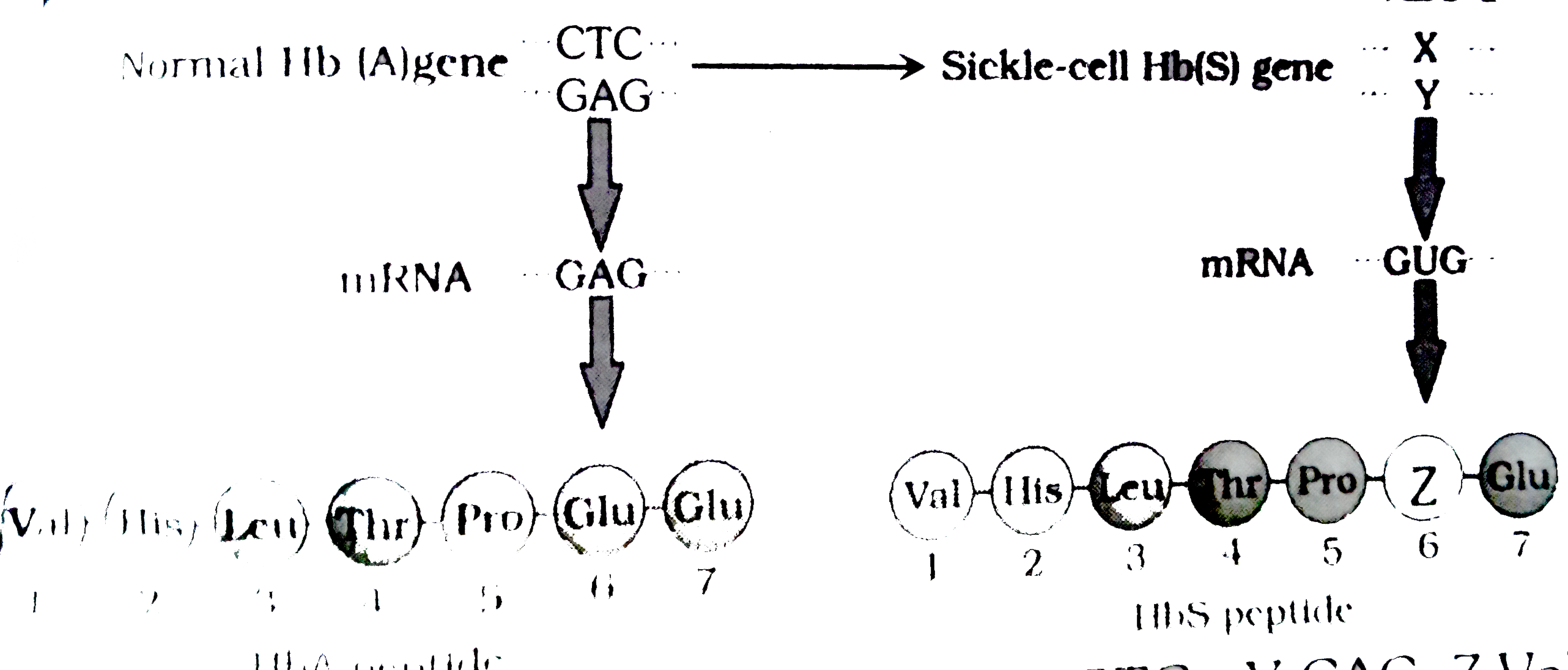
Sickle- cell anaemia is an autosome linked recessive trait that can be transmitted from parents to the offspring when both the partners are carrier for all the gene (or heterozygous ).The disease is controlled by a single pair of allele,`Hb^(A)` & `Hb^(S)`. Out of the three possible genotypes only homozygous individuals for HbS `(Hb^(s) Hb^(s))` are lethal. Select the right option in which X,Y and Z are correctly identified



Similar Questions
Explore conceptually related problems
Sickle cell anemia is a genetic disorder where the body produces an abnormal hemoglobin called hemoglobin S. Red blood cells are normally flexible and round, but when the hemoglobin is defective, blood cells take on a “sickle” or crescent shape. Sickle cell anemia is caused by mutations in a gene called HBB. It is an inherited blood disorder that occurs if both the maternal and paternal copies of the HBB gene are defective. In other words, if an individual receives just one copy of the defective HBB gene, either from mother or father, then the individual has no sickle cell anemia but has what is called “sickle cell trait”. People with sickle cell trait usually do not have any symptoms or problems but they can pass the mutated gene onto their children. There are three inheritance scenarios that can lead to a child having sickle cell anemia: - Both parents have sickle cell trait - One parent has sickle cell anemia and the other has sickle cell trait - Both parents have sickle cell anemia If one parent has sickle cell anemia and the other has sickle cell trait, there is __________that their children will have sickle cell anemia and ___________will have sickle cell trait.
Sickle cell anemia is a genetic disorder where the body produces an abnormal hemoglobin called hemoglobin S. Red blood cells are normally flexible and round, but when the hemoglobin is defective, blood cells take on a “sickle” or crescent shape. Sickle cell anemia is caused by mutations in a gene called HBB. It is an inherited blood disorder that occurs if both the maternal and paternal copies of the HBB gene are defective. In other words, if an individual receives just one copy of the defective HBB gene, either from mother or father, then the individual has no sickle cell anemia but has what is called “sickle cell trait”. People with sickle cell trait usually do not have any symptoms or problems but they can pass the mutated gene onto their children. There are three inheritance scenarios that can lead to a child having sickle cell anemia: - Both parents have sickle cell trait - One parent has sickle cell anemia and the other has sickle cell trait - Both parents have sickle cell anemia If both parents have sickle cell trait, then there is _______________of the child having sickle cell trait.
Sickle cell anemia is a genetic disorder where the body produces an abnormal hemoglobin called hemoglobin S. Red blood cells are normally flexible and round, but when the hemoglobin is defective, blood cells take on a “sickle” or crescent shape. Sickle cell anemia is caused by mutations in a gene called HBB. It is an inherited blood disorder that occurs if both the maternal and paternal copies of the HBB gene are defective. In other words, if an individual receives just one copy of the defective HBB gene, either from mother or father, then the individual has no sickle cell anemia but has what is called “sickle cell trait”. People with sickle cell trait usually do not have any symptoms or problems but they can pass the mutated gene onto their children. There are three inheritance scenarios that can lead to a child having sickle cell anemia: - Both parents have sickle cell trait - One parent has sickle cell anemia and the other has sickle cell trait - Both parents have sickle cell anemia If both parents have sickle cell trait, then there is _______________of the child having sickle cell anemia.
Sickle cell anemia is a genetic disorder where the body produces an abnormal hemoglobin called hemoglobin S. Red blood cells are normally flexible and round, but when the hemoglobin is defective, blood cells take on a “sickle” or crescent shape. Sickle cell anemia is caused by mutations in a gene called HBB. It is an inherited blood disorder that occurs if both the maternal and paternal copies of the HBB gene are defective. In other words, if an individual receives just one copy of the defective HBB gene, either from mother or father, then the individual has no sickle cell anemia but has what is called “sickle cell trait”. People with sickle cell trait usually do not have any symptoms or problems but they can pass the mutated gene onto their children. There are three inheritance scenarios that can lead to a child having sickle cell anemia: - Both parents have sickle cell trait - One parent has sickle cell anemia and the other has sickle cell trait - Both parents have sickle cell anemia Sickle cell anemia is a/ an ______________________ disease.
Sickle cell anemia is a genetic disorder where the body produces an abnormal hemoglobin called hemoglobin S. Red blood cells are normally flexible and round, but when the hemoglobin is defective, blood cells take on a “sickle” or crescent shape. Sickle cell anemia is caused by mutations in a gene called HBB. It is an inherited blood disorder that occurs if both the maternal and paternal copies of the HBB gene are defective. In other words, if an individual receives just one copy of the defective HBB gene, either from mother or father, then the individual has no sickle cell anemia but has what is called “sickle cell trait”. People with sickle cell trait usually do not have any symptoms or problems but they can pass the mutated gene onto their children. There are three inheritance scenarios that can lead to a child having sickle cell anemia: - Both parents have sickle cell trait - One parent has sickle cell anemia and the other has sickle cell trait - Both parents have sickle cell anemia The following statements are drawn as conclusions from the above data (Kenya). I. Patients with SCD (Sickle Cell Disease) are less likely to be infected with malaria. II. Patients with SCD (Sickle Cell Disease) are more likely to be infected with malaria. III. Over the years the percentage of people infected with malaria has been decreasing. IV. Year 2000 saw the largest percentage difference between malaria patients with and without SCD. Choose from below the correct alternative.
Assertion : The person heterozygous for sickle- cell trait produces both normal (Hb^(A)) and abnormal haemoglobin (Hb^(S)) . Reason : Huamn normal allele and the sickle allele are codominant.
Recommended Questions
- Sickle- cell anaemia is an autosome linked recessive trait that can be...
Text Solution
|
- Sickle- cell anaemia is an autosome linked recessive trait that can be...
Text Solution
|
- Autosomal mutant allele HbS causes
Text Solution
|
- Autosomal mutant allele Hb^s causes:
Text Solution
|
- Hb^(A) and Hb^(S) alleles of normal and sickle called RBC are
Text Solution
|
- Which is true of Hb^(S) gene ?
Text Solution
|
- Heterozygous ("Hb"^(A) "Hb"^(S)) individuals have how much per cent of...
Text Solution
|
- Assertion: Hb^(S) Hb^(S) is homozygous condition of sickle cell anaemi...
Text Solution
|
- Assertion : The person heterozygous for sickle- cell trait produces bo...
Text Solution
|